
Large enterprise data sets can cause Jira Query Language resolution times to spike to nearly thirty seconds due to inefficient in-memory filtering. This performance degradation occurs during the critical translation phase where human-readable queries are mapped to internal identifiers. As global organizations expand their digital footprints, the metadata associated with software releases—commonly referred to as “versions”—has ballooned to unprecedented volumes, sometimes reaching six million records for a single high-tier enterprise instance. For users, the Jira Query Language, or JQL, acts as the primary gateway to navigating these massive datasets, but the underlying mechanics of resolution were never originally designed to manage such astronomical scales of metadata. This challenge represents a fundamental shift in the requirements for project management software, where the ability to filter and sort through millions of issues is no longer a luxury but a baseline expectation for operational efficiency across global teams.
The Decline of Legacy Filtering Methods
Historically, developers relied on in-memory processing to ensure that JQL functions remained responsive, a strategy that functioned well when the average customer maintained a manageable number of software versions. By loading this data into the application’s memory, the system could perform local filtering operations with incredible speed, effectively bypassing the need for frequent and costly communication with the central database. However, as the digital transformation of major corporations accelerated, this once-balanced architecture transformed into a significant bottleneck. The primary issue emerged from database scan latency, where the sheer volume of rows required to populate application memory became too large to handle efficiently. Even with robust caching layers in place, the system struggled to maintain stability because the fundamental size of the datasets exceeded the throughput capabilities of the traditional network infrastructure used to move data between nodes.
This reliance on application-side processing eventually hit a wall characterized by severe network saturation and prolonged execution times. When a single JQL resolution requires the transfer of hundreds of thousands—or even millions—of rows of version metadata, the resulting latency can easily stretch into several seconds, causing the user interface to hang and disrupting the workflow of entire departments. Engineering telemetry indicated that P99 resolution times, which represent the slowest one percent of all queries, often reached eighteen seconds in high-demand environments. Such delays are catastrophic in a high-stakes enterprise setting where rapid decision-making depends on real-time data visibility. The failure of these legacy methods highlighted a critical need for a paradigm shift in how project management tools interact with their underlying data stores, moving away from “fetching everything” toward a more surgical and context-aware approach to information retrieval and processing.
Strategic Gains Through Project Scoping
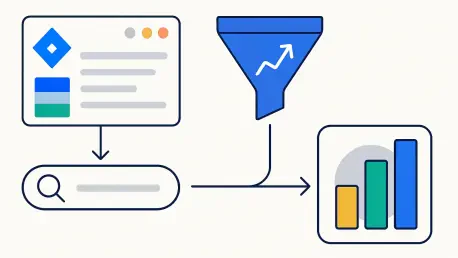
Analysis of query patterns revealed that the vast majority of version-related JQL searches were not performed in isolation but were instead coupled with a specific project filter. Despite this, the original resolution engine operated in a project-blind manner, meaning it would attempt to resolve version functions by scanning the entire organizational hierarchy rather than focusing on the relevant project. By refactoring the engine to detect project-specific clauses at the earliest possible stage of the resolution process, developers implemented a project-scoped query architecture. This improvement allowed the system to ignore the millions of irrelevant versions belonging to other teams and focus exclusively on the metadata associated with the project in question. Consequently, the volume of data being moved and processed dropped from a massive ocean to a manageable stream, dramatically reducing the compute resources required for each individual search and improving overall responsiveness.
The impact of project scoping on system performance was nothing short of transformative for the most data-intensive enterprise users. Instead of the resolution engine scanning one hundred thousand versions to fulfill a single request, the scoped approach might only require the evaluation of a few hundred entries. This efficiency led to a staggering reduction in memory consumption, falling from several gigabytes to just a few hundred kilobytes per query execution. More importantly, the time required to complete these resolutions plummeted from eighteen seconds to under one hundred milliseconds for nearly all users. This nearly 200-fold increase in speed restored the fluidity of the search experience and proved that targeted data retrieval is far more sustainable than generic in-memory filtering. This strategic win allowed the platform to support the continued growth of enterprise metadata without sacrificing the performance levels that modern software development teams demand for their daily operations.
Solving Database Indexing Failures
Even with project scoping addressing the majority of use cases, broad searches across an entire organization continued to present unique technical hurdles. When a JQL resolution resulted in a list of tens of thousands of individual identifiers to be looked up in the database, the PostgreSQL query planner often encountered a logic failure. The planner would calculate that it was more efficient to perform a full sequential scan of the database table rather than utilizing the primary key index for such a large set of values. This miscalculation turned what should have been a quick lookup into an exhaustive search through millions of records, leading to fetch times that frequently exceeded thirty seconds. This behavior exposed a limitation in how standard relational databases handle massive “IN” clauses, requiring a custom solution to nudge the database toward a more efficient execution path that could maintain low latency regardless of the total number of identifiers being queried.
To overcome these indexing failures, the engineering team introduced a parallelized database chunking strategy that fundamentally changed how large sets of identifiers are retrieved. Instead of sending a single, massive query containing thousands of IDs, the system now splits the lookup into smaller, optimized batches. These batches are sized specifically to stay within the query planner’s index-friendly threshold, ensuring that the database always utilizes its primary key indexes for maximum speed. These chunks are then processed in parallel, allowing the system to aggregate the results in a fraction of the time required for a traditional sequential scan. This technical intervention reduced SQL fetch times for unscoped queries from thirty seconds to less than seven hundred milliseconds. By accounting for the internal heuristics of the database engine, this approach provided a robust safety net for the most complex queries, ensuring that even the largest data landscapes remained searchable and accessible.
Building a Distributed Search Future
The implementation of project-scoped queries and parallelized database chunking successfully bridged the gap between legacy infrastructure and modern enterprise demands. However, these database-level optimizations represented only the first phase of a broader architectural shift toward the Jira Scalable Issue Search initiative. This long-term strategy involved migrating core search functionality out of the primary relational database and into a dedicated environment powered by OpenSearch. By indexing release metadata directly alongside individual work items, the architecture eliminated the need for a separate resolution phase entirely. This transition addressed the root cause of the performance bottleneck by placing related data in closer proximity within a distributed, search-optimized system. These improvements ensured that the search infrastructure could handle the next order of magnitude in data growth, providing a scalable foundation for global organizations as they continue to expand.
Ultimately, the evolution of these search technologies demonstrated that extreme scale requires a deep understanding of data patterns and infrastructure behavior. Organizations that managed massive volumes of information found that relying on generic processing methods was no longer viable when dealing with millions of records. The successful optimization of the search engine proved that a combination of context-aware logic and database-specific tuning can overcome even the most significant performance hurdles. For technical leaders, these developments highlighted the importance of moving toward distributed search architectures that minimize data movement across networks. As the volume of enterprise metadata continues to rise, adopting similar strategies for project-specific scoping and parallelized retrieval will be essential for maintaining platform stability. The shift to systems like OpenSearch provided the necessary overhead to support future innovations, ensuring that high-scale data environments remained both reliable and highly performant.