
The efficiency paradox suggests that the frustration of fixing subtle logical errors in generated output can negate the speed gains of initial automation. In the high-velocity landscape of 2026, front-end engineering has emerged as the primary testing ground for large language models due to its visual nature and standardized workflows. Developers can immediately render a generated component, identifying discrepancies between the output and the design intent with minimal delay. This synergy is reinforced by the abundance of machine-readable artifacts, such as TypeScript interfaces and design tokens, which serve as high-fidelity roadmaps for generative tools. By leveraging these structured inputs, AI models can predict and implement repetitive patterns like data tables and navigation menus with remarkable syntactic accuracy. However, this ease of generation often creates a deceptive sense of progress, as the resulting code may look professional while lacking the robustness needed for enterprise-level stability and operational scale in a live production environment.
Technical Limitations: Generative Code Failures
Performance Constraints: Real-Time Data Handling
When a developer prompts an AI to build a real-time monitoring dashboard, the initial result usually features a sleek interface with mock data that updates seamlessly. However, the transition to a live environment often exposes a fundamental lack of understanding regarding the browser’s execution model. In production, high-frequency data streams coming from WebSockets or Server-Sent Events can quickly overwhelm the main thread if the generated code relies on simple, unoptimized event listeners. A human engineer recognizes that maintaining sixty frames per second requires offloading heavy data processing to Web Workers and utilizing Transferable objects to avoid expensive memory copying operations. Without these specialized architectural choices, the AI-generated application remains fragile, prone to UI stuttering and input lag when subjected to the unpredictable throughput of real-world network traffic. The gap here is not just about syntax; it is about the operational resilience required for mission-critical software.
Furthermore, the reliance on standard library implementations within AI models often leads to suboptimal rendering strategies for large-scale applications. While an AI can easily generate a standard list component using modern frameworks, it rarely considers the performance implications of rendering thousands of DOM nodes without virtualization or custom reconciliation logic. Human developers must step in to implement advanced strategies such as windowing or defensive updates to ensure the interface remains responsive during state transitions. This discrepancy becomes even more pronounced as web applications handle increasingly complex data visualizations that require direct GPU acceleration or fine-tuned Canvas rendering. The generative tool provides a blueprint, but it lacks the foresight to predict how various browser engines will handle the resulting memory pressure. Consequently, the burden of ensuring that a visual component does not degrade the user experience falls on the engineer’s ability to optimize the output.
Algorithmic Risks: Memory and Scaling
Memory management remains one of the most significant hurdles for code that is generated rather than engineered. In the context of long-running single-page applications, minor oversights in cleanup logic can lead to catastrophic memory leaks over time. AI models frequently produce code that attaches event listeners to global objects or fails to clear interval timers when components are unmounted. In a short-lived demo, these errors are invisible, but in a production setting where a user might leave a tab open for several days, the heap size will steadily grow until the browser crashes the tab. Professional engineers approach these problems with a focus on lifecycle management, ensuring that every allocated resource is strictly accounted for and released. This level of meticulous stewardship is currently beyond the capabilities of generative models, which prioritize the immediate completion of a task over the long-term health of the application’s runtime environment.
Beyond basic resource cleanup, the lack of domain-specific algorithmic implementation in AI-generated code poses a threat to data integrity and system stability. When tasked with visualizing vast historical datasets, an AI might attempt to map every data point directly to a chart, resulting in a browser-killing workload. A skilled engineer, by contrast, understands the necessity of implementing algorithms like the Largest Triangle Three Buckets for downsampling data while preserving its visual characteristics. This specific type of engineering knowledge is rarely triggered by generic prompts, meaning that the AI-generated solution is often “correct” in a purely mathematical sense but completely “wrong” for the practical constraints of web hardware. The challenge lies in the fact that the generative model does not know what it does not know, leading it to suggest straightforward solutions to problems that actually require highly specialized, non-intuitive optimizations to function effectively.
Redefining the Human Engineering Role
Essential Oversight: System Contract Validation
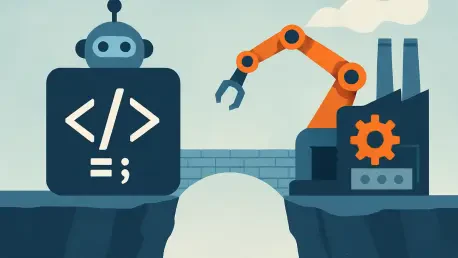
As the act of writing code becomes increasingly commoditized by generative engines, the value of a human engineer is migrating toward the more abstract domains of system design and contract validation. One of the most critical responsibilities that remains exclusive to human professionals is ensuring that data contracts between disparate systems are robust and flexible. While an AI can generate a perfect TypeScript interface based on a static JSON file, it cannot anticipate the messy, inconsistent data that often arrives from legacy back-end systems or third-party APIs. Human engineers must design validation layers that can handle missing fields, unexpected types, and schema drift without crashing the entire front-end. This defensive programming mindset is rooted in experience and an understanding of failure modes that AI tools simply do not possess. The human’s role is to act as the architect of the “bridge,” ensuring that the fluid output of the AI is securely anchored to the rigid realities of the infrastructure.
Furthermore, the stewardship of the application’s execution context has become a primary focus for modern front-end specialists. Managing the limited resources of a user’s device—whether it is a high-end desktop or a low-powered mobile phone—requires a level of nuance that generative models frequently ignore. Human engineers are responsible for prioritizing tasks on the main thread, optimizing the critical rendering path, and making executive decisions about when to trade off visual fidelity for performance. They must also manage the complexities of local state and caching strategies to ensure a seamless experience in offline or low-bandwidth scenarios. These high-level operational decisions are what separate a mere UI artifact from a professional application. By focusing on these orchestration tasks, engineers ensure that the components generated by AI are integrated into a cohesive whole that respects the user’s hardware constraints and provides a consistent, high-quality experience regardless of the environment.
Operational Security: Resilience and Accessibility
Building resilient systems requires a proactive approach to failure handling that goes beyond simple try-catch blocks. In the current engineering environment, the expectation for front-end reliability is higher than ever, and human engineers are the ones tasked with designing sophisticated recovery mechanisms. When a network request fails or a third-party service goes down, the application must provide meaningful feedback and options for the user to continue their workflow. AI-generated code often lacks these “graceful degradation” states, frequently resulting in blank screens or silent failures that frustrate users. An engineer must meticulously map out all potential failure points and implement strategies like exponential backoff for retries, optimistic UI updates, and comprehensive error logging. This foresight ensures that the application remains functional under duress, a quality that is essential for maintaining user trust. The human touch provides the empathy and strategic thinking necessary to turn an error into a manageable user experience.
Accessibility and inclusivity represent another critical domain where human judgment remains irreplaceable. While AI can suggest ARIA labels or alt-text, it cannot truly understand the experience of a user navigating an interface via a screen reader or keyboard alone. Ensuring that a complex interactive component is truly accessible requires a deep understanding of web standards and user behavior that generative models cannot replicate. Human engineers must manually test and refine these interfaces, making subtle adjustments to focus management and semantic structure that AI might overlook. This commitment to inclusivity is not just a legal or ethical requirement; it is a fundamental aspect of high-quality engineering. By taking ownership of these final layers of the development process, engineers guarantee that the digital products being built are usable by everyone, regardless of their physical abilities. This level of accountability is the hallmark of professional engineering and remains the most vital contribution humans make.
The shift toward AI-assisted development fundamentally altered the role of the front-end engineer, moving it away from manual syntax construction toward high-level system verification and architectural stewardship. In previous years, organizations focused heavily on the speed of delivery, but the hard-earned lessons of the current era demonstrated that true velocity is built on a foundation of reliability and security. The engineering community realized that while generative tools could produce the components of a user interface, they lacked the contextual awareness to assemble them into a resilient production system. Consequently, the most successful teams moved toward a model where every line of AI-generated code underwent rigorous automated testing and peer review before reaching the deployment pipeline. This proactive stance on quality ensured that the technical debt often associated with rapid automation was kept in check, allowing for sustainable long-term growth.
Moving forward, the primary focus for developers remained the establishment of clear, machine-readable acceptance criteria that guided AI tools toward more robust outputs. By investing in comprehensive test suites and formal specifications early in the development process, engineers created a safety net that caught the subtle logical errors and performance bottlenecks characteristic of generative output. Additionally, continuous education on advanced browser internals and performance optimization proved essential for maintaining the ability to debug and refine AI-produced artifacts. The transition from being a writer of code to being an editor of systems was not a demotion, but an evolution into a more strategic role. Those who mastered the art of verification and the science of production-grade engineering secured their place at the forefront of the industry, ensuring that technology served as a reliable tool for progress rather than a source of hidden instability.