
The meteoric rise of autonomous software development has fundamentally shifted how engineering teams deliver value, yet the sheer volume of AI-generated code introduces unprecedented security vulnerabilities that traditional scanning tools struggle to mitigate. Modern software engineering has reached a point where nearly eighty percent of enterprise code contains snippets generated by large language models, creating a paradox where development velocity increases while the underlying security posture becomes increasingly fragile. While these generative agents excel at boilerplate, they lack an inherent understanding of security contexts, often hallucinating deprecated libraries or suggesting patterns that invite cross-site scripting. This lack of deterministic logic means that an AI might generate a functional function that simultaneously opens a critical back door into a production environment. As organizations move from manual code reviews toward automated pipelines, the reliance on purely probabilistic models has proven to be a significant liability. The industry now faces a critical inflection point where the speed of synthetic code production threatens to overwhelm human-led security audits, necessitating a new architectural approach.
Bridging Neural Creativity with Symbolic Precision
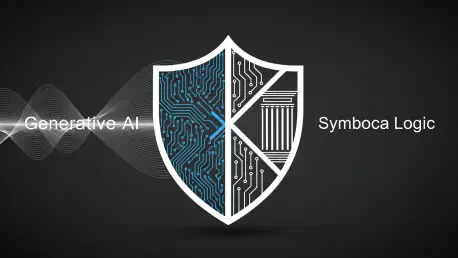
The transition toward a hybrid artificial intelligence model represents a fundamental shift from relying solely on neural networks to an approach that integrates symbolic logic and deterministic rules. Purely generative models are essentially sophisticated pattern matchers that predict the most likely sequence of characters based on training data, which often includes legacy code with known vulnerabilities. By contrast, symbolic AI utilizes a predefined set of rules and logical constraints to evaluate code against strict security standards and organizational policies. When these two methodologies are combined, the generative component provides creative problem-solving and rapid drafting capabilities, while the symbolic component acts as a rigorous filter that rejects any output violating established safety protocols. This synthesis ensures that the resulting code is not only syntactically correct and functional but also adheres to the complex security requirements of modern cloud-native infrastructures.
Integrating static analysis security testing and formal verification directly into the inference process allows for a robust validation of code before it ever reaches a developer’s terminal. Unlike traditional post-hoc scanning which identifies issues after the code is written, a hybrid system can perform real-time checks using abstract interpretation to prove the absence of specific error classes. For instance, a symbolic engine can analyze the data flow of a generated script to ensure that user-controlled input never reaches a sensitive database sink without proper sanitization. This deterministic layer provides a level of certainty that neural networks cannot achieve on their own, effectively bridging the gap between human-like intuition and mathematical precision. Consequently, the hybrid approach minimizes the cognitive load on developers by filtering out insecure suggestions at the source, which reduces the time spent on remediation during later stages of the development lifecycle.
Enhancing Contextual Integrity in Development Pipelines
Contextual awareness serves as the second pillar of the hybrid AI strategy, enabling the system to understand the unique architectural constraints and internal security policies of a specific organization. Traditional large language models often struggle with the narrow context problem, where they suggest generic solutions that may conflict with internal proprietary frameworks or specific compliance mandates like SOC2 or HIPAA. By utilizing retrieval-augmented generation and vector databases, a hybrid system can inject relevant local codebase metadata and security documentation into the prompt window, ensuring the AI operates within a defined sandbox of safe practices. This prevents the model from suggesting external, untrusted third-party dependencies that have not been vetted by the internal security team. Furthermore, this deep integration allows the system to recognize when a developer is working on a high-risk component and automatically increase the rigor of its internal symbolic checks.
Proactive defense mechanisms within hybrid systems have evolved to provide automated remediation suggestions that are both secure and tailored to the specific execution environment. When a potential vulnerability is detected by the symbolic logic layer, the generative engine is tasked with refactoring the code to eliminate the risk while maintaining the original intent of the developer. This closed-loop system creates a continuous improvement cycle where the AI learns from its own rejected outputs, progressively refining its ability to generate secure code from the outset. In contrast to legacy tools that merely flag issues, hybrid AI provides the reasoning behind security failures, acting as a tireless mentor for developers who may not yet be well-versed in secure coding practices. This capability is vital in 2026, as the complexity of microservices and distributed systems continues to expand, making it difficult for human operators to track every potential attack vector across a massive surface area.
Strategic Implementation and Future Resilience
The industry recognized that the initial euphoria surrounding autonomous coding had to be balanced with a disciplined framework that prioritized systemic integrity over raw output volume. This realization led to the widespread adoption of hybrid architectures that combined the fluidity of neural networks with the unyielding logic of formal verification systems. Organizations that successfully navigated this transition focused on creating a unified data layer where security policies were treated as code, allowing the hybrid AI to enforce compliance at every stage of the pipeline. It was observed that the most resilient teams were those that treated AI assistants not as a replacement for security experts, but as a first-line defense capable of neutralizing low-level threats automatically. Moving forward, the emphasis must shift toward fine-tuning these hybrid models on curated, high-integrity datasets while maintaining a strict human-in-the-loop requirement for critical infrastructure updates.