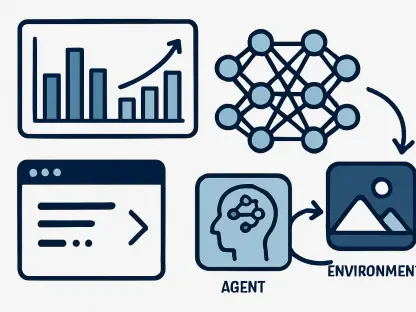

When corporate chief financial officers receive notifications regarding million-dollar cloud billing overages in the middle of a standard Tuesday afternoon, the culprit is increasingly a new form of digital asset theft known as LLMJacking. This phenomenon represents a fundamental shift in the motivations of cybercriminals who have moved past traditional data exfiltration toward the direct theft of expensive computational resources. Unlike standard breaches that target sensitive personal information for identity theft, LLMJacking focuses on hijacking API quotas and raw compute power to fuel unauthorized large-scale workloads. By gaining access to high-performance foundation models, malicious actors can execute hundreds of thousands of queries using a victimized company’s credit line. This creates a catastrophic financial impact that far outweighs the value of the data itself, transforming a company’s technological edge into a massive balance-sheet liability that can cripple a department’s annual operating budget in mere hours if left unmonitored.
The Industrialization: Resource Hijacking Trends
The emergence of specialized syndicates has turned AI resource theft into a highly professionalized ecosystem where different criminal groups operate with a clear and effective division of labor. One specific segment of this underground market focuses exclusively on the initial penetration of corporate networks to harvest cloud credentials, session tokens, and API keys through automated vulnerability scanning. Once these access points are secured, they are frequently handed off to a second group of specialists who manage what are known as LLM Mixers. These illicit platforms function as black-market service providers, reselling access to premium foundation models to third parties at a fraction of the legitimate market rate. For instance, the Jet Night syndicate has been observed offering unlimited access to high-tier AI models for approximately sixty dollars per month, a price point only achievable because the backend infrastructure is being powered by the stolen quotas of legitimate enterprises across the globe.
This economic shift demonstrates that cybercriminals are no longer just looking for a one-time payout but are instead building sustainable business models based on the arbitrage of stolen cloud utilities. The commoditization of these stolen credentials allows even low-skilled attackers to utilize sophisticated AI tools for a small fee, further expanding the threat landscape for organizations. This professionalized approach also complicates attribution, as the group performing the initial breach may be entirely separate from the one profiting from the resold API access. As these marketplaces mature, the barrier to entry for high-power computational crime continues to drop, leading to a proliferation of unauthorized AI usage that is difficult to track through traditional security measures. Organizations find themselves not only fighting a technical battle against intruders but also competing against a shadow economy that systematically devalues their legitimate investments in AI infrastructure by flooding the market with stolen alternatives.
Velocity and Scale: Technical Mechanisms of Theft
A defining characteristic of LLMJacking is its extreme operational velocity, which distinguishes it from the older, more patient tactics of illicit cryptocurrency mining typically seen in cloud environments. Traditional cryptojacking involves a slow and steady drain on processing resources designed to stay just below the threshold of automated alerts to ensure long-term persistence within a system. In contrast, LLMJacking is built for immediate, high-volume exploitation where speed is prioritized over stealth to maximize the value of a stolen token before it is revoked. Investigative reports have documented instances where attackers funneled over five hundred thousand queries through a single victim’s foundation model in less than eight hours. This surge in activity generates massive financial spikes that can exceed one million dollars in charges before a security team even receives an initial warning, making the response window for these attacks significantly shorter than for any previous form of cloud-based resource exploitation.
To achieve such massive scale, attackers bypass consumer-facing chat interfaces and interact directly with backend infrastructure using sophisticated techniques like token proxying and automated model streaming. By utilizing scripts to maintain a constant, high-speed flow of data, syndicates can effectively drain a company’s entire API quota in a single session while redirecting the output to their own illicit resale portals. Furthermore, these actors often force cloud environments to provision expensive graphics processing unit hardware to handle the heavy computational load, further inflating the final bill for the victimized organization. Some sophisticated groups have even been observed setting up lookalike domains that mimic legitimate internal corporate traffic to route stolen quotas into commercial fronts without raising immediate suspicion. This tactical evolution suggests that monitoring for simple unauthorized logins is no longer sufficient, as the sheer volume of activity requires automated defenses capable of identifying anomalous billing patterns.
Security Lapses: Vulnerabilities and Human Error
Surprisingly, the majority of these high-cost breaches do not rely on complex zero-day exploits but instead capitalize on common security lapses and organizational misconfigurations that are frequently overlooked. Cybercriminals routinely employ automated bots to scrape public repositories for stray API keys or session tokens that developers accidentally leave in code snippets or configuration files. Additionally, poorly secured service accounts with overly broad permissions provide a prime entry point for attackers to gain a foothold within a cloud environment. Through targeted social engineering, such as the creation of fake developer registration portals, malicious actors trick engineers into submitting live access tokens under the guise of trying out new tools or joining beta programs. These relatively simple methods allow intruders to circumvent multi-factor authentication controls by using legitimate tokens that have already been authorized, granting them direct access to the company’s most expensive machine learning engines.
The security of AI routing gateways has also emerged as a critical point of failure in the modern enterprise stack, particularly when third-party tools are used to manage complex model interactions. Recent vulnerabilities, such as those found in the LiteLLM routing gateway, have demonstrated how attackers can escalate their privileges from a standard user to a root administrator within the cloud management layer. This escalation provides full control over the provisioning of new services and the modification of existing API limits, effectively giving the attacker the keys to the kingdom. As enterprises adopt more layers of software to orchestrate their AI workloads, the attack surface expands, creating new opportunities for exploitation that sit outside the traditional purview of cloud security monitoring. This trend emphasizes the need for a comprehensive audit of every intermediary tool within the AI infrastructure to ensure that a single vulnerability in a management gateway does not lead to a catastrophic financial loss for the entire organization.
Future Resilience: Strategic Governance and Next Steps
The security teams and financial departments addressed these emerging threats by implementing a shift toward strict operational governance and proactive resource monitoring. They mandated the use of hard spend caps on all machine learning accounts, which functioned as a critical fail-safe by automatically disabling services once a specific dollar threshold was crossed during a billing cycle. This measure effectively prevented the runaway costs associated with high-velocity API hijacking, regardless of how quickly an attacker attempted to drain a company’s quota. Furthermore, organizations began treating the activation of any previously dormant high-tier model engine as a high-priority security event that required immediate human verification before activity could continue. By establishing these automated alerts and hard limits, enterprises successfully moved from a state of passive observation to an active defensive posture that recognized every artificial intelligence query as a direct and measurable financial transaction.
A renewed focus on credential hygiene and infrastructure integrity became the cornerstone of a resilient defensive strategy against future resource hijacking attempts. Security professionals conducted thorough and recurring audits of all public repositories and internal service accounts to identify any exposed API keys or session tokens that could serve as unauthorized entry points. They also prioritized the deployment of security patches for all intermediary tools and routing gateways, specifically targeting vulnerabilities that allowed for administrative privilege escalation. These collective efforts transformed cloud management from a purely technical necessity into a strategic component of corporate risk oversight. By combining rigorous financial controls with automated technical responses, businesses effectively insulated themselves from the catastrophic economic impact of LLMJacking while continuing to leverage the capabilities of foundation models in a safe and sustainable manner for their long-term growth.