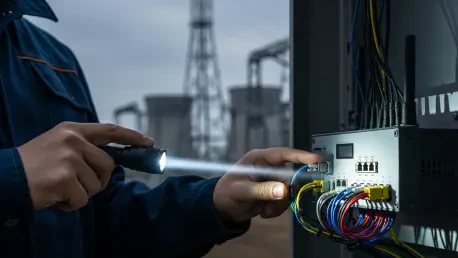

The vulnerability of a modern power grid is often found not in the core of the utility but in the remote appendages of renewable energy installations that dot the rural landscape. When a sophisticated group of hackers targeted the Polish energy sector in late 2025, they did not launch a brute-force assault on the central dispatch center but rather systematically exploited the periphery. By gaining a foothold in a distributed network of wind farms, these actors demonstrated that the shift toward sustainable energy introduces a series of complex risks that traditional security models are ill-equipped to handle. This specific breach shifted the paradigm from simple data exfiltration to operational sabotage, proving that any component of the grid, no matter how remote, can serve as a conduit for failure. The incident served as a stark reminder that as energy systems become more decentralized, the surface area for potential attacks expands, requiring a rethink of industrial security.
Vulnerabilities in Perimeter Security and Remote Access
The initial point of entry was a perimeter firewall at a specific wind farm installation that failed to uphold even the most basic modern security standards during its deployment. Despite being a critical gateway for maintenance crews and remote engineers to monitor performance, the device relied on local accounts that lacked multi-factor authentication. This oversight allowed the intruders to utilize credential harvesting techniques to gain administrative access without triggering any significant alarms within the security operations center. Once they controlled the firewall, the attackers essentially held the keys to the entire local area network of the wind farm, allowing them to bypass the traditional boundaries that are supposed to separate the public internet from sensitive industrial controls. This level of access provided a stable platform from which the group could conduct further exploration of the internal topology without the immediate threat of being disconnected by security protocols.
With administrative control firmly established, the hackers were able to map out every device connected to the wind farm’s internal architecture, ranging from weather sensors to the heavy-duty turbines themselves. The lack of internal segmentation meant that once the perimeter was breached, there were no secondary barriers to prevent the lateral movement of malicious traffic across the facility. This environment allowed the attackers to install persistent backdoors and sniff network traffic to identify further credentials that might be used to reach other parts of the energy provider’s infrastructure. By manipulating the configuration of the local network switches, they ensured that their presence remained hidden from basic diagnostic tools used by onsite technicians. This phase of the operation highlighted a critical failure in the assumption that a remote, physical location is inherently secure simply because of its geographic isolation or specialized function within the grid’s ecosystem.
Bridging Networks via Compromised Mobile Connections
The escalation of the attack took a technical turn when the intruders identified a cellular router used to maintain connectivity between the wind farm and a Combined Heat and Power plant. This connection utilized a Private Access Point Name, a mobile networking solution that many industrial operators mistakenly believe provides an air-gapped or inherently secure tunnel across the public cellular spectrum. In reality, the configuration lacked essential client isolation, which meant that any device on this private mobile network could potentially communicate with any other device on the same APN. The hackers exploited this architectural flaw to leapfrog from the wind farm’s network directly into the internal systems of the thermal power plant, effectively bypassing the traditional firewalls and intrusion detection systems that the utility had placed at its boundaries. This maneuver showcased a sophisticated understanding of how modern industrial telecommunications are structured and where the hidden overlaps exist.
Upon reaching the Combined Heat and Power plant, the attackers focused their efforts on identifying the programmable logic controllers that dictate the physical operations of the facility. Because the mobile network had granted them a trusted status within the internal environment, they were able to communicate with these controllers using standard industrial protocols that rarely feature robust authentication or encryption. The hackers spent several days in a quiet reconnaissance phase, observing the data flows and hardware responses to understand the specific logic required to manage the plant’s machinery. This patient approach ensured that when they finally chose to strike, their commands would appear legitimate to the automated safety systems that might otherwise have intervened. By bridging the gap between a remote wind farm and a central power generation unit via an unmanaged mobile link, the attackers turned a convenient communication tool into a high-speed highway for industrial sabotage.
Systematic Sabotage and Lessons in Forensic Evasion
On December 29, the intruders executed a series of precise commands that forced the power plant’s industrial controllers into a STOP mode, a state usually reserved for emergency maintenance or safety shutdowns. This action immediately paralyzed the steam turbine and the water-treatment systems, which are essential components of the electricity generation process at a thermal facility. The sudden cessation of these mechanical processes caused a ripple effect across the plant’s infrastructure, leading to a complete halt in production that could not be easily reversed through standard remote restarts. While the broader regional grid remained operational thanks to automated backup systems, the specific facility was rendered useless by the remote manipulation of its digital brain. To complicate the investigation, the attackers performed several anti-forensic maneuvers designed to erase their digital footprint and delay the recovery of the power plant’s systems by the staff.
The breach of the Polish energy sector provided a vital lesson for utility operators regarding the inherent dangers of treating decentralized assets as low-risk environments. It was determined that the reliance on private mobile networks without additional layers of encryption and isolation created a false sense of security that was easily pierced by determined actors. Moving forward, the implementation of mandatory multi-factor authentication for every access point, regardless of its perceived importance, was identified as a non-negotiable standard for critical infrastructure. Furthermore, energy providers were encouraged to treat every communication link as an untrusted zone requiring zero-trust architecture to prevent lateral movement. Centralizing the storage of security logs in a read-only, offsite environment was also highlighted as a necessary step to ensure that forensic data remains available. These measures represented the necessary evolution of grid security to protect against future threats.