
While many anticipated a consumer-grade wearable, OpenAI delivered a high-end niche productivity tool focused entirely on the needs of the professional developer community. This move into the hardware market materialized through a collaboration with the boutique peripheral manufacturer Work Louder, resulting in the Codex Micro. Retailing at a premium price of $230, this specialized mechanical keypad targets the eight million software engineers who have integrated OpenAI’s advanced coding models into their daily lives. By stepping outside its traditional boundaries of software development, the company has created a bridge between the digital and physical realms. This device is not merely a novelty but a dedicated workstation accessory designed to facilitate the management of autonomous AI agents. It represents a significant shift in strategy, acknowledging that as AI becomes more central to software construction, the standard keyboard alone may no longer suffice for modern tasks.
Physical Architecture and Visual Feedback Systems
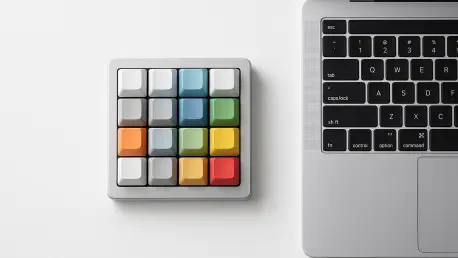
Constructed from a solid block of CNC-machined aluminum, the Codex Micro exudes a level of industrial quality typically reserved for high-end custom mechanical keyboards. The layout is purposefully minimalist yet functional, featuring thirteen individual mechanical switches, a multi-purpose rotary dial, and a precision joystick for navigation. Perhaps the most innovative aspect of the hardware design is its unique glanceable feedback system, which utilizes a specialized RGB lighting language to communicate the internal state of AI threads. In a busy development environment, developers often find themselves buried under dozens of browser tabs or terminal windows, making it difficult to track the progress of background AI tasks. By assigning specific colors to different operations—such as a steady blue for active processing or a soft peach when human input is required—the device allows users to monitor their automated workflows through peripheral vision alone, reducing cognitive load.
Beyond the visual cues, the physical switches provide a tactile satisfaction that software-based toggles simply cannot replicate. Each switch is tuned for a specific actuation force, ensuring that critical AI commands are intentional and deliberate. This physical interface acts as a dedicated control center, effectively offloading the most repetitive AI management tasks from the primary keyboard. This separation of concerns is vital for professional developers who need to maintain a state of flow while orchestrating multiple autonomous agents simultaneously. Furthermore, the partnership with Work Louder ensures that the device meets the ergonomic standards of power users who spend long hours at their desks. The inclusion of high-quality components suggests that OpenAI is prioritizing durability and professional utility over mass-market appeal. This approach underscores a broader trend where specialized hardware is becoming a necessity to manage the interactions between humans and machine learning.
Tactile Orchestration and Workflow Customization
Deep integration with the existing software ecosystem is what truly distinguishes the Codex Micro from standard programmable macro pads. The centerpiece of this integration is the rotary dial, which offers a granular level of control over the Codex model’s reasoning depth. A simple turn of the knob allows a developer to toggle between rapid, low-latency boilerplate generation and deep, computationally intensive architectural debugging. This eliminates the need to navigate through complex settings menus or adjust prompt parameters manually, making the AI’s power more accessible during the heat of a coding session. Additionally, the integrated joystick is designed to trigger a contextual radial menu on the primary display. This menu provides one-touch access to a suite of common developer operations, such as refactoring legacy code blocks or generating unit tests. By mapping these high-value actions to physical gestures, the device streamlines the developer’s interaction loop, allowing for a more fluid creative process.
Personalization remains at the heart of the developer experience, and OpenAI has addressed this by shipping the device with a set of thirty-two interchangeable keycaps. These caps are not just aesthetic; they are designed to represent specific AI-driven functions, such as accepting or rejecting code suggestions or initiating a global project search. Interestingly, the set also includes caps that lean into the specific cultural language of the engineering world, featuring labels like “yolo” and “yeet.” This choice reflects an understanding of the modern developer persona, blending high-stakes professional utility with a sense of community identity. Users can reconfigure the layout of these keys to match their specific branching strategies or deployment pipelines, ensuring that the keypad evolves alongside their personal workflow. This level of customization ensures that the Codex Micro is not a static tool but a flexible platform capable of adapting to various programming languages and project requirements.
Strategic Market Impact and Operational Standards
The timing of this hardware release coincides with an unprecedented expansion of OpenAI’s developer base, which recently eclipsed eight million weekly active users. This surge in adoption was driven by the release of more capable reasoning models and a suite of desktop integrations that have made AI an inseparable part of the modern software stack. While the Codex Micro is currently positioned as a limited-run project aimed at a niche segment of power users, it serves as a critical proof of concept for the company’s hardware ambitions. It remains distinct from the broader consumer-oriented AI projects currently being discussed in industry circles. Instead of attempting to replace the smartphone, OpenAI is focusing its initial hardware efforts on the professional community that builds the digital world. By solving the specific friction points of engineers, the company is establishing a foothold while reinforcing its tool dominance and preparing for a future where physical AI interfaces are standard for all professional workstations.
As organizations began integrating these specialized peripherals into their engineering departments, the focus shifted toward optimizing the collaboration between human creativity and autonomous agents. Engineering leads encouraged teams to standardize their color-coded feedback systems, ensuring that project managers could gauge the progress of complex automated migrations simply by glancing at the hardware on a developer’s desk. It was observed that teams using dedicated tactile controllers reported lower levels of context-switching fatigue and a higher success rate in managing concurrent AI threads. Moving forward, developers were urged to implement modular keycap configurations that aligned with their specific automated testing protocols. This transition underscored the necessity of bridging the gap between abstract algorithmic processes and the physical reality of the workstation. By treating these devices as critical infrastructure, firms successfully reduced the cognitive overhead associated with orchestrating high-scale autonomous software deployments.