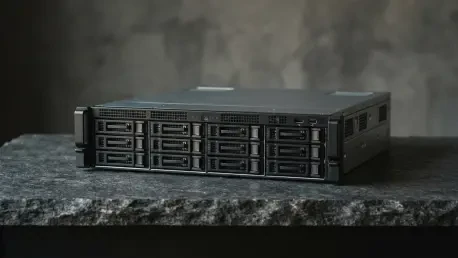

Large file transfers on the RS4826xs+ maintain impressive speeds between 5.3 and 5.6Gbits/sec, proving its efficiency for high-volume media and data workflows. As digital transformation continues to accelerate throughout 2026, small and medium-sized businesses face an unprecedented deluge of data that requires more than just raw storage capacity; it demands high intelligence, extreme reliability, and rack-optimized density. The Synology RackStation RS4826xs+ enters this competitive landscape as a 2U rackmount powerhouse designed to bridge the gap between traditional local file servers and modern cloud-integrated infrastructure. By shifting from the bulkier 3U predecessors to a streamlined 2U chassis, Synology has prioritized rack efficiency without sacrificing the scalability needed for massive data expansion. This model signifies a shift toward high-performance computing within the NAS sector, offering a robust platform for everything from intense backup schedules to the large-scale AI-driven surveillance networks that modern enterprises now depend on to maintain their competitive edge.
Hardware Prowess: Power and Design
Modern Architecture: Processing Power
The internal hardware of the RS4826xs+ marks a significant generational leap for the brand, finally moving away from the aging processors of previous eras to the robust 3GHz 8-core Intel Xeon D-1739. This specific upgrade provides the computational headroom necessary for modern virtualization and containerization tasks that are becoming standard in corporate environments during 2026. The shift to a more contemporary CPU architecture ensures that the appliance can handle multiple simultaneous Docker containers and virtual machines without the latency issues that plagued older systems. This processing power is crucial for businesses running resource-intensive applications like real-time data analytics or centralized management systems. By choosing this silicon, Synology provides a clear path for companies to consolidate their server rooms, moving away from disparate hardware toward a centralized, high-performance unit that balances energy efficiency with the raw speed required for modern operations.
While the system typically ships with a base memory configuration of 16GB ECC DDR4, it can be scaled up significantly to a maximum of 96GB across six available RDIMM slots. This high memory ceiling is an essential feature for businesses running concurrent high-demand applications, providing the necessary buffer for complex deduplication processes and multi-user environments. However, IT managers should be aware that Synology emphasizes the use of its proprietary certified memory modules to ensure full system integrity and ongoing technical support. This focus on first-party components is part of a broader strategy to minimize hardware-related downtime, which is often caused by incompatible or lower-grade third-party RAM. Despite the premium cost associated with these modules, the benefit of a fully validated hardware stack becomes evident during periods of peak load where stability is paramount. The ability to expand memory as needs grow over the period from 2026 to 2028 allows for a more flexible and sustainable long-term infrastructure investment.
Physical Design: Redundant Systems
The 2U chassis of the RS4826xs+ is a masterpiece of industrial engineering, specifically designed to withstand the rigors of 24/7 enterprise operation without thermal throttling. A key feature of this physical architecture is the easily accessible cooling system, which houses four 8-cm-diameter hot-plug fans that can be replaced while the system remains fully powered. This design choice highlights Synology’s commitment to maximum uptime, as it allows IT staff to perform routine maintenance or emergency repairs without interrupting critical business services. Furthermore, the inclusion of dual 550W hot-plug power supply units as standard equipment provides a necessary layer of electrical redundancy. In a typical 2026 data center environment, power failures at the rack level are a constant risk, and having a secondary power module ensures that a single circuit failure does not lead to catastrophic data loss or system corruption. This mechanical resilience is a hallmark of the RackStation series.
Connectivity on the rear of the unit has been overhauled to meet the demands of high-speed local area networks, moving past the quartet of standard Gigabit ports found on previous generations. The RS4826xs+ features dual 10GbE RJ-45 ports as the primary interface, allowing for massive data throughput right out of the box without the need for additional expansion cards. Perhaps most importantly for remote management, Synology has included a dedicated Out-of-Band management port, which operates on its own dedicated Gigabit controller. This allows system administrators to access the DiskStation Manager interface even if the primary data ports are saturated or if the main network experiences a significant outage. By isolating management traffic from the data plane, organizations can ensure a higher level of security and control, preventing accidental lockouts and providing a reliable gateway for troubleshooting and system updates during critical infrastructure maintenance windows.
Expansion and Software: Versatile Ecosystem
Flexible Connectivity: Expansion Slots
Internal expansion is facilitated by four PCIe slots, though it is important to note that two of these are occupied by the essential storage controllers and expansion shelf interfaces. This leaves two free Gen4 x8 slots that provide businesses with the flexibility to adapt the NAS to their specific networking requirements, whether that involves adding more 10GbE ports or moving to 25GbE fiber optics. As businesses transition toward faster internal backbones through 2026, the ability to upgrade networking hardware ensures that the storage appliance does not become a bottleneck in the corporate workflow. These slots are also compatible with Synology’s various network interface cards, which are designed to work seamlessly with the DSM operating system. This modular approach allows for a customized balance between traditional copper networking and modern high-speed optical links, depending on the existing infrastructure and the future growth plans of the IT department.
To overcome the lack of integrated M.2 slots on the motherboard, Synology offers specialized combo cards that provide both high-speed networking and dual M.2 NVMe SSD slots for cache acceleration. Utilizing these cards in the available PCIe slots is a strategic move for businesses that require high random I/O performance, such as those hosting large databases or intensive virtual machine environments. By adding an NVMe cache, the system can significantly reduce latency and improve the overall responsiveness of the file system, especially when dealing with thousands of small, frequently accessed files. This hardware flexibility is complemented by the ability to connect up to three RX1225RP expansion shelves, bringing the total drive count to a massive 48 bays. This level of scalability means that a business can start with a modest storage footprint and expand its capacity to hundreds of terabytes as its data retention requirements grow over the next several years.
Software Ecosystem: Advanced Tools
Operating on DiskStation Manager 7.4, the RS4826xs+ provides a sophisticated suite of productivity and data protection tools that are specifically designed for the modern enterprise. The Active Backup suite remains one of the most compelling reasons for SMBs to choose Synology, as it offers license-free backup services for a wide variety of environments, including Microsoft 365, Google Workspace, and VMware. In an era where software-as-a-service costs are constantly rising, the ability to centralize backups without recurring monthly fees represents a massive value proposition for budget-conscious IT departments. The software also includes advanced features like Snapshot Replication and Hyper Backup, which provide multi-layered protection against data loss. These tools enable businesses to implement a robust 3-2-1 backup strategy with minimal configuration effort, ensuring that critical business information is always recoverable in the event of hardware failure, human error, or a coordinated cyberattack.
Synology is also aggressively integrating artificial intelligence into its platform to help businesses manage their data more effectively through 2026. The new AI Console allows administrators to connect their NAS to generative models from industry leaders like OpenAI and Amazon Bedrock, enabling features such as AI-powered search within Synology Drive and translation services in MailPlus. To address the significant privacy concerns associated with cloud-based AI, Synology has introduced a “De-identification” feature that can automatically anonymize sensitive personal information before it is sent to external servers for processing. This ensures that businesses can leverage the power of modern AI tools while remaining in compliance with strict data protection regulations like GDPR. By blending local storage with cloud intelligence, the RS4826xs+ becomes more than just a place to store files; it evolves into an active participant in the business workflow, helping users find information faster and communicate more efficiently across global teams.
Performance and Policy: Strategic Benchmarks
Storage Ecosystem: Media Policies
A defining characteristic of the Synology enterprise experience is the strict enforcement of storage device compatibility, often referred to as a “walled garden” approach. The RS4826xs+ is designed to work exclusively with Synology-certified drives, such as the HAT5300 series HDDs and SAT5200 series SSDs. If an IT administrator attempts to install third-party drives, the DSM Storage Manager will flag them as unrecognized and prevent the creation of storage pools. While this policy can be frustrating for those looking to save money by purchasing generic hardware, Synology argues that this restriction is necessary to ensure the highest possible levels of system stability and performance. By controlling the entire storage stack from the operating system to the physical disk, Synology can guarantee that every drive in the array is running optimized firmware and has been thoroughly tested for compatibility with the specific RAID controllers and cooling profiles of the RackStation.
One of the practical benefits of this strict drive policy is the seamless integration of disk maintenance into the central management interface. Firmware updates for Synology-certified drives are delivered directly through the DSM operating system, allowing administrators to update their entire storage fleet with just a few clicks and no manual intervention. This reduces the administrative overhead associated with long-term storage maintenance and ensures that the system is always protected against known drive-level bugs or performance issues. For enterprise IT departments that prioritize reliability and ease of management over the lowest possible hardware cost, this integrated approach provides significant peace of mind. The stability provided by a fully validated hardware stack is especially valuable in mission-critical environments where even a few minutes of downtime can result in substantial financial losses. Consequently, the walled garden approach serves as a form of insurance for the integrity of the business’s most valuable asset.
Benchmark Results: Real Performance
In rigorous performance testing conducted within a 10GbE network environment, the RS4826xs+ proved that it is more than capable of handling high-demand enterprise workloads. When configured with a RAID 5 array of Synology HAT5300 hard drives and connected to a Windows Server 2025 host, the appliance consistently reached near-wire speeds for sequential data transfers. Sequential read and write operations both hovered around the 9.3Gbits/sec mark, effectively saturating the available bandwidth of a single 10GbE link. These results indicate that the unit is an ideal candidate for roles that require fast data access, such as serving as a high-speed repository for 4K video editing teams or supporting large-scale file sharing for hundreds of concurrent users. The consistency of these speeds under heavy load demonstrates the effectiveness of the Xeon processor and the optimized storage drivers within DSM, providing a reliable foundation for any business that requires high-performance local storage.
For organizations utilizing the appliance as an IP SAN, the performance figures are even more impressive, particularly when leveraging advanced networking configurations. In a dual 10GbE Multi-Path I/O setup, the RS4826xs+ reached sequential read speeds of 18.5Gbits/sec and write speeds of 17Gbits/sec. These numbers are high enough to support demanding virtualization environments where multiple virtual machines are accessing the storage simultaneously. The appliance also excelled in random I/O tasks, especially when an NVMe cache was introduced to the system, providing the low latency required for database hosting and web server applications. Whether it was handling a complex backup of over 10,000 small files or a single massive database export, the system remained responsive and stable. This level of performance ensures that the RS4826xs+ can serve as the primary storage hub for a wide variety of business applications, providing the speed and reliability that modern IT infrastructures demand in 2026.
Strategic Value: Next Steps
The Synology RackStation RS4826xs+ establishes itself as a versatile and formidable contender for businesses seeking to modernize their storage infrastructure. While the initial investment is significant, the combination of advanced Xeon processing, massive 48-bay scalability, and the license-free DSM software suite provides a clear path toward a more efficient data management strategy. For IT departments that prioritize stability and seamless integration, the requirement for proprietary drives becomes a secondary concern compared to the reliability of a fully validated hardware stack. This appliance effectively balances raw performance with intelligent software features, making it a sustainable choice for organizations planning their growth through 2028. Moving forward, businesses are encouraged to evaluate their specific I/O requirements to determine if adding NVMe caching or 25GbE networking is necessary for their unique workloads. Ultimately, the RS4826xs+ delivers a robust foundation for the complex data challenges of the current enterprise landscape.