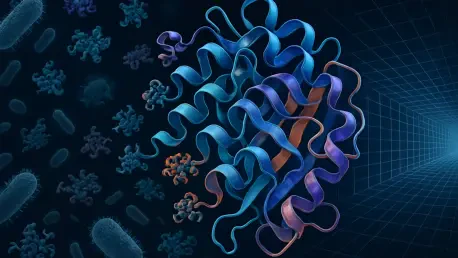

The rapid evolution of structural biology has historically been defined by the capacity to visualize life at a molecular level, yet the recent emergence of massive AI-driven databases is fundamentally altering this trajectory. While the initial release of AlphaFold provided a groundbreaking look at 200 million protein structures, the arrival of the ESM Atlas has expanded this horizon significantly by cataloging over 1.1 billion predictions. This massive database serves as a map for the “dark matter” of biology, focusing on the microbial world where millions of sequences exist without clear functional assignments. These sequences, pulled from diverse environments such as agricultural soil and marine ecosystems, represent a frontier that was previously unmapped due to the limitations of traditional laboratory techniques. By bridging this gap, ESMFold2 provides researchers with the high-resolution tools necessary to analyze complex ecological interactions and metabolic pathways that drive planetary biochemical health. This expansion signifies a move from studying a few model organisms to understanding the totality of the biosphere.
The Methodology Behind ESMFold2
Protein Languages: Applying Linguistic Patterns to Sequences
The technical core of this shift lies in the adoption of protein language models, which apply the principles of natural language processing to the complexity of amino acid sequences. Instead of relying solely on evolutionary information from multiple sequence alignments, ESMFold2 treats the 20 symbols of the amino acid alphabet like words in a sentence, learning the underlying grammar of protein folding. This approach allows the model to predict how a sequence will fold into a three-dimensional shape based on the contextual relationships between residues. By training on billions of diverse sequences, the model has developed an internal logic that mirrors physical laws without requiring explicit programming. This internal representation enables the AI to fill in missing information and predict structures of entirely novel proteins that lack close relatives in existing databases. Consequently, the reliance on evolutionary data has been mitigated, allowing for much faster predictions than previous iterations of structural modeling software.
Computational Performance: Enhancing Structural Prediction Capabilities
Beyond the basic folding of single chains, this transformer-based architecture excels at identifying structural motifs that are critical for molecular interactions. In the current year, the ability to model how proteins dock with one another or with small molecules has become the primary bottleneck in digital drug discovery. ESMFold2 addresses this by utilizing its massive training set to recognize the subtle geometric patterns required for protein-protein interfaces. This capability is essential because most biological processes, from immune responses to metabolic regulation, depend on the coordinated action of protein complexes. The speed at which these structures are generated allows for high-throughput screening of billions of potential drug candidates, far outpacing the capabilities of older models. This efficiency does not come at the cost of accuracy; rather, it provides a probabilistic framework that helps scientists prioritize the most promising leads for physical synthesis. This methodology effectively transforms the search for new medicines into a scalable computational task.
Strategic Competition and Open-Source Science
Intellectual Property: Challenging Proprietary Standards in Biotechnology
The competitive landscape of biotechnology is currently defined by a tension between proprietary corporate interests and the global movement toward open science. While many early innovators in the field have shifted toward more restrictive licensing for their most advanced tools, ESMFold2 stands out as a fully open-source resource. This transparency allows the global scientific community to inspect the code, retrain the models on private datasets, and integrate the technology into diverse workflows without legal constraints. This open nature is particularly significant for pharmaceutical research, where the ability to run models on local servers is critical for maintaining the confidentiality of intellectual property. By removing the barriers of entry that often accompany high-tier AI tools, Biohub has forced a reconsideration of how biological data should be managed. This shift challenges the idea that progress in structural biology should be controlled by a few centralized entities, suggesting instead that a decentralized approach is faster and more equitable.
Universal Access: Democratizing Tools for Scientific Collaboration
Furthermore, the democratization of these tools empowers smaller research institutions and laboratories in developing regions to participate in cutting-edge research that was previously out of reach. In the current year, the disparity between well-funded corporate labs and academic groups has been narrowed by the availability of high-performance models that run on standard hardware. This accessibility fosters a collaborative ecosystem where researchers can share improvements to the underlying architecture, leading to rapid iterations and collective bug-fixing. The ESM Atlas, as a public utility, provides a foundation upon which a variety of specialized applications can be built, from agricultural biotechnology to environmental remediation. This collaborative model ensures that the benefits of AI-driven structural biology are not siloed but are distributed across the entire scientific community. This encourages a diverse range of perspectives and applications, ensuring that the most pressing global challenges are addressed using the best available computational resources.
Engineering the Future of Molecular Design
Synthetic Design: Advancing Biology into an Engineering Discipline
The true validation of ESMFold2 comes from its application in physical laboratories, where the gap between digital prediction and biological reality is bridged. Recent experiments have demonstrated that the model is capable of designing de novo proteins that do not exist in nature, specifically tailored to perform predefined functions. These synthetic proteins have been successfully expressed in cellular systems, confirming that the structural predictions made by the AI are accurate enough to guide the assembly of functional molecules. This success indicates that we are moving toward a period where biology can be treated as an engineering discipline rather than a purely descriptive science. Engineers can now specify the desired function of a protein and use these models to work backward to the necessary amino acid sequence. This “reverse engineering” of life allows for the creation of industrial catalysts that operate at room temperature or new classes of sensors that can detect environmental pollutants at parts-per-billion levels, revolutionizing several industries.
Strategic Development: Establishing Protocols for Sustainable Biotechnology
Researchers recognized that the shift toward engineering-driven biology necessitated a robust framework for ethical oversight and practical implementation. They focused on creating standardized protocols for the synthesis of AI-designed proteins to ensure that these tools were used safely and effectively. It was determined that the most effective path forward involved the integration of these structural databases into global health surveillance systems, allowing for the rapid identification of emerging viral threats. These steps facilitated a transition from reactive to proactive biological research, where scientists prepared for future challenges by modeling potential mutations in advance. The scientific community prioritized the creation of international agreements regarding the sharing of synthetic biology data to maintain the open-source spirit that defined the project. These actions established a foundation for sustainable biotechnology, ensuring that the power to design molecular structures remained a shared human achievement. This proactive stance provided the necessary security for the field.