
Biometric authentication has successfully transitioned from a specialized security feature into an essential component of the global technological infrastructure as the world moves through the current year. As organizations seek more efficient ways to manage access and verify identity, facial recognition has emerged as the leading solution due to its non-intrusive nature and high accuracy rates. The ability to distinguish between individuals in real time is no longer a complex feat restricted to high-budget labs; instead, it is now achievable for any developer with a basic understanding of Python and computer vision. This accessibility is driven by powerful algorithms that process visual data with incredible precision, turning facial features into distinct mathematical signatures. Consequently, the demand for custom-built recognition tools has skyrocketed in industries ranging from retail and finance to corporate facility management. By leveraging the right software stacks, engineers can build robust systems that provide immediate feedback and enhance the security posture of any environment.
1. Foundations: Biometric Trends and Environment Configuration
The current state of artificial intelligence has redefined identity verification by integrating deep learning models directly into standard business operations. Smartphones and secure facilities have championed this technology, using it for everything from unlocking devices to tracking employee attendance with minimal human intervention. Open-source libraries play a pivotal role in this landscape, providing the necessary tools to build and refine recognition systems without starting from scratch. These libraries enable developers to implement state-of-the-art detection and identification features while maintaining the flexibility to customize the software for specific needs. As facial recognition becomes more ubiquitous, the emphasis has shifted toward creating systems that are not only accurate but also respect privacy and ethical standards. This trend is expected to continue as the technology matures, leading to even more seamless interactions between humans and the digital world in various public and private sectors.
Setting up a professional development environment is the essential first step in launching a facial recognition project. Developers should begin by installing a current version of Python or configuring a dedicated Anaconda environment to manage specific software dependencies efficiently. Following this, it is necessary to download and install CMake, ensuring it is properly added to the system PATH to allow the compiler to function across various directories. To support the heavy lifting of C++ libraries, Microsoft Visual Studio Build Tools must be installed with the Desktop Development with C++ workload selected. After completing these installations, a full computer restart is required to finalize the registration of system variables and ensure that all build tools are recognized. Once the environment is stable, the final task involves using the command line to install the required Python libraries, such as OpenCV and Face Recognition, which provide the high-level functions needed for visual processing and feature extraction.
2. Execution: Strategic Workflow and Input Management
The core workflow of a real-time recognition project begins with the systematic importation of known reference photographs which represent the target individuals. Each image is processed to create a unique numerical signature or embedding that defines the specific facial features of the person. This step is vital because it allows the computer to compare live subjects against a pre-existing database of mathematical models rather than raw image files, which saves significant processing time. Once the reference signatures are organized, the application initiates a live video feed from a webcam or a pre-recorded file to begin the active monitoring phase. During this phase, the system continuously scans every frame to identify facial locations and generate corresponding embeddings for anyone currently in view. These live embeddings are then cross-referenced with the stored signatures to determine a match. If the system finds a close fit, it identifies the person and prepares the results for display on the screen, completing the full identification loop in real time.
Managing the video input effectively is crucial for maintaining the speed and responsiveness of the recognition application. The software must run a continuous loop that captures individual frames from the camera while simultaneously performing complex image analysis. To prevent the system from lagging, especially when using high-resolution video, it is common practice to downscale the image size before processing. By reducing the resolution, the detection and encoding algorithms can operate much faster, allowing for a higher number of frames to be analyzed per second. This downscaled frame is used for the mathematical work, while the original high-quality frame is used for the visual output shown to the user. This approach ensures that the application remains snappy and responsive, even on standard consumer-grade hardware. Additionally, utilizing efficient functions to read and convert image files helps in organizing the encodings and names in a searchable format that the matching engine can access with minimal latency during operation.
3. Analytics: Real-Time Detection and Matching Logic
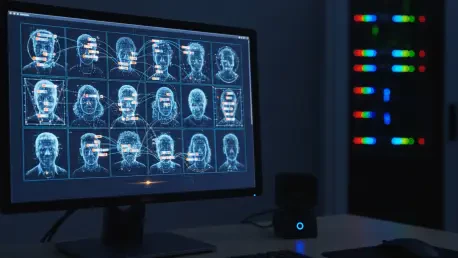
Locating faces within a dynamic video stream is achieved by utilizing the HOG model, which offers a balanced approach between detection speed and accuracy. This model identifies the boundary coordinates for every face found in the frame, providing the exact location of the forehead, chin, and sides of the face. Once these facial locations are identified, the system must adjust the coordinates to match the original image size to ensure that any visual markers are placed correctly. Following detection, the software creates detailed facial encodings by translating visual features into 128-dimensional numerical signatures. These embeddings are the cornerstone of the identification process, as they provide a compact representation of the unique geometry of each face. By converting pixels into numbers, the system can perform rapid comparisons that would be impossible with raw visual data. This transition from visual detection to mathematical representation is what allows the software to distinguish between different individuals with high levels of confidence and precision.
The process of performing identity matches involves checking new face data against the saved database of known signatures. For each face detected in the live stream, the matching algorithm calculates the distance between its embedding and every encoding in the reference list. If the distance is within the specified threshold, the system assigns the corresponding name to the individual; otherwise, they are labeled as Unknown. This logic allows the system to accurately identify authorized personnel while simultaneously flagging unauthorized visitors or strangers. The importance of these embeddings in machine learning comparisons cannot be overstated, as they allow the system to ignore irrelevant factors like background lighting or slight changes in facial expression. By focusing on the essential numerical data, the matching engine provides a robust and reliable way to verify identities in a fraction of a second. This capability is what makes the technology suitable for high-speed environments where immediate and accurate identification is required for security or logging.
4. Implementation: Visual Output and Operational Context
Visualizing the recognition results is the final step in the application cycle, turning the internal data into a readable format for the user. The software draws boxes around every detected face and adds text labels that display the person’s name or status directly on the video stream. To ensure a smooth user experience, keyboard commands are typically integrated to allow for manual control, such as stopping the application or toggling certain visual features. Beyond the technical implementation, these systems find practical use in tracking worker attendance, managing secure entrance points, and monitoring public spaces for security purposes. They are also highly effective for identifying guests at events or verifying identities automatically in retail environments. In research and academic settings, such tools provide a foundation for building advanced surveillance systems and exploring new frontiers in human-computer interaction. The ability to provide clear, real-time feedback makes these applications invaluable for any organization looking to enhance awareness through automation.
The project concluded that the combination of Python, OpenCV, and Dlib provided a highly effective framework for building sophisticated real-time recognition systems. Developers found that using graphics cards to speed up the process significantly improved performance, especially when switching to deep learning detection models for higher accuracy. The system successfully managed multiple camera feeds and explored the potential for storing face data in the cloud for better scalability. Future enhancements included the addition of emotion detection and the ability to verify the presence of facial masks, further expanding the utility of the application. Automating attendance logs and connecting the system to mobile apps proved to be a valuable next step for corporate implementation. The accessibility of this computer vision technology offered a great opportunity for students and professional developers to innovate in the field of biometrics. Ultimately, the successful deployment of these tools confirmed their value as a versatile solution for modern identity management.