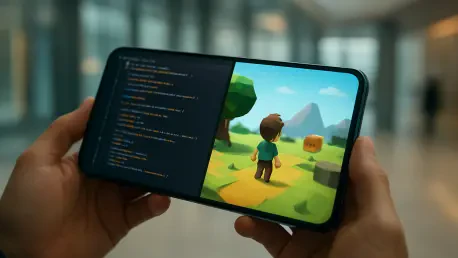

The transition from writing syntax to managing intent represents a fundamental change in how software is created, effectively lowering the technical barrier for non-programmers using mobile hardware. This evolution finds its most striking expression in Gotcha, an agentic system that reimagines the smartphone not merely as a communication tool, but as a sophisticated engineering workstation. While previous iterations of mobile coding environments relied on simplified text editors or remote cloud connections, this new architecture leverages the internal processing power of modern Android devices to perform complex logic directly on the metal. It marks a departure from the traditional paradigm where the phone was a consumer endpoint, turning it into a creative engine capable of synthesizing code, managing file structures, and deploying interactive applications through conversational prompts. By integrating deep system access with advanced reasoning capabilities, the platform allows users to navigate the entire development lifecycle from the palm of their hand, effectively bridging the gap between an abstract idea and a functional, compiled piece of software without requiring a dedicated desktop setup.
Technical Framework: Integration and Onboard Processing
The underlying power of this development agent resides in its unique ability to synchronize high-level artificial intelligence with the low-level functions of the Android operating system. Unlike conventional mobile applications that operate within a sandbox, this system utilizes Android’s Accessibility Services to visually interpret the screen and simulate user inputs with precision. By pairing this visual comprehension with Termux, a robust terminal emulator, the agent gains the ability to execute Bash scripts and Python code natively. This synergy allows the AI to perform complex administrative tasks, such as managing Git repositories for version control and initializing local Node.js or Python servers to host the software being developed. This approach effectively circumvents the limitations of mobile browsers, providing a full-stack environment where the AI acts as both the architect and the system administrator. Consequently, the device transforms into a self-contained development unit capable of handling intricate file systems and environment configurations without external assistance or manual intervention.
Further enhancing its versatility, the system offers a hybrid approach to processing power by allowing users to toggle between remote cloud-based models and local Large Language Models. In scenarios where data privacy is paramount or network connectivity is unavailable, the agent can utilize the onboard Neural Processing Units of modern mobile chipsets to run smaller, optimized models. This localized execution ensures that sensitive source code and proprietary project data never leave the device, providing a layer of security that is often missing from standard cloud-centric tools. Conversely, when a project demands the deep reasoning capabilities of a trillion-parameter model, the agent can seamlessly hook into high-end APIs to solve complex algorithmic puzzles before implementing the solution locally. This flexibility ensures that the development process remains resilient and adaptable to the user’s specific environmental constraints. By maintaining this dual-path architecture, the platform ensures that the future of mobile engineering is not tethered to a single infrastructure provider, promoting a decentralized workflow.
Development Dynamics: Prototyping and Subjective Debugging
A practical demonstration of these capabilities is seen in the rapid creation of interactive applications, such as a feature-complete game built from simple natural language prompts. When tasked with developing a Tetris clone, the agent manages the entire project lifecycle autonomously, from initializing the folder structure to implementing the game loop. It independently identifies and resolves common development roadblocks, such as port conflicts or missing dependencies, without requiring human intervention. The resulting software is optimized for the vertical orientation of mobile screens, featuring intuitive touch controls and sophisticated visual elements like ghost pieces to guide the player. This level of self-contained project management highlights the agent’s ability to act as a high-level administrator rather than just a code generator. The user’s role is simplified to providing high-level direction, while the AI ensures that the technical execution remains robust and functional. This efficiency drastically reduces the time required to move from a conceptual design to a playable prototype on a mobile device.
Beyond basic logic, the agent excels at interpreting subjective feedback and translating it into precise mathematical adjustments during the debugging phase. In 3D physics simulations utilizing Three.js, a user can provide feedback based on “vibes,” such as stating that an object feels too bouncy or that the gravity is unresponsive. The agent then performs an internal audit of the code to identify the specific physical parameters that govern these sensations. It calculates the necessary changes to mass, friction, and velocity to align the simulation with the user’s qualitative description. This capability demonstrates a sophisticated bridge between vague human intent and the rigid logic of computer programming. By maintaining an internal to-do list and verifying each adjustment through iterative testing, the agent ensures that the final experience feels intuitive and polished. This process of vibe-based debugging represents a significant advancement in human-computer interaction, allowing for a more conversational and fluid approach to refining complex digital experiences on handheld hardware.
Future Perspectives: Security and Industry Evolution
The proliferation of these autonomous tools is fundamentally altering the professional landscape of the software industry, moving the emphasis away from manual syntax entry toward strategic intent management. In this new paradigm, the role of the developer evolves into that of a creative director who provides the vision and strategic constraints, while the AI manages the structural and logistical execution. This shift allows for ultra-short iteration cycles, where conceptual changes can be implemented and tested in a matter of seconds rather than hours or days. Because the agent handles the heavy lifting of writing boilerplate code and managing dependencies, the creative process becomes much more fluid and experimental. Professionals can rapidly explore multiple architectural directions without the heavy time investment typically required for manual prototyping. This transformation suggests that the most valuable skill for future software creators will not be their ability to memorize specific programming languages, but their capacity to clearly define problems and refine the AI’s output through precise, high-level instructions.
While the capabilities of mobile autonomous agents are undoubtedly impressive, they necessitate a sober assessment of the security risks and functional boundaries inherent in such deep system integration. Granting an AI agent broad permissions to read the screen and access the terminal through Accessibility Services creates a potential attack vector if the software is not properly audited. To mitigate these concerns, the community has emphasized the importance of open-source development and local execution, ensuring that users have full transparency regarding how their data is handled. Furthermore, because the agent operates within the limitations of the mobile environment, the software it produces often lacks the complex backend systems found in enterprise-grade applications. Users must remain vigilant and treat the AI’s output as a highly advanced prototype rather than a final, production-ready product. Establishing clear boundaries for the agent’s autonomy is crucial for maintaining system stability and ensuring that the developer remains the ultimate authority over the code being generated.
The successful deployment of Gotcha demonstrated that mobile phones had matured into powerful engines of autonomous production, forever changing the landscape of handheld computing. To navigate this new environment, developers focused on refining their prompt engineering skills and establishing robust local testing protocols to ensure the reliability of their projects. The industry established a new standard that prioritized modular design and decentralized execution, which significantly enhanced the security and scalability of mobile-created software. For those looking to capitalize on this shift, the immediate next step involved mastering the art of intent management and becoming familiar with the local execution environments provided by modern platforms. This transition encouraged a proactive approach to software design, where the focus shifted toward solving real-world problems through rapid, on-device experimentation rather than syntax mastery. Ultimately, the industry moved toward a future where the ability to articulate a vision became the most critical skill in the developer’s toolkit, forever changing how software was built.