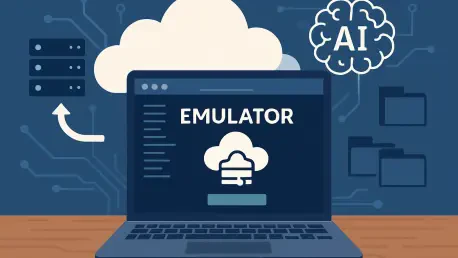

By using the Creative Commons CC0 license, AWS has made the emulator’s source code and evaluation suite publicly available to encourage community-driven cloud innovation. This landmark decision highlights a significant pivot in the cloud industry, where the barriers between proprietary infrastructure and local development are finally dissolving. The emulator represents more than just a convenient tool; it is a testament to the power of autonomous engineering, having been designed and maintained by sophisticated AI agents rather than traditional human development teams. By functioning as a high-fidelity local proxy, the software intercepts API calls from standard software development kits and command-line interfaces, effectively simulating a full-scale cloud environment on a developer’s own machine. This allows for an unprecedented level of freedom, as engineers can now iterate on complex cloud-native applications without the constant need for internet connectivity or the immediate financial commitment of active service accounts. This democratization of cloud access is poised to catalyze a new wave of experimentation across the global developer community.
Local Resource Simulation: Development Speed
Operational Efficiency: Benefits for High-Speed Workflows
The core strength of the AWS Emulator lies in its ability to deliver millisecond response times by operating entirely in-memory on a local workstation. This performance profile is a drastic improvement over traditional cloud testing, which often involves significant latency as requests travel to remote data centers and back. By simulating essential resources such as Amazon S3 buckets and Amazon DynamoDB tables locally, the emulator removes the friction typically associated with infrastructure provisioning. Developers can create, update, and delete resources nearly instantaneously, allowing for a much tighter feedback loop during the initial stages of application logic design. This immediate response is essential for maintaining a state of flow in software engineering, where any delay in the testing cycle can lead to a loss of focus and reduced productivity. Furthermore, because the environment is completely isolated and temporary, developers can experiment with destructive operations or complex configuration changes without any risk to their production cloud environments.
Building on this foundation of speed, the tool significantly enhances the efficiency of continuous integration and continuous delivery pipelines. In a standard cloud-based setup, multiple test jobs often compete for the same cloud resources, leading to potential contention issues or the need for expensive, dedicated test environments. The AWS Emulator resolves this by allowing each test runner to instantiate its own private, isolated version of the cloud services on the same physical hardware. This parallelization capability ensures that large-scale test suites can execute simultaneously without any cross-test interference, drastically reducing the total time required for code verification. Because the tool is provided at no cost, organizations can scale their testing infrastructure horizontally without worrying about the ballooning costs associated with high-frequency cloud deployments. This approach essentially shifts the entire testing process left, ensuring that the vast majority of architectural bugs are identified and resolved long before they ever reach a staging environment.
Automated Productivity: Enhancing AI-Native Coding Assistant Performance
A major driver for this local simulation technology is the recent surge in AI-native development assistants, such as Kiro and Claude Code. These tools are designed to operate autonomously, writing and testing code at a pace that far exceeds human capabilities. However, their primary bottleneck has historically been the time required to provision and communicate with remote cloud services. The AWS Emulator eliminates this barrier by providing these AI agents with an instantaneous environment for validation. When an AI agent can receive feedback on a code change in milliseconds rather than minutes, it can perform hundreds of iteration cycles in the same timeframe it would normally take to complete one. This synergy between AI-generated code and an AI-built simulation environment creates a highly optimized development ecosystem where software logic can be refined with incredible precision. This allows autonomous agents to explore a wider range of potential solutions and configurations, ultimately leading to more robust and optimized cloud-native software architectures for the modern enterprise.
This acceleration of the software development lifecycle represents a fundamental change in how engineering teams manage complex projects. By utilizing the emulator, teams can focus their high-cost cloud resources on final validation and production workloads rather than wasting budget on the early stages of trial and error. The local-first approach also facilitates better collaboration between human developers and their AI assistants, as both can work within the same high-speed environment. This reduced reliance on the real cloud during the building phase means that developers are no longer constrained by regional outages or network performance issues while they are coding. This newfound independence allows for more consistent progress on critical projects, regardless of the developer’s location or connection quality. As these AI-native tools continue to evolve, the importance of high-fidelity local environments will only grow, serving as the essential foundation for a future where software is written and verified almost entirely by automated systems, overseen by strategic human leadership.
AI-First Methodology: Future Industry Shifts
Autonomous Engineering: Utilizing Multi-Agent Systems
The creation process behind the AWS Emulator was as innovative as the tool itself, relying on a multi-agent AI ecosystem to ensure comprehensive coverage. The development started with Fidelity Test Agents, which used over four hundred AWS API models to generate thousands of ground-truth tests. These tests were rigorously validated against the live AWS cloud to establish exactly how each service should respond to various calls and parameters. Once the baseline was established, Issue Identification Agents took over, running these tests against the emulator’s codebase to find any discrepancies in behavior or status codes. When a gap was identified, it was automatically logged and passed to a fleet of Fix Implementation Agents. Working in parallel, these agents addressed thousands of daily issues by writing and refining code, which was then funneled through an automated pipeline for security and compatibility audits. This closed-loop system allowed the project to scale at a speed that would have been impossible for a manual engineering team, all while maintaining a high standard of quality.
To ensure that developers can rely on the accuracy of these simulations, the project includes an Emulator Evaluation Suite that provides transparent performance metrics. This suite compares the emulator’s responses against actual AWS behavior, providing fidelity scores for each supported service. Currently, the tool demonstrates high proficiency in control-plane operations, which involve administrative tasks such as creating or configuring resources. While data-plane operations are also supported, their accuracy can vary depending on the complexity of the service being simulated. AWS maintains a public log of these fidelity scores, allowing developers to see exactly where the emulator matches the cloud and where it might deviate. If a developer attempts to call a function that has not yet been fully implemented by the AI agents, the emulator returns a predictable error code. This level of transparency builds trust within the developer community, as it provides a clear roadmap of what is possible and where final testing in the actual cloud is still required for mission-critical applications.
Community Standards: Promoting Trust and Security
While the emulator provides a powerful local environment, it is crucial to recognize the boundaries of its current simulation capabilities. The tool is designed for logic and architectural testing but does not account for real-world production phenomena such as service throttling, regional latency differences, or unexpected cloud outages. Furthermore, a significant security distinction exists in the way Identity and Access Management is handled. The emulator currently does not enforce the complex permission structures found in a live AWS environment, meaning that a request that might fail in production due to insufficient IAM privileges could incorrectly succeed locally. Additionally, because the emulator runs with the permissions of the local user rather than inside a managed cloud sandbox, engineers must exercise caution when running untrusted or experimental code. If malicious scripts are executed within the emulator, they could potentially access or modify files on the host machine’s local file system. Understanding these limitations is vital for maintaining a secure and reliable development process.
The launch of the AWS Emulator established a new standard for how enterprises approach cloud-native development by merging AI-driven engineering with open-source accessibility. Organizations that integrated this tool into their internal developer platforms realized significant savings in cloud expenditure while simultaneously improving code quality through more frequent local testing. The project demonstrated that the role of the software engineer was effectively evolving from a manual coder into a strategic governor who managed fleets of AI agents to solve complex problems. To capitalize on this shift, development teams started prioritizing the automation of their local testing suites and invested in training for AI orchestration. Moving forward, it became clear that the integration of high-fidelity local environments was no longer optional for those seeking to remain competitive in an AI-accelerated market. Industry leaders encouraged a local-first mindset, ensuring that the cloud was reserved for final delivery, thereby maximizing both speed and security in the digital age.