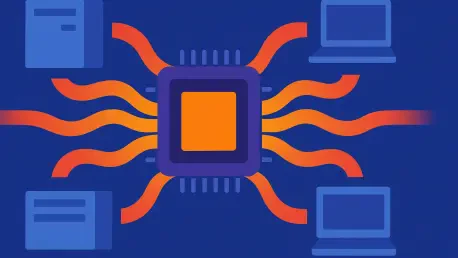

Microsecond-scale latency is the critical threshold for performing real-time quantum error correction and adaptive calibration during active computation. This specific time constraint has long stood as a formidable barrier, separating theoretical quantum advantage from practical, real-world utility in supercomputing centers. Anyon Computing recently addressed this challenge by introducing a revolutionary quantum control system built on the NVIDIA NVQLink interconnect. This breakthrough represents a fundamental shift in how hardware architects view the relationship between classical and quantum resources. Rather than operating as a distant, external device, the Quantum Processing Unit is now positioned as a native co-processor. This integration relies on a shared RDMA-over-Ethernet fabric, which allows for a unified memory space and streamlined communication. By removing the traditional communication silos, engineers have created a singular, cohesive machine that functions with the efficiency required for the most demanding hybrid workloads currently seen in the industry.
Architectural Synergy: Integrating Quantum Units as Native Co-Processors
The Shift Toward Unified Hardware Fabrics
The central theme of this architectural evolution involves the implementation of high-bandwidth, low-latency networking that treats quantum nodes with the same priority as classical accelerators. By utilizing NVIDIA’s NVQLink technology, Anyon Computing has successfully minimized the physical and logical distances between different computing modalities. This setup allows for the direct transfer of data between GPU memory and the quantum control plane without the excessive overhead typical of standard PCIe-based connections. Such an approach is essential for executing algorithms that require rapid feedback loops, where classical results must immediately influence the next set of quantum operations. In this environment, the quantum processor functions as a truly integrated component of the cluster, benefitting from the same robust management and data movement protocols that define modern high-performance computing. This shift ensures that the system can scale vertically as qubit counts increase and horizontally as more nodes are added.
Software Synergy and Programming Efficiency
Software accessibility plays an equally vital role in realizing the benefits of this low-latency hardware, and the native support for the NVIDIA CUDA-Q platform provides a streamlined path for developers. This system allows programmers to write hybrid code that executes seamlessly across CPUs, GPUs, and QPUs without the performance-degrading delays associated with per-call recompilation. By supporting industry standards such as OpenQASM and the Quantum Intermediate Representation, the control system offers a versatile development environment that caters to both research and commercial applications. The ability to perform mid-circuit measurements and classical branching in real-time opens the door to more sophisticated error correction strategies that were previously impossible to implement. Consequently, the convergence of high-level programming models with deep hardware integration allows for the deployment of complex, state-aware quantum circuits that can adjust their parameters dynamically based on environmental noise and computational feedback.
The New Engineering Paradigm: AI-Driven Systems Development
Autonomous Agents and the Future of Hardware Verification
One of the most striking aspects of this technological leap is that the control system itself was designed largely by autonomous AI agents, marking a milestone in computer-aided engineering. These agents were responsible for the entire lifecycle of the hardware design, ranging from the initial register-transfer-level code to the complex hardware-in-the-loop verification processes. This autonomous design methodology allowed for rapid iteration and the optimization of signal paths that would have taken human engineering teams significantly longer to finalize. By simulating millions of potential configurations, the AI agents identified the most efficient ways to utilize commodity networking components and phase-locked controllers to maintain coherence. This trend highlights a future where the complexity of quantum-classical integration is managed by the same artificial intelligence technologies that these systems are eventually intended to accelerate. This recursive development cycle ensures that the hardware remains adaptable to the evolving requirements of next-generation quantum bits.
Strategic Pathways for Production-Ready Quantum Utility
The successful deployment of this AI-engineered control plane demonstrated that the path to quantum utility lies in the tight coupling of specialized hardware with accelerated classical computing. Industry leaders moved toward a model where quantum systems were no longer treated as experimental curiosities but as essential tools for high-value industries. To prepare for this shift, organizations began prioritizing the acquisition of personnel who understood both quantum mechanics and classical software engineering. They also invested in infrastructure that supported hybrid data center architectures, ensuring that their current GPU clusters could easily incorporate quantum nodes as they became available. By focusing on low-latency interconnects and unified programming environments, the industry effectively bridged the gap between theoretical physics and production supercomputing. These developments set the stage for more resilient quantum operations, allowing for the execution of large-scale workloads that paved the way for breakthroughs in chemistry, materials science, and cryptography.