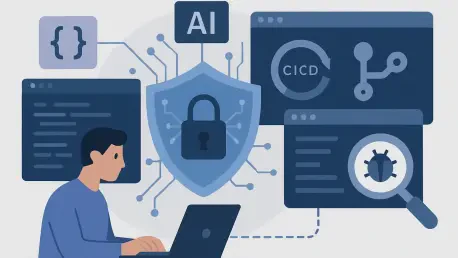

The pull request remains the only consistent location to scan code, regardless of whether a human developer or an AI agent authored it. As engineering teams in 2026 navigate a landscape where autonomous digital assistants generate or heavily augment nearly half of all active codebases, the traditional manual peer review process faces an unprecedented scaling crisis. While human oversight was once sufficient to catch obvious flaws, the sheer velocity of modern development cycles has turned the human bottleneck into a primary risk factor. Automated coding agents can produce thousands of lines of functional code in seconds, yet recent industry benchmarks reveal a disturbing trend: while these agents achieve high functional correctness, their security posture often lags significantly behind. Without a standardized, automated checkpoint, vulnerabilities such as insecure direct object references or flawed cryptographic implementations can easily slip into production branches. The pull request serves as this essential frontier, providing a unified stage where security policies are enforced uniformly across every contribution, ensuring that the speed of innovation does not compromise the integrity of the software supply chain. By centralizing analysis at this juncture, organizations can establish a predictable and auditable security trail that satisfies both internal governance and increasingly stringent external regulatory requirements for secure software development.
1. Advantages of Pull Request AI SAST
Integrating AI Static Application Security Testing into the pull request workflow addresses the fragmentation inherent in modern development environments. Developers and AI agents use a wide array of integrated development environments, specialized coding assistants, and local configurations, making it virtually impossible to enforce security at the individual workstation level. By moving the primary security gate to the pull request, organizations ensure that every line of code undergoes a rigorous, centralized evaluation before it can impact the shared codebase. This approach is vital given the current state of software production, where the volume of code being committed has outpaced the capacity of security teams to perform manual audits. When an AI agent submits a diff, it often lacks the broader context of the application’s business logic, potentially introducing subtle flaws that appear harmless in isolation. A centralized SAST scan provides the necessary bird’s-eye view, identifying complex vulnerabilities that might otherwise be missed by local tools that prioritize development speed over deep security analysis. This centralized oversight creates a level playing field where all code, regardless of its origin, must meet the same high standards for safety and reliability.
Furthermore, the implementation of automated reviews at the pull request level is no longer just a best practice but a foundational requirement for compliance in regulated sectors. Industry frameworks, such as the NIST Secure Software Development Framework, specifically highlight the necessity of analyzing source code to identify and remediate vulnerabilities early in the life cycle. By automating this process, companies generate a persistent and verifiable record of security diligence for every change introduced to the system. This documentation is invaluable during audits, providing clear evidence that security checks were performed consistently and that identified risks were addressed before merging. Beyond compliance, the primary advantage lies in catching sophisticated flaw classes, such as broken access control and business logic errors. Unlike traditional rule-based scanners that struggle with these nuances, modern AI engines can interpret the intent of the code and its interaction with existing services. This allows for the detection of vulnerabilities that do not follow a simple pattern, protecting the organization from complex exploits that leverage the unique logic of its specific application architecture.
2. The Security Hierarchy
Effective security in 2026 relies on a multilayered hierarchy where AI SAST is deployed across different stages of the development life cycle to catch issues at varying speeds and depths. At the very front of this hierarchy are pre-commit hooks, which serve as the first line of defense by scanning for hardcoded secrets, API keys, and credentials before they ever enter the version-control history. These checks must be exceptionally fast, completing in seconds to avoid disrupting the developer’s immediate flow. Parallel to this, the IDE and coding-agent loop provides real-time feedback, acting as a security linter that alerts the author to obvious flaws as they write or generate code. However, while these early interventions are useful for catching low-hanging fruit, they often lack the full repository context required for deep data-flow analysis. The pull request serves as the critical middle layer in this hierarchy, acting as the definitive backstop. It is here that the system performs a comprehensive trace of data across the entire repository, identifying how a seemingly small change in one file might create an exploitable path in another. This stage balances the need for thoroughness with a reasonable processing time of a few minutes, ensuring high-fidelity results before the code is integrated.
Once the pull request is approved and integrated, the security hierarchy extends into the post-merge and maintenance phases to ensure long-term codebase health. The merge to the main branch triggers a baseline refresh, which updates the system’s model of the application to include the latest changes. This updated baseline is crucial because it serves as the reference point for all subsequent pull request scans, allowing the engine to distinguish between pre-existing issues and those newly introduced by the next set of changes. Complementing this are scheduled full scans, which run outside the critical path of daily development. These deeper analyses can take hours to complete, allowing them to explore complex, multi-component interactions and apply the latest detection logic to code that may not have been touched in months. This holistic approach ensures that even if a new vulnerability type is discovered today, the system will eventually flag it in older parts of the application. By layering these different scanning methods—from near-instant pre-commit checks to exhaustive scheduled audits—security teams can maintain a robust defense-in-depth strategy that adapts to both the speed of modern development and the evolving threat landscape.
3. Difference Between Diff-Aware and Baseline Scans
A fundamental challenge in pull request security is performing an analysis that is both fast enough for CI/CD and deep enough to be accurate. This is where diff-aware scans prove their value by focusing specifically on the lines of code that have been added or modified. However, a common misconception is that a diff-aware scan only needs to look at the changed files. In reality, vulnerabilities often lie in the interaction between the new code and the existing foundation of the repository. For example, a developer might add a new API route that appears perfectly secure on its own, but this route might pass user-controlled input to an existing database helper function that was never designed to handle untrusted data. A scan that only examines the diff would miss this connection entirely. Therefore, modern AI SAST engines must ingest the entire repository to build a semantic model of the application, even if they only report findings relevant to the current pull request. By tracing the path of data from the new entry point all the way to a potentially dangerous sink in an unchanged file, the system provides a complete picture of the security impact of the change, ensuring that clean code does not hide systemic risks.
To make this deep analysis actionable for developers, the system compares the results of the current scan against an established baseline of the target branch. This comparison is critical for maintaining developer trust, as it allows the tool to filter out inherited vulnerabilities that existed long before the current pull request was opened. Without this deduplication process, a developer making a minor fix could be overwhelmed by hundreds of unrelated security warnings from the rest of the project, leading to alert fatigue and eventually causing them to ignore the security tool. By leveraging a baseline scan, the AI engine can isolate the true delta of security risk—the findings that would not exist if the pull request were not merged. This scoping ensures that developers are only held responsible for the code they are currently modifying, which significantly increases the likelihood that they will address issues promptly. Furthermore, recording these PR-specific runs separately from main branch monitoring allows security teams to track the cleanliness of incoming code over time, providing clear metrics on how many new vulnerabilities are being caught and neutralized before they can pollute the production environment.
4. Elements of an Effective PR Comment
The effectiveness of a pull request security scan is ultimately measured by how easily a developer can understand and address the findings. A high-quality security comment must function as a self-contained guide, providing all the information necessary to resolve the issue without requiring the developer to jump between different tools or dashboards. This starts with a clear, plain-language description of the vulnerability, its location, and the severity of the risk it poses. Crucially, the comment must provide the data flow path, showing exactly how untrusted input moves from the source to a dangerous sink. When a developer can see the step-by-step trace through the code, they are much more likely to accept the finding as legitimate rather than dismissing it as a false positive. Furthermore, providing a triage verdict—classifying the issue as a true positive, false positive, or unknown—gives the developer an immediate sense of urgency. When the engine also includes a context-aware remediation suggestion or a specific code fix, it transforms a security warning into an actionable task. This reduces the cognitive load on the developer, allowing them to verify the fix and apply it as a new commit with minimal friction, thereby accelerating the overall development cycle.
Beyond the content of individual findings, maintaining strict comment hygiene is essential for keeping pull request conversations productive and uncluttered. If a security tool posts dozens of individual comments for a single root cause, it quickly becomes a nuisance, leading reviewers to scroll past critical information. An intelligent integration should consolidate related findings and post a single, comprehensive comment that addresses the core issue. Furthermore, the tool should be dynamic: when a developer pushes a new commit to address a security concern, the existing comment should be updated or automatically resolved to reflect the current state of the code. Stacking multiple comments for the same file as the PR evolves creates a confusing history that is difficult for both authors and reviewers to navigate. By automatically resolving comments once a fix is verified, the tool provides a clear signal that the security gate has been passed, allowing the human review process to focus on design and logic rather than technical debt. This level of automation and clarity ensures that security remains a collaborative part of the development process rather than a noisy, external imposition that developers feel the need to bypass or ignore.
5. Implementation Levels for Merge Policies
Establishing a successful merge policy requires a strategic, phased approach that balances security requirements with the need for development velocity. Most organizations begin with an observation mode, where the AI SAST engine provides feedback on pull requests without impacting the build status. This initial phase is crucial for calibration, allowing both security teams and developers to gain confidence in the tool’s accuracy and adjust detection rules to suit the specific context of their applications. Once the system has proven its reliability, the next level of enforcement involves failing the security check while still allowing the merge to proceed if necessary. This serves as a strong signal to the developer that a fix is required, but it does not completely halt the workflow for edge cases. The final and most mature level of enforcement is a mandatory block, where a failing security check prevents the pull request from being merged. This is typically managed through branch protection rules, ensuring that no high-severity vulnerabilities can reach the main branch. By gradually escalating these enforcement levels, organizations can introduce rigorous security standards without causing widespread disruption or resistance among the engineering staff.
To prevent these policies from becoming a source of frustration, it is essential to base enforcement actions on the triage verdict rather than just the severity level. Traditional scanners often fail builds based on generic severity labels, which frequently leads to developers being blocked by false positives. In contrast, a modern AI-driven approach allows for a more nuanced policy: blocking merges only for findings that have been verified as true positives. For findings categorized as unknown, the policy should trigger a notification to the security team for a quick manual review while allowing the developer to continue their work. Findings confirmed as false positives should never block a build. Additionally, a robust exception path must be available for cases where a developer disagrees with a finding. Providing a simple mechanism for a developer to dispute a verdict—along with a brief justification—ensures that the security process remains flexible and transparent. When security teams commit to reviewing these disputes within a set turnaround time, it fosters a culture of mutual respect and shared responsibility. This intelligent enforcement strategy ensures that the security gate remains a reliable filter for genuine risks rather than an arbitrary barrier that developers eventually learn to circumvent through workarounds or policy overrides.
6. Maintaining Pipeline Velocity
In the high-speed development landscape of 2026, security tools must operate at the speed of code or risk being disabled by frustrated engineering teams. Maintaining pipeline velocity requires a highly optimized integration strategy that minimizes the time a developer spends waiting for scan results. One of the most effective tactics is to run security jobs in parallel with standard automated tests and build processes, rather than making them sequential dependencies. This ensures that the total time for the pull-request check is determined by the longest-running job, not the sum of all jobs. Furthermore, the CI/CD pipeline should be configured to automatically cancel superseded runs. If a developer pushes a new commit while a security scan is already in progress for a previous one, the outdated scan should be terminated immediately to free up compute resources and ensure the developer sees only the most relevant results. Implementing path filters is another essential optimization; by skipping security scans for changes that only affect documentation or configuration files, teams can avoid unnecessary processing and reduce noise in the pipeline. These small but impactful configurations ensure that the security infrastructure is both efficient and respectful of the developer’s time.
Beyond pipeline configuration, the underlying architecture of the AI engine itself plays a significant role in maintaining speed at an enterprise scale. Modern engines often utilize a specialized Code API, which creates a semantic model of the application—including call graphs and data flow relationships—before the scan even begins. Instead of processing the entire codebase through a large language model for every pull request, the system queries this pre-built model to analyze only the specific changes introduced by the code differences. This approach is significantly faster and more cost-effective than generic AI analysis, as it limits the scope of the heavy lifting to the parts of the code that have actually changed. Supporting a wide range of languages through this semantic modeling ensures that large, polyglot organizations can maintain consistent scanning performance across different tech stacks. The result is a security check that typically completes in just a few minutes, often delivering its findings before a human reviewer has even had a chance to open the pull request. By combining efficient CI/CD patterns with an intelligently architected analysis engine, security teams can provide deep, comprehensive coverage without introducing any noticeable lag in the software delivery lifecycle, proving that robust security and high velocity can indeed coexist.
7. Security and Permissions in CI/CD
Integrating AI-driven security tools into a CI/CD pipeline necessitates a rigorous evaluation of the pipeline’s own attack surface. Because security scanners require access to source code and have the ability to post comments or fail builds, they can become high-value targets for attackers. A primary concern is managing pull requests from external contributors or forks, as these changes contain code that the organization does not yet control. If a pipeline is misconfigured to run these untrusted changes with high-level privileges, it creates a significant risk of Poisoned Pipeline Execution, where an attacker can steal secrets or compromise the build environment. To mitigate this, standard practice involves using triggers that naturally withhold repository secrets from forks and limit the scope of the workflow token. It is critical to resist the urge to switch to more permissive triggers merely to simplify the scanning process. Instead, organizations should implement a manual approval step where a maintainer must review and authorize the workflow to run for outside contributors. This human-in-the-loop verification ensures that the automated security engine only processes code that has undergone a preliminary sanity check, protecting the integrity of the internal infrastructure.
Furthermore, the principle of least privilege must be applied to every aspect of the CI/CD environment. Security jobs should be granted only the minimum permissions required to perform their tasks: read access to repository contents, write access for posting pull request comments, and the necessary tokens for identity verification. In 2026, the industry has largely moved away from long-lived, static scanner tokens in favor of keyless authentication methods like OpenID Connect. By using OIDC, the CI platform generates short-lived, verifiable tokens for each job, eliminating the risk associated with leaked or stolen credentials. Additionally, security teams should mandate the pinning of all third-party GitHub Actions and pipeline components to a specific, full commit SHA rather than a mutable version tag. While tags are convenient, they can be repointed by a malicious actor to a compromised version of the action, leading to a supply chain attack. A commit SHA is immutable, providing a guarantee that the code being executed is exactly what the security team audited. Finally, it is essential to maintain a clear record of what code leaves the runner during an AI analysis step. Documenting the data flow between the CI environment and the AI provider ensures that the organization can maintain transparency about its data handling practices.
8. Measuring Integration Success
To ensure that AI SAST is delivering genuine value and not just adding overhead, organizations must track a set of key performance indicators that measure both security impact and developer experience. One of the most important metrics is the rate of blocked changes, which tracks how many pull requests are prevented from merging due to security findings. If this rate is excessively high, it may indicate that the security policy is too aggressive or that the tool is generating too much noise, which can lead to friction between security and engineering teams. Alongside this, tracking the resolution time within a pull request provides insight into the clarity and actionability of the tool’s findings. When security comments are clear and provide direct remediation advice, developers can often resolve the issue in a matter of hours. Conversely, if it takes days for a developer to address a finding, it suggests that the tool’s output is confusing or that the suggested fixes are difficult to implement. By monitoring these metrics, security leaders can identify specific repositories or teams that may need additional training or more finely tuned detection rules, ensuring that the security process remains a help rather than a hindrance to delivery goals.
Another critical measure of success is the pre-merge correction rate, which calculates the percentage of identified vulnerabilities successfully resolved before the code reaches the main branch. A high correction rate is the ultimate goal of pull request scanning, as it proves that the tool is preventing security debt from accumulating in the core codebase. This should be balanced against the dismissal rate, which tracks how often developers mark findings as false positives or not applicable. A rising dismissal rate is a warning sign that the tool’s accuracy is declining or that developers are losing trust in its output. When analyzed together, these trends provide a comprehensive view of the health of the security integration. For instance, a falling dismissal rate combined with a stable correction rate indicates that the AI SAST engine is becoming more accurate and that developers are actively engaging with its findings. Finally, organizations should monitor the leakage rate—the number of new issues found during scheduled full scans that were missed by previous pull request checks. This helps identify gaps in the PR scanning logic or areas where the whole-repository context was not fully captured. By maintaining a data-driven approach to security, organizations can continuously refine their strategies for an automated digital landscape.
9. Actionable Strategies for Implementation
Moving forward, organizations should prioritize a structured rollout that emphasizes developer enablement and collaborative governance. The first actionable step is to conduct a baseline scan across all critical repositories to understand the current state of the codebase without immediately blocking active development. This allows security teams to identify the most common vulnerability patterns and tailor their training programs to address those specific gaps. Once the baseline is established, teams should implement a comment-only feedback loop to familiarize developers with the AI output. It is also highly effective to appoint security champions within development teams who can act as the first point of contact for interpreting findings and refining policies. These champions bridge the gap between security requirements and practical coding constraints, ensuring that the integration feels like a team effort rather than a top-down mandate. By investing in these human-centric strategies alongside technical automation, organizations can build a sustainable security culture that views AI SAST as a valuable asset for writing higher-quality, more secure code from the very first commit.
In conclusion, the transition to AI-integrated security reviews proved to be a pivotal shift for engineering teams aiming to balance the unprecedented speed of 2026 development with the necessity of robust protection. By centralizing analysis at the pull request, organizations successfully created a unified defense that addressed the risks of both human-written and agent-generated code. This approach moved beyond the limitations of legacy static analysis, leveraging the semantic depth of AI to identify sophisticated business logic flaws and access control errors that were previously impossible to automate. The implementation of tiered merge policies and developer-centric feedback loops ensured that security became a seamless part of the workflow rather than a bottleneck. Ultimately, the successful integration of AI SAST into the CI/CD pipeline demonstrated that high-velocity innovation and rigorous security standards were not mutually exclusive but were, in fact, mutually reinforcing. As development cycles continued to accelerate, the foundations laid by these automated, diff-aware strategies provided the necessary resilience to navigate an increasingly complex and automated digital landscape with confidence and operational clarity.