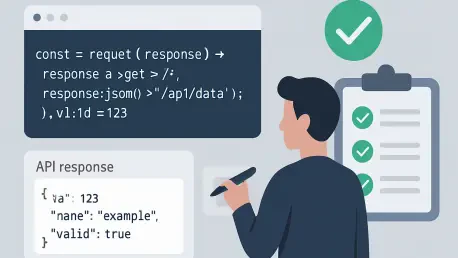

Basic assertions serve as a primary layer of verification to confirm endpoint stability and data presence before performing deeper structural checks. In the current landscape of 2026, where microservices dominate the software architecture, the reliability of communication between these services hinges entirely on the accuracy of API responses. When developers and testers utilize Playwright with TypeScript, they gain access to a powerful set of tools designed to ensure that every byte of data returned by a server aligns with the expected business logic. This process is not merely about checking if a request was successful; it involves a meticulous examination of the payload to safeguard against silent failures that could propagate through an entire ecosystem. Whether dealing with GET requests for information retrieval or POST requests for data creation, the validation strategy remains a critical safeguard. By establishing a robust framework for response verification, teams can confidently deploy updates, knowing that their automated suites will catch even the most subtle deviations in data integrity or structural consistency before they ever reach a production environment.
1. Confirm the Response Format: Guaranteeing Consistency
Structure checks are the bedrock of any sophisticated API testing strategy because they guarantee that the service consistently adheres to a predefined format. In the high-velocity development environments of 2026, backend engineers often modify data models to accommodate new features, which can inadvertently introduce breaking changes for frontend clients or third-party consumers. By verifying the response structure, teams ensure that the contract between the provider and the consumer remains intact, even when the underlying code changes. This involves checking that the JSON payload contains all the required top-level keys and that nested objects maintain their expected hierarchy. If a field like “order_status” is suddenly renamed to “status,” a structural test will catch the discrepancy immediately, preventing a cascade of errors in downstream systems. Such proactive verification is essential for maintaining trust in a distributed architecture where multiple teams rely on the stability of shared endpoints and common data definitions.
Beyond just checking for existence, validating the format involves ensuring that specific mandatory fields within an object are present and correctly positioned. When an API returns a list of items, such as orders or products, the structure check should confirm that every item in that list follows the same blueprint. This level of scrutiny goes beyond the status code; an API might return a 200 OK while failing to provide the actual data required for the application to function. By enforcing a strict structural validation, testers can identify missing keys that might otherwise cause the application to crash or display incorrect information. TypeScript enhances this process by providing a type-safe environment where expected structures can be defined as interfaces, allowing the test suite to act as a living documentation of the API’s current state. This consistency is vital for maintaining a robust CI/CD pipeline where automated tests act as the final gatekeeper before code reaches the production environment.
2. Execute Primary Verifications: Establishing Initial Stability
Executing primary verifications marks the first real hurdle for an API response after the connection has been established. This stage focuses on the immediate feedback provided by the server, such as the success message embedded within the body or the confirmation text that indicates a requested action was performed. For instance, when a user creates a new record, the response might contain a message saying “Order created successfully.” Verifying this specific string ensures that the business logic on the server-side has progressed to the intended state. It is a simple yet powerful way to distinguish between a generic successful response and one that truly fulfills the specific intent of the request. Utilizing Playwright’s assertion library, one can easily check if the response body contains these specific keywords. This layer of testing acts as a sanity check, providing quick feedback to the developer during the early stages of the testing lifecycle before more complex data comparisons begin.
Another crucial aspect of primary verification is the validation of data types and the general presence of content. It is not enough for a field to exist; it must also exist in the correct format, such as an array for lists or a number for prices. For example, if an endpoint is designed to return a collection of orders, the “orders” field must be validated as an array to prevent processing errors in the client-side code. Furthermore, checks must be implemented to ensure that the response is not empty when data is expected. Verifying that the returned array contains at least one record confirms that the database query was successful and that the system is returning actual information rather than just a successful but empty shell. This ensures that the test suite remains resilient against false positives where a test passes because no errors occurred, even though no data was actually retrieved. High-quality assertions at this level provide the foundation for deeper, more granular data inspection later on.
3. Validate Specific Data Points: Verifying Critical Identifiers
Detailed validation focuses on specific data points that are critical to the system’s operational logic, particularly unique identifiers like IDs. In the context of 2026 software ecosystems, these identifiers serve as the primary link between different services, making their accuracy and presence non-negotiable. When an API creates an order or a user, it typically generates a unique ID that is used for all subsequent interactions, including updates, retrievals, and deletions. Testing must therefore verify that these IDs are not only present but also follow the expected format, such as a non-empty string or a positive integer. If an ID is missing or returned as a null value, any following test steps or real-world operations will inevitably fail. By asserting that the “id” field contains a valid, system-generated value, the test suite confirms that the backend has correctly persisted the data and is ready for further workflows. This level of detail is what separates a basic connectivity test from a comprehensive functional validation suite.
Moving beyond identifiers, cross-referencing request-specific details is a vital step in ensuring that the API is actually returning the information that was requested. If a test sends a GET request for a specific “user_id,” the verification logic must confirm that the data in the response matches that specific user and not a random entry from the database. This involves checking fields such as product names, quantities, or prices against the original input parameters provided in the request payload. For example, if a user orders a “Smart Watch,” the response must explicitly list that product name in the order details. This alignment proves that the API’s filtering and data retrieval logic is functioning correctly across the entire stack. By validating these specific values, testers can detect subtle bugs where the API might be returning the correct structure and a success message but incorrect or mismatched data. This rigorous checking ensures that the application remains reliable and that users receive the exact services they have requested.
4. Compare Objects and Collections: Utilizing Flexible Matchers
Comparing objects and collections requires a flexible approach to accommodate dynamic API responses that might change slightly over time. Playwright provides specialized tools like the “toMatchObject” matcher, which allows for partial verification of a response body. This is particularly useful when an API returns a large object with dozens of fields, but only a few are relevant to the current test case. Instead of asserting every single property, which can lead to brittle tests that break whenever an unrelated field is added, testers can focus on a specific subset of data. This partial matching strategy ensures that the essential keys and values are present while ignoring extra metadata that does not impact the core functionality being tested. It creates a balance between thoroughness and maintainable code, allowing the test suite to remain stable even as the API evolves. This methodology is highly effective for validating complex responses from modern microservices that often aggregate data from multiple backend sources into a single large JSON payload.
When dealing with lists of items, Playwright’s collection matchers like “expect.arrayContaining” and “expect.objectContaining” offer a powerful way to verify content without needing to know the exact order or total size of the list. These tools allow testers to search through an array to find at least one item that matches a specific set of criteria. For instance, in a list of a hundred orders, a test might only need to verify that a specific order ID exists with a specific product name. This flexibility is crucial for testing production-like environments where the data in the database may be changing constantly due to other concurrent activities. By using these matchers, the verification logic becomes much more resilient, as it does not rely on a fixed index or a static snapshot of the database. It confirms that the system can still find and return specific items among a sea of other data. This approach significantly reduces the overhead of maintaining test data while still providing high confidence in the accuracy of the search and retrieval functions.
5. Implement Best Practices for Reliability: Layering the Assertions
Implementing best practices for reliability ensures that the automation suite remains a trusted tool rather than a source of flaky results. One of the most effective strategies is to use a layered assertion approach, where the most fundamental checks are performed before the more complex ones. This sequence typically begins with enforcing a successful status code through configurations like “failOnStatusCode: true” in the Playwright request options. By doing this, the test will immediately halt if the server returns a 4xx or 5xx error, preventing the execution of subsequent logic that would inevitably fail anyway. This early exit saves time and provides a clearer indication of the root cause of the failure, distinguishing between a server downtime issue and a data validation error. In 2026, where CI/CD pipelines require rapid feedback loops, these optimizations are essential for keeping the development process moving forward without being bogged down by misleading test results or long execution times.
Building on this foundation, a professional assertion strategy involves organizing checks in a logical sequence that reflects the hierarchy of the data. After confirming the status code, the next layer should verify the overall response message and then the integrity of the data collections, such as the length of an array. Only after these basic conditions are met should the test proceed to validate specific nested values and business logic. This structured approach makes the tests much easier to debug because the point of failure clearly indicates where the problem lies within the response lifecycle. Moreover, this layering prevents the “false positive” scenario where a test might pass because it incorrectly identifies an empty object as valid. By ensuring that every stage of the validation—from the initial HTTP handshake to the final field-level comparison—is handled with precision, the test suite becomes a robust guardian of the application’s functional requirements, maintaining high quality in a fast-paced environment.
6. Pull Information from the Response: Supporting Dynamic Workflows
Pulling information from the response is a standard pattern in modern API testing that enables dynamic workflows and end-to-end validation. In many scenarios, the data returned by one API call is required as an input for the next, such as using a newly created “order_id” to fetch the details of that specific order in a separate GET request. This process of data extraction turns a series of isolated tests into a cohesive flow that mimics real-world user behavior. Playwright makes this extraction straightforward by allowing testers to parse the response body into a JSON object and then access its properties using standard TypeScript dot notation. Before the data is used in a subsequent step, it is a best practice to verify that the value is not null or undefined, ensuring that the chain of operations does not break midway. This dynamic approach allows for more comprehensive testing of complex business processes that span multiple endpoints, providing a much higher level of assurance than testing each API in a vacuum.
Furthermore, extracted data serves as an invaluable tool for debugging and logging within the automated test environment. By isolating specific values like product names or timestamps and printing them to the console during execution, developers can gain immediate visibility into the data being processed by the system. This is particularly helpful when troubleshooting intermittent issues that only occur with certain data sets. These extracted values can also be saved as variables to be used in assertions later in the test or even compared against data from different sources, such as a database query. In 2026, as APIs become more interconnected, the ability to pass data seamlessly between different stages of a test suite is a critical skill for any automation engineer. It allows for the creation of sophisticated test scenarios that can adapt to the dynamic nature of cloud-based services, ensuring that the entire system works together as intended, from the initial request to the final confirmation of data persistence.
7. Embed Response Details in Playwright Reports: Improving Visibility
Embedding response details in Playwright reports is a transformative practice that brings transparency to the results of automated test suites. By default, standard test reports typically only show whether a step passed or failed, which often leaves developers guessing about the actual data that caused a failure. By utilizing the “testInfo” fixture in Playwright, testers can capture the full metadata of an API response, including the status code, status text, and the various headers returned by the server. This information is crucial for diagnosing issues related to authentication, caching, or rate limiting, which might not be immediately obvious from the response body alone. Capturing this metadata during the test execution ensures that if a failure occurs in a remote CI environment, all the necessary information is readily available for analysis without needing to re-run the tests locally. This level of detail turns a simple pass/fail notification into a comprehensive diagnostic document that speeds up the resolution of complex backend issues.
The final step in enhancing the reporting process is to consolidate all the captured metadata and the actual response body into a single, well-formatted JSON object and attach it to the report. Using the “testInfo.attach()” method, this payload can be included in the final HTML report, complete with a descriptive label like “Full API Response.” To ensure the information is readable, the JSON should be stringified with proper indentation, making it easy for a human to scan and identify discrepancies. This practice is especially beneficial when working in large teams where a developer who did not write the test might be the one responsible for fixing a reported bug. Having the exact response that the API returned at the moment of failure provides undeniable evidence of the system’s behavior, eliminating the need for back-and-forth communication between teams. In 2026, this transparency is a cornerstone of high-performance engineering cultures, as it fosters accountability and provides a clear path toward continuous improvement of the software product.
8. Run the Test Suite: Executing and Reviewing Results
Running the test suite in Playwright is designed to be a seamless and efficient experience for developers and automation engineers alike. To trigger the execution of the written scripts, a standard terminal command is used, which initiates the Playwright runner and begins the process of sending requests to the specified API endpoints. This execution phase is where all the defined assertions and data validations are put to the test against the live or staging environment. The runner provides real-time feedback in the terminal, showing the progress of each test case and highlighting any immediate failures. In 2026, the speed of these test runners has been optimized to handle hundreds of requests in a matter of seconds, making it possible to integrate full API validation into every code commit. This rapid execution ensures that any regressions are identified within minutes of being introduced, allowing the development team to address them before they can impact the wider system or delay the overall release schedule for new features.
After the test suite concluded, the team analyzed the generated reports to implement several strategic improvements for the upcoming development cycles. The insights gained from the detailed response attachments allowed engineers to refine the data models and optimize endpoint performance, leading to a more resilient architecture. Moving forward, the integration of schema validation libraries alongside these Playwright assertions was identified as a key step to further automate the detection of structural anomalies. This shift toward a more proactive, data-driven testing culture ensured that every change to the API was vetted against strict integrity standards before reaching any user. By adopting these layered verification techniques, the organization successfully minimized the risk of breaking changes and established a scalable framework for future service expansions. These actionable steps provided a clear roadmap for enhancing the quality of the software ecosystem, proving that robust API validation was not just a technical necessity but a critical driver of overall business success in the modern digital landscape.