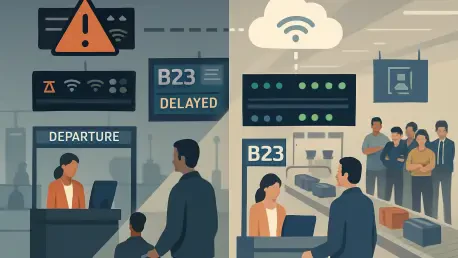

A single network outage can ripple from a departure gate to the baggage hall and onward to a crowded immigration queue, turning a routine day into a sequence of missed connections, delayed turnarounds, and costly service recoveries that test the patience of travelers and strain airline and airport teams alike. That vulnerability has become more pronounced as terminals fill with digital services—from passenger Wi‑Fi and smart signage to crew apps and IoT sensors—that all depend on clean, resilient connectivity. Responding to this pressure, SITA has launched a managed, cloud-native Campus Network built with HPE Aruba Networking to consolidate wired and wireless operations under one control plane. The offer targets a longstanding pain point: fragmented, multi-vendor networks and on-premises servers that are hard to manage, slow to adapt, and expensive to secure. By unifying management, automating remediation, and standardizing security, the platform promises a measurable lift in reliability and agility without forcing disruptive overhauls.
Why It Matters
Aviation’s digital backbone has historically grown by accretion, with terminal expansions adding separate LAN segments, stand-up projects deploying isolated Wi‑Fi, and new baggage or gate systems attaching their own management consoles. Each increment solved an immediate need but multiplied long-term complexity. When an application stutters or a switch fails, teams must swivel between tools, sift through siloed logs, and coordinate vendors with only partial visibility. The cost is not only higher operating spend; it is the operational drag of slow root-cause analysis that prolongs disruption and erodes trust in airport services. As passenger volumes climb and regulatory expectations tighten, tolerance for downtime has narrowed to minutes rather than hours, turning network resilience into a frontline differentiator.
This context makes a centralized, aviation-specific network fabric more than a technical refresh. It is a strategic pivot toward global visibility and consistent control across terminals, aprons, hangars, and offices where workflows intersect. During peak travel periods, traffic patterns are volatile: a burst of boarding passes, a surge of video analytics, and a wave of baggage scans can collide. AI-assisted orchestration that balances loads and preempts faults can prevent those spikes from cascading into failures. Moreover, standardizing configuration and security policy from a cloud console reduces the variance that creeps in as stations evolve at different speeds. The result is not abstract efficiency but tangible gains: steadier passenger Wi‑Fi, more reliable ground systems, and fewer incidents that escalate into headlines.
What the SITA Campus Network Is
The SITA Campus Network is a managed service that brings LAN and Wi‑Fi under a single cloud control plane using HPE Aruba Networking technology, replacing scattered appliances and on-prem management servers with centralized dashboards. It is delivered as a standardized platform tailored for airport and airline environments, from curb to gate and onward to maintenance bays and operations centers. Instead of separate provisioning workflows and security postures for wired and wireless domains, the platform applies unified policies, identity controls, and performance baselines. That consolidation opens the door to consistent experiences across a global footprint, allowing operators to set targets once and propagate them everywhere—hub, outstation, or partner-managed facility—without recreating artisanal setups in each location.
Equally important, the platform is designed to live alongside what airports and airlines already operate. Many critical systems—CUPPS and CUSS deployments, baggage sorters, building automations, and flight information displays—cannot be replaced overnight. Backward compatibility and standards-based interoperability let teams modernize in phases, de-risking transitions by running new and legacy segments in parallel. New gates or lounges can be lit up through automated templates, while existing areas migrate on a schedule aligned with construction timelines, staffing, and contracts. For organizations under budget pressure, that staged approach avoids dramatic capital spikes, shifting effort toward predictable operating spend and allowing gains in uptime and productivity to start compounding early in the rollout.
Architecture, AI Operations, and Security
At the core sits a cloud-native architecture that centralizes intelligence for orchestration, analytics, and policy control, while pushing data plane functions to edge switches and access points tuned for airport conditions. This separation means global teams see the same live topology, utilization, and health metrics across sites, enabling faster triage when incidents occur and simpler planning when expansions are proposed. AI-driven operations analyze device telemetry, traffic flows, and user experience indicators to spot anomalies—packet loss on a busy concourse, sticky clients near a lounge, a misconfigured SSID at a remote gate—before they degrade service. Automated runbooks can remediate routine issues, escalate with rich context, or suggest configuration changes that lift performance during surges.
This operational model breaks down historical barriers between wired and wireless domains, which often produced duplicated tools and fragmented ownership. A single workflow now handles provisioning, segmentation, and monitoring across both, with role-based access that lets airport authorities, airline tenants, and trusted service partners collaborate without crossing policy boundaries. Unified observability also transforms capacity planning from a quarterly spreadsheet exercise into a continuous discipline, using baselines and trend analysis to right-size bandwidth and improve return on infrastructure. In practice, that can translate into smarter placements of APs near biometric kiosks, tighter QoS for turn-around coordination apps, or dynamic throttling of nonessential traffic when storms pile up delays.
Security in this design is not bolted on after the fact. The zero-trust model enforces identity-based access down to the port and SSID, with granular segmentation that separates passenger traffic, operational applications, and IoT devices. Strong encryption protects data in motion, and policies follow users and devices as they roam, maintaining posture whether a tablet is at a check-in desk or on the ramp. Centralized governance curbs configuration drift, a common source of exposure when stations manage their own exceptions over time. Because compliance requirements vary across jurisdictions, policy templates can be tuned per region while preserving a common baseline, ensuring that innovations like smart cameras or location-aware services do not outpace the guardrails that keep sensitive data and systems insulated from threats.
Benefits Across the Aviation Ecosystem
For airports, the proposition centers on reliability, speed of recovery, and measurable cost control. Predictive maintenance driven by AI signals failing components before outages occur, shrinking the window where passengers notice slow Wi‑Fi or staff lose access to handheld tools. When incidents do happen, mean time to detect and repair drops as diagnostics assemble automatically: affected VLANs, AP densities, upstream dependencies, and recent config changes appear in one console. Reduced dependence on on-site servers lowers capex and the cycle of hardware refresh, while vendor consolidation trims license sprawl and support contracts. With holistic analytics, teams can identify underused segments, retire legacy SSIDs, and tune QoS for seasonal peaks, turning bandwidth into a budget lever rather than a blind spot.
Airlines gain consistency across stations, which has always been a limiting factor for digital operations that must thread through varying local infrastructures. Flight planning tools, eTechLog systems, and crew apps rely on low-latency, stable links that historically differed by airport. Standardizing performance and security targets means the same playbook can run in a flagship hub and a remote outstation without extensive custom work. Interoperability with airport partners improves baggage status exchange, gate changes, and passenger information updates, smoothing handoffs that often create friction during disruptions. For travelers, these back-end shifts show up as steadier terminal Wi‑Fi under load, faster check-in and boarding because scanners and kiosks stay responsive, more timely baggage notifications, and fewer stale flight displays that send people to counters for answers.
Deployment and Change Management
Transforming a live airport or airline network requires choreography that respects operational rhythms. Rollouts commonly start in passenger-facing terminals where gains are visible and dependencies are well-mapped, then extend to ramps, maintenance hangars, and back-office areas. Pilot phases validate templates, segmentation policies, and roaming behaviors with a subset of airlines and concessionaires. Training pairs day-to-day operators with centralized SITA teams to embed new workflows before scale-out. Change windows align with flight banks to minimize impact, and fallback plans are scripted for each cutover. Because the platform integrates with existing systems, staged migrations allow legacy services—like older CUPPS installs or proprietary building controls—to continue uninterrupted while new segments adopt cloud-based management and monitoring.
Beyond the technical steps, governance and communication are critical. Stakeholders from airport IT, airline tenants, ground handlers, and retail partners need clear roles and escalation paths as the platform expands. Configuration standards should be captured as code—templates for SSIDs, VLANs, DHCP scopes, and ACLs—so that future adds and changes do not reintroduce drift. Dashboards tailored to different audiences ensure that executives see service-level trends, security teams monitor policy adherence, and field engineers access port-level diagnostics without wading through irrelevant data. Lessons from early phases then inform subsequent sites, turning each deployment into a playbook refinement. This approach allows momentum to build, with confidence growing as metrics—uptime, incident response, ticket volumes—move in the right direction.
Strategic Impact and Next Steps
When standardized, cloud-managed networks become common across airports and airline stations, the industry’s baseline shifts. Procurement priorities favor platforms that prove AI-driven operations at scale and integrate seamlessly with airport operational databases and common-use systems. Vendor roadmaps in adjacent areas—edge compute for video analytics, location services for wayfinding, or digital identity at checkpoints—start to assume always-available, policy-enforced connectivity. As more sites share compatible technology stacks and security postures, interoperability improves for airlines that turn aircraft multiple times per day across continents. This convergence raises service expectations: consistent passenger connectivity, dependable ground ops, and faster recovery from irregular operations, regardless of where a flight lands.
For decision-makers evaluating the SITA Campus Network, practical steps emerged from early discussions. Begin with a readiness assessment that inventories current VLANs, SSIDs, tenant arrangements, and compliance obligations, then map these to target-state policies. Prioritize zones with high incident frequency or visible passenger impact to maximize early wins. Define success metrics beyond uptime, including mean time to repair, number of escalations, and hours returned to engineering teams for strategic work. Establish a joint security working group to adapt zero-trust segmentation to local regulatory contexts without diluting the global baseline. Finally, plan for capability uplift: train staff on AI insights and automation runbooks so operators trust recommendations and know when to intervene. Taken together, these actions positioned organizations to capture reliability gains quickly while laying a foundation for broader digital improvements that depended on the network’s newfound stability.