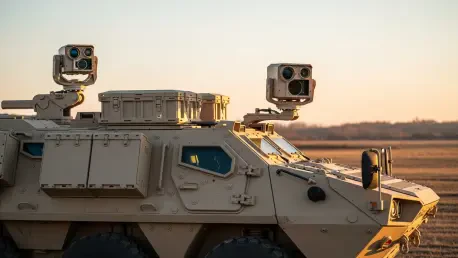

The sudden dominance of first-person view drones and loitering munitions on the modern battlefield has forced a radical rethink of how armored vehicles must be defended against low-cost aerial threats. Traditional active protection systems, while effective against high-velocity anti-tank missiles, often struggle with the erratic flight paths and smaller cross-sections of kamikaze drones. In response to this tactical gap, German manufacturer Mehler Protection has introduced the SCILT system, marking a significant milestone as the world’s first active protection suite dedicated specifically to neutralizing small-scale unmanned aerial systems. Developed over an intensive eighteen-month period involving forty-eight distinct test campaigns, the system represents a departure from expensive, over-engineered defense mechanisms. By focusing on the unique vulnerabilities of drone rotors and electronics, the developers have created a tool that addresses the realities of current attrition-based conflicts where quantity and cost-efficiency are just as vital as technological sophistication.
Modular Architecture and Optical Detection Methods
A defining characteristic of the SCILT system is its modular architecture, which provides military commanders with the flexibility to outfit a diverse range of platforms with tailored defensive layers. Rather than being confined to heavy main battle tanks, these independent modules can be distributed across various vehicle types, including armored personnel carriers and light logistical pickup trucks used for rapid frontline transport. Each unit operates as a self-contained entity, housing its own set of counter-munitions and advanced sensors. This decentralized approach ensures that the loss or damage of one module does not compromise the protective envelope of the entire vehicle, maintaining a higher level of survivability in high-intensity combat zones. The modularity also simplifies the installation process, allowing maintenance crews to swap out depleted or damaged components in the field without requiring specialized depot-level equipment or long periods of downtime, which is a critical factor for maintaining operational tempo during active maneuvers.
The detection strategy employed by Mehler Protection avoids the traditional reliance on radar, opting instead for a dual-camera optical setup that utilizes stereoscopic imaging. By using two cameras to track incoming threats, the system can calculate the precise distance and closing speed of a drone with remarkable accuracy, which is essential for the split-second timing required to intercept a target. One of the primary strategic advantages of this optical approach is its passive nature; unlike radar arrays that emit radio-frequency signals, cameras do not give away the vehicle’s position to enemy electronic warfare assets. This allows the host vehicle to remain electronically “dark” while still maintaining full situational awareness of the surrounding airspace. Furthermore, optical sensors are far more cost-effective than high-end radar systems, enabling the mass production and wide-scale deployment of the technology across entire fleets rather than restricting it to only the most expensive or high-value assets.
Cost-Effective Interception and Logistical Pragmatism
In a landscape where inexpensive drones are used to destroy multi-million dollar vehicles, the economic logic of defense must shift toward affordability and simplicity to remain viable. Mehler Protection addressed this challenge by designing the SCILT system to fire standard 12-gauge shotgun shells rather than complex and expensive interceptor missiles. These ubiquitous rounds are highly effective at shredding the delicate plastic rotors and sensitive exposed electronics found on most small unmanned systems. By utilizing a common ammunition caliber, the system integrates seamlessly into existing military supply chains, ensuring that reloading is both fast and inexpensive. This pragmatic engineering choice reflects a deep understanding of modern attrition warfare, where the ability to sustain defensive capabilities over long periods is just as important as the initial performance of the hardware. The use of kinetic, widespread pellet clouds creates a high probability of kill against small targets that might otherwise evade single-point interceptors.
Beyond the immediate tactical benefits, the reliance on standard ammunition and passive sensors significantly lowers the total cost of ownership for military forces looking to modernize their defenses. Traditional active protection systems often require specialized technicians and rare components, but the SCILT system is designed for rugged reliability and ease of use in the field. This focus on logistical pragmatism ensures that even smaller or less wealthy nations can afford to provide their troops with meaningful protection against the growing drone threat. The system’s ability to be mounted on lighter vehicles also means that supply convoys and medical evacuation units, which are often targeted by loitering munitions, can now carry their own self-defense mechanisms. This democratization of active protection technology represents a shift in how armor is perceived, moving away from a luxury reserved for the elite units toward a standard requirement for any mobile platform operating in a modern contested environment.
Operational Control and Strategic Implementation
The current operational logic of the SCILT system emphasizes a “human-in-the-loop” philosophy to ensure safety and precision in complex battlefield environments. While the internal software is fully capable of autonomously detecting, identifying, and tracking potential threats, the final decision to engage a target remains with the vehicle crew through a dedicated internal control panel. This semi-automatic mode was designed to prevent the accidental discharge of kinetic rounds in crowded areas or the targeting of non-threatening objects like birds or friendly small-unit drones. However, the manufacturer has signaled that as the detection algorithms continue to mature through real-world data collection, a fully autonomous mode will likely be introduced. This future software update would allow for even faster response times, which could be necessary when facing synchronized “swarm” attacks where human reaction speeds might be overwhelmed by the sheer volume of incoming threats from multiple different directions.
Looking ahead, the strategic implementation of this technology focused on addressing the immediate needs of frontline operators who faced the most persistent drone threats. The first production units were scheduled to reach the market by the summer of 2026, with a clear focus on providing actionable solutions for ongoing regional conflicts where loitering munitions had become the primary instrument of precision strikes. Analysts noted that the current fixed-launcher configuration provided a solid foundation, though future iterations might incorporate rotating mounts to eliminate potential blind spots in the upper hemisphere of the vehicle. By prioritizing rapid deployment and field-testing in active combat zones like Ukraine, Mehler Protection sought to establish a new global standard for mobile defense. The ultimate goal involved a shift toward proactive protection layers that combined affordability with high lethality, ensuring that ground forces maintained the initiative despite the increasing saturation of the skies by unmanned systems.