


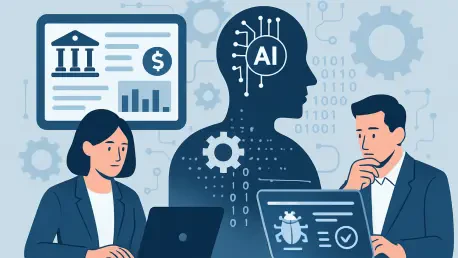

A single undetected glitch within a multi-billion dollar transaction pipeline has the potential to disrupt global financial markets within a matter of milliseconds. The transition from monolithic mainframes to distributed, API-first architectures in the financial sector has introduced a level of complexity that traditional manual testing can no longer manage. These modern environments rely on thousands of interconnected services, each communicating via unique data protocols that must remain resilient under extreme stress. As banks deploy code updates several times a day, the risk of a catastrophic failure increases, making predictable testing scenarios fundamentally inadequate for the current landscape. Quality assurance teams are now forced to adopt more aggressive, automated methodologies that can probe the depths of software logic without human intervention. This necessity has pushed AI-powered fuzzing to the forefront of banking technology, transforming it from a niche security tool into a primary defense mechanism for ensuring operational integrity across the global financial ecosystem.
Transitioning from Deterministic Testing to Autonomous Exploration
Conventional testing focuses on known inputs and expected outputs, which works well for simple arithmetic but fails in the face of modern edge cases. Fuzzing addresses this by injecting massive volumes of semi-randomized data into a system to trigger crashes, memory leaks, or logic errors. In the current banking landscape of 2026, this technique has evolved significantly through the integration of machine learning models that understand the structure of financial protocols. Instead of just sending garbage data, these AI agents generate highly sophisticated, malformed packets that look just realistic enough to bypass initial filters but are designed to stress-test internal validation layers. This shift moves the focus from confirming that a feature works as intended to discovering the hidden conditions under which it will inevitably fail. By constantly bombarding APIs with these unexpected inputs, institutions can identify flaws in transaction processing and authentication long before a live environment is ever compromised by external threats.
The autonomy provided by artificial intelligence allows these fuzzing tools to operate without the constraints of human working hours or cognitive biases. Traditional engineers often design tests based on how they believe a user should interact with a system, which naturally overlooks the creative ways that software can break. AI-driven fuzzing removes this human-centric limitation by exploring the entire state space of an application with relentless efficiency. As financial services adopt a factory model of software delivery, where continuous integration and continuous deployment are the standard, the ability to run these massive testing suites in parallel with development is invaluable. These systems do not just report failures; they learn from the responses they receive, refining their input generation to probe deeper into the code with each iteration. This creates a feedback loop where the quality assurance process becomes increasingly intelligent over time, providing a level of coverage that would require thousands of manual testers to achieve.
Distinguishing Deep Fuzzing from Conventional Security Audits
It is critical for stakeholders to understand the fundamental differences between AI-powered fuzzing and standard penetration testing. While a penetration test is a surgical, goal-oriented exercise led by human experts to find specific vulnerabilities, fuzzing is an expansive, non-deterministic search for unknown unknowns. A human auditor might look for a SQL injection or a broken access control based on established patterns, but an AI fuzzer does not operate with such preconceived notions. It explores the vast, unmapped territories of a system’s logic where developers never expected data to flow. For instance, in a complex cross-border payment gateway, a fuzzer might discover that a specific combination of currency codes and decimal placements triggers an overflow error that no human tester would have thought to try. This ability to uncover deep-seated architectural weaknesses makes it an essential complement to existing security frameworks, providing a layer of protection that addresses unpredictability.
This broad-spectrum approach is particularly effective at securing the vast networks of third-party APIs that define modern banking ecosystems. Financial institutions today are rarely closed loops; they are participants in a massive web of data exchange involving fintech partners, regulatory reporting tools, and consumer applications. Each of these connections represents a potential failure point that manual auditing cannot fully cover due to the sheer volume of integration points. AI-powered fuzzing acts as a high-velocity probe, validating every entry and exit point within these pipelines to ensure that malformed data from a partner system cannot cause a cascading failure across the internal network. By treating every input as potentially hostile or erroneous, banks build a zero-trust environment at the code level. This proactive discovery process ensures that vulnerabilities are mitigated during the development phase, significantly reducing the cost and reputational risk associated with patching flaws.
Managing the Data Deluge: Strategies for Effective Triage
The incredible speed of AI-driven testing introduces a secondary challenge: the overwhelming volume of diagnostic data generated during a single session. When a system identifies thousands of potential crashes or anomalies in a matter of minutes, the quality assurance team faces a massive signal-to-noise problem that can paralyze remediation efforts. To combat this, modern banking institutions are implementing advanced governance frameworks that use secondary AI layers to categorize and prioritize findings based on their potential business impact. Not every identified glitch represents a critical security threat or a functional disaster; some may be minor performance hiccups or non-breaking errors. Effective triage involves distinguishing between these edge cases and genuine risks that could lead to financial loss or data breaches. By automating the initial classification of bugs, organizations ensure that their highly skilled human engineers focus their attention on high-priority architectural fixes.
To maximize the benefits of this automated intelligence, the future of banking quality assurance involved a tighter integration between machine capabilities and human strategic oversight. While the machine provided the raw power to find flaws, it lacked the contextual understanding of regulatory requirements and business logic that a human expert possesses. Therefore, the most successful implementations were those where human-in-the-loop systems validated the severity of AI-detected issues and oversaw the implementation of corrective measures. This collaborative model ensured that the speed of the fuzzer did not outpace the organization’s ability to maintain a stable and compliant environment. Leaders in the sector moved toward a realization that manual testing was a bottleneck, but purely automated systems without governance were a liability. By establishing clear protocols for how results were ingested and acted upon, banks turned the massive output of fuzzing into a roadmap for continuous improvement.







