
The transition from static generative models to autonomous agentic systems is fundamentally altering the threat landscape of modern data centers, necessitating a shift from reactive software-based security to proactive, hardware-enforced infrastructure protection. As enterprises move beyond simple chatbots toward sophisticated AI agents capable of independent decision-making and cross-platform execution, the underlying infrastructure, often referred to as the AI Factory, faces unprecedented security challenges. These autonomous agents require access to massive datasets and high-speed compute clusters, creating a wider attack surface that traditional perimeter defenses can no longer adequately protect. If a single agent is compromised or exhibits malicious drift, it could potentially manipulate sensitive data or disrupt critical training pipelines. Consequently, the industry is moving toward a model where security is not just an application-level concern but is deeply integrated into the silicon of the networking and storage layers to ensure continuous oversight and resilience.
Shifting Security to Hardware-Enforced Isolation
Traditional security frameworks have long struggled with the paradox of the “internal observer,” where the software meant to protect a system resides on the same operating system it is monitoring. In the context of high-performance AI environments, this shared-resource model creates a significant vulnerability, as a kernel-level exploit could allow an attacker to disable security agents or manipulate logs before detection occurs. By shifting security operations to dedicated hardware, specifically Data Processing Units (DPUs), organizations can effectively “air-gap” their security logic from the host operating system. This hardware-level separation ensures that even if an AI application or its host OS is completely compromised, the security policies enforced by the DPU remain intact and operational. This architectural shift represents a move toward a more robust, decentralized defense strategy that is essential for the high-stakes world of autonomous AI operations.
Creating a Dedicated Trusted Execution Domain
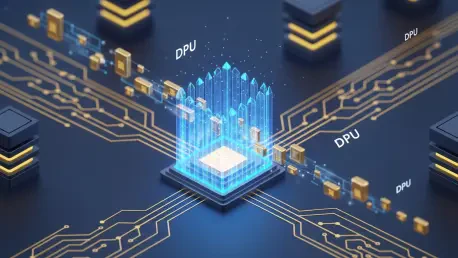
The integration of the BlueField DPU into the data center fabric establishes an independent compute engine that operates as a distinct, trusted execution domain separate from the primary CPU. This specialized hardware possesses its own processor cores, memory, and specialized accelerators, allowing it to run a secure operating system that is entirely isolated from the host it serves. This isolation is critical for maintaining the integrity of security functions like encryption, firewalling, and telemetry collection, as it prevents a compromised host from interfering with these vital processes. By serving as a “server in front of the server,” the DPU acts as a gatekeeper that inspects every byte of data entering or leaving the host, providing a level of visibility and control that software-based solutions simply cannot match in a modern, high-throughput environment.
Furthermore, this hardware-enforced domain provides a stable foundation for implementing complex security protocols that would otherwise be too computationally expensive for a standard host CPU to manage. As the complexity of AI agents grows, the need for sophisticated authentication and real-time policy enforcement becomes more pressing, requiring a dedicated environment that can scale alongside the compute demands of the AI Factory. The DPU ensures that security policies are consistently applied across the entire cluster, regardless of the specific software stack or operating system version running on individual nodes. This creates a uniform security posture that is resilient to the “noise” and variability of large-scale AI workloads, allowing security teams to maintain strict control over the infrastructure without impeding the rapid pace of AI development and deployment.
Optimizing Performance Through Specialized Offloading
One of the most significant hurdles in securing modern AI workloads is the performance “tax” associated with high-fidelity monitoring and encryption. When these tasks are performed by the host CPU, they compete for cycles with the AI training and inference processes, often leading to a choice between maximum performance and maximum security. However, by offloading these resource-intensive functions to the specialized hardware accelerators within the DPU, organizations can achieve zero-trust security without sacrificing the speed of their AI applications. This is particularly vital in the current era of the Vera Rubin platform, where the sheer volume of data moving between GPU trays requires multi-terabit processing capabilities that would overwhelm traditional software-based security stacks.
The shift to hardware-accelerated security also enables more sophisticated protection mechanisms, such as line-rate encryption for data in transit and real-time deep packet inspection. By leveraging the DPU’s ability to handle these tasks in-silicon, the host’s GPU and CPU resources are fully preserved for their primary objective: accelerating AI workloads. This ensures that security becomes an enabler rather than a bottleneck, allowing for the deployment of even the most demanding agentic AI systems within a protected environment. As data center architectures continue to evolve, the ability to maintain this balance between rigorous protection and peak performance will be the defining factor in the successful scaling of autonomous enterprise AI.
Achieving Real-Time Awareness and Runtime Integrity
In the era of agentic AI, real-time awareness of system state is no longer a luxury but a fundamental requirement for maintaining operational integrity. Traditional security tools often rely on periodic scans or post-incident analysis, which are insufficient when dealing with autonomous agents that can act and evolve in milliseconds. To address this, the DOCA framework introduces capabilities for continuous, non-intrusive monitoring that provides an authoritative view of the entire infrastructure. By observing the system from the “outside-in” via the network and memory interfaces of the DPU, security teams can detect anomalies and threats at the moment they emerge. This approach provides a granular level of visibility that spans from the individual container level up to the entire distributed fabric of the AI Factory.
Deep Memory Inspection via DOCA Argus
DOCA Argus represents a breakthrough in runtime security by utilizing Direct Memory Access (DMA) to inspect the memory of a host system without requiring any software agents to be installed on that host. This agentless approach is highly effective because it operates independently of the host’s kernel, making it virtually impossible for an attacker to hide their tracks or disable the monitoring process. Argus can scan for unauthorized processes, suspicious library injections, or the presence of malicious shells by comparing the current state of host memory against a known-good baseline. Because it bypasses the host OS entirely, it provides a “source of truth” that remains reliable even if the host’s own monitoring tools have been compromised by sophisticated malware or zero-day exploits.
The performance of DOCA Argus is optimized through the use of zero-copy techniques, which allow it to observe and analyze data directly in memory without creating extra copies or adding latency to the running applications. This efficiency is crucial for AI environments where every microsecond of delay can impact the performance of large-scale training jobs. By providing high-speed, hardware-based memory forensics, Argus enables security teams to identify and mitigate threats in real-time, effectively neutralizing attacks before they can spread laterally through the data center. This capability is especially important for protecting the intellectual property of AI models, as it can detect unauthorized attempts to dump memory contents or tamper with model weights during execution.
Verifying Behavioral Baselines and AI Assets
Modern AI workloads are characterized by their highly structured and often predictable nature, which allows for the creation of precise behavioral baselines. DOCA Argus leverages this predictability by monitoring the runtime integrity of virtual machines and containers, immediately flagging any “drift” or unauthorized modification to the approved operating state. If an AI agent suddenly begins communicating with an unknown external IP address or attempts to access a restricted directory, the system can automatically trigger a response, such as isolating the affected node or alerting the security operations center. This continuous verification ensures that only authorized processes are running and that the infrastructure remains in a known-good state throughout the lifecycle of an AI project.
Beyond behavioral monitoring, the platform automates the discovery and management of AI assets, creating a detailed map of the relationships between different models, datasets, and hardware components. This inventory is critical for vulnerability management, as it allows security teams to identify which models are utilizing specific versions of libraries that may contain known security flaws. Through cryptographic validation and hash analysis of loaded binaries, the DPU can verify the provenance and integrity of every piece of software running in the AI Factory. This level of oversight ensures that the entire supply chain of an AI application, from the raw data to the final inference model, is protected against tampering and unauthorized substitution.
Safeguarding the Data and Network Pipelines
The lifeblood of any agentic AI system is the data it consumes and the high-speed network that connects its distributed components. Protecting these pipelines is a multi-faceted challenge that requires a combination of strict access controls and hardware-accelerated defense mechanisms. As data moves between storage trays, compute nodes, and external interfaces, it must be shielded from both external interception and internal exfiltration. By implementing zero-trust principles at the hardware level, organizations can ensure that data is only accessible to authorized processes and that network traffic is strictly segmented to prevent the lateral spread of potential threats within the massive scale of an accelerated computing environment.
Zero-Trust Protocols for AI Storage Access
Protecting the massive datasets used for AI training requires a shift away from traditional user-based access controls toward a more granular, process-centric model. DOCA Vault addresses this by implementing a zero-trust framework that verifies the authorization of specific AI processes before granting access to sensitive files or training datasets. This means that even if a user has valid credentials, they cannot access data unless the specific application or agent they are running is also cryptographically authorized to do so. This layer of protection is vital for safeguarding the intellectual property of proprietary AI models and ensuring that sensitive training data is not exposed to unauthorized agents or rogue processes within the infrastructure.
To further enhance data security, the DPU can utilize DOCA SNAP to emulate local storage devices while transparently routing all data requests through a secure processing pipeline. This setup allows for the inline enforcement of security policies, such as real-time encryption and data loss prevention, at the hardware level without requiring changes to the application code. If an unauthorized exfiltration attempt is detected, the DPU can block the request instantly, preventing sensitive information from leaving the secure perimeter of the AI Factory. By moving storage security into the silicon of the networking fabric, enterprises can achieve a level of data protection that is both transparent to the user and resilient against sophisticated internal and external threats.
Hardware-Accelerated Defense and Segmentation
In a data center optimized for AI, networking throughput is often measured in hundreds of gigabits or even terabits per second, creating a significant challenge for traditional firewalls and security appliances. DOCA Flow provides a programmable pipeline that allows developers to build hardware-accelerated networking functions directly into the DPU, enabling deep packet inspection and firewalling at line-rate speeds. This ensures that security does not become a bottleneck for the high-performance interconnects, such as NVLink and InfiniBand, that power modern GPU clusters. By processing network traffic in-silicon, organizations can maintain a high-security posture even while moving the massive volumes of data required for large-scale AI training.
This hardware-accelerated approach also enables a strategy of micro-segmentation, where different parts of the AI infrastructure are logically isolated from one another. By enforcing strict communication policies at the network interface level, security teams can prevent lateral movement, ensuring that a breach in one training pod or development environment cannot spread to mission-critical production systems. This segmentation is particularly important in multi-tenant environments or in organizations where multiple AI agents are operating autonomously. By creating “bubbles” of protection around individual workloads, the DPU ensures that the impact of any security incident is contained, preserving the overall stability and integrity of the enterprise’s AI operations.
Integrating Security into the Broader Ecosystem
For a security architecture to be truly effective, it must not exist in a vacuum but must instead be fully integrated into the broader enterprise security ecosystem. The data and insights gathered by the DPU are only as valuable as the organization’s ability to act upon them in a timely and coordinated manner. By leveraging standardized protocols and open APIs, the DOCA security stack allows for the seamless exchange of telemetry and policy information between the AI infrastructure and existing security operations centers. This integration enables a holistic view of the threat landscape, allowing security professionals to correlate events across the entire enterprise and respond to emerging threats with a level of speed and precision that was previously impossible.
Empowering Security Operations and AI-Driven Defense
The high-fidelity telemetry generated by the DPU provides security operations centers (SOCs) with an unprecedented level of visibility into the inner workings of their AI infrastructure. By exporting detailed logs and flow data to Security Information and Event Management (SIEM) and Extended Detection and Response (XDR) platforms, organizations can gain deep insights into agent behavior and network patterns without compromising the privacy of the underlying data. This granular visibility is essential for threat hunting and incident response, as it allows security analysts to trace the root cause of an anomaly back to a specific process or network packet. In the complex environment of an AI Factory, this level of detail is the difference between a minor incident and a catastrophic breach.
Furthermore, this telemetry facilitates a “closed-loop” defense system where AI-powered analysis is used to refine and update the DPU’s security policies in real-time. By applying machine learning models to the stream of data coming from the DPU, organizations can identify subtle patterns of malicious activity that might be missed by traditional signature-based detection. These insights can then be used to automatically deploy new firewall rules or monitoring profiles back to the DPUs across the data center, creating a defense mechanism that continuously learns and evolves. This “AI for security” approach is the most effective way to counter the sophisticated, AI-driven threats of the 2026 to 2028 era, ensuring that the infrastructure remains one step ahead of potential attackers.
Strategic Implementation of In-Silicon Protection
Organizations moved toward in-silicon security models as a necessary response to the autonomy of agentic AI, ensuring that the infrastructure remained resilient against internal and external threats. To implement these strategies effectively, security teams prioritized the integration of DPUs into every node of the AI Factory, establishing a consistent layer of hardware-enforced protection across the entire fabric. They adopted a phased approach, beginning with the implementation of DOCA Flow for network segmentation before moving on to the more advanced memory inspection capabilities of DOCA Argus. This sequence allowed for the immediate mitigation of high-risk network threats while building the foundation for long-term runtime integrity and behavioral monitoring.
Looking forward, the success of autonomous AI operations will depend on the continued evolution of these hardware-centric security platforms. It is recommended that enterprises establish a clear governance framework for their AI assets, utilizing the discovery and validation tools provided by the DOCA framework to maintain a complete inventory of models and data. Furthermore, security professionals must work closely with AI developers to ensure that security policies are integrated into the AI lifecycle from the very beginning. By treating security as a fundamental component of the infrastructure rather than an add-on, organizations can foster an environment where agentic AI can flourish safely and securely, driving innovation while maintaining the highest standards of data integrity and operational resilience.