
The complexity of designing modern aerospace vehicles often reaches a point where traditional computational methods fail to provide the necessary speed and fidelity required for rapid development cycles. NASA has addressed this bottleneck by officially transitioning its Launch, Ascent, and Vehicle Aerodynamics (LAVA) software framework from an internal developmental asset to a publicly available resource for the domestic aerospace industry. Developed primarily at the Ames Research Center in California’s Silicon Valley, this sophisticated toolset represents a monumental leap in computational fluid dynamics (CFD). By granting researchers, universities, and private enterprises access to high-grade precision modeling, the agency seeks to catalyze a new era of efficiency across the entire sector. This move ensures that the same advanced technology used to safeguard high-profile government missions is now at the fingertips of engineers working on the next generation of aircraft and spacecraft.
The Technical Leap: GPU-Powered Simulations
The fundamental significance of the LAVA framework lies in its strategic departure from the historical reliance on central processing units for intensive aerodynamic calculations. In the past, complex simulations involving fluid-structure interactions required massive arrays of CPUs and could take days or weeks to produce meaningful results for a single design iteration. LAVA has been specifically engineered to leverage the parallel processing capabilities of graphics processing units, or GPUs, which process data in a fundamentally different way than their CPU counterparts. This architectural shift has essentially revolutionized the timeline for aerospace design, turning what used to be a sluggish and cumbersome process into a high-speed digital operation. NASA engineers often compare this transition to moving from a standard-definition television to a 4K streaming service, where the clarity and speed of the information allow for immediate adjustments and much deeper technical insights into vehicle performance.
Operating in tandem with the Cabeus supercomputer, the LAVA framework provides a level of scale-resolving simulation that was previously unattainable for most commercial entities. These simulations are capable of capturing high-fidelity renderings of physical phenomena such as pressure waves, atmospheric turbulence, and the subtle ways air interacts with a vehicle’s skin. Unlike many commercial software packages that force users into a single mathematical box, LAVA offers three distinct meshing options that allow engineers to tailor their approach to the specific geometry of a vehicle. This flexibility is crucial because it allows for a “best-fit” scenario where the mathematical model matches the physical reality as closely as possible. By providing these diverse computational methods, NASA ensures that the software remains versatile enough to handle everything from the subsonic flight of a delivery drone to the hypersonic reentry of a deep-space capsule, all while maintaining the highest possible standards of predictive accuracy.
Transforming DatAchieving Visual Insights
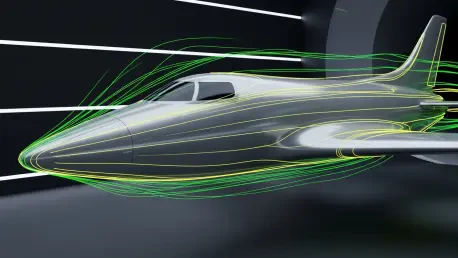
Beyond its raw computational power, LAVA excels in its ability to translate abstract mathematical data into intuitive visual maps that help engineers identify potential design flaws before they manifest in physical hardware. The software employs a sophisticated color-coding system where specific hues represent different physical forces acting upon the vehicle during flight. High-pressure zones are typically depicted in vibrant red, while low-pressure areas appear in deep blue, allowing designers to see exactly where structural stress is most likely to occur. Furthermore, green and yellow contours illustrate the way air essentially scrapes against the exterior of a craft, identifying regions of friction and drag that could impede fuel efficiency or cause overheating. These visual representations turn massive datasets into actionable engineering intelligence, enabling teams to perform rapid virtual testing that would otherwise require expensive and time-consuming wind tunnel experiments or even high-risk flight tests.
The integration of these visual tools into the design workflow allows for a more holistic understanding of atmospheric conditions and how they interact with shock waves at high velocities. Teal contours within the LAVA interface are used to visualize the presence and movement of moisture, while bright, high-contrast regions signal changes in air density that occur as a vehicle approaches the speed of sound. This level of detail is essential for mastering the “transonic” regime, where air behaves unpredictably and can cause sudden changes in stability. By seeing these invisible forces in a rendered environment, engineers can refine the contours of a wing or the shape of a rocket’s nose cone with unprecedented precision. This capability effectively bridges the gap between theoretical physics and practical engineering, fostering a culture of innovation where the risks of a design can be thoroughly mitigated long before a single piece of metal is cut or a composite mold is cast for a new aerospace prototype.
Practical Success: Space and Planetary Exploration
The most high-profile validation of the LAVA framework has been its critical role in refining the Space Launch System for the Artemis missions currently leading human exploration efforts. During the development of the Artemis II flight hardware, simulations identified potential issues with flight vibrations that could have jeopardized mission safety during the intense ascent phase. NASA researchers used LAVA to model the airflow around the core stage with extreme fidelity, discovering that the air was not flowing smoothly over the massive rocket’s surface. The software indicated that the addition of six-foot-long aerodynamic surfaces, known as strakes, would stabilize the flow and significantly reduce the structural vibrations felt by the crew and the onboard electronics. This hardware modification was informed entirely by digital data, demonstrating how advanced software can solve “intractable” engineering problems and produce practical, physical solutions that enhance the reliability of the most powerful launch vehicles.
LAVA’s utility is equally vital for missions that venture far beyond Earth’s orbit, particularly for the harrowing entry and descent phases on planets with atmospheres, such as Mars. Landing on the Red Planet involves a complex sequence of events often described as the “seven minutes of terror,” where a supersonic parachute must deploy and inflate while moving at several times the speed of sound. Modeling the fluid-structure interaction during this phase is one of the most difficult challenges in aerospace, as the flexible fabric of the parachute and the surrounding thin air influence each other in real time. The LAVA framework allows scientists to simulate these environments with high confidence, reducing the inherent risks for upcoming missions to Saturn’s moon Titan and the dense atmosphere of Venus. By simulating these extreme conditions on Earth using the power of GPU-accelerated computing, NASA ensures that its robotic explorers are structurally prepared for the unique pressures and temperatures they will encounter on distant worlds.
Broad Impact: Empowering the Commercial Sector
The release of LAVA into the public domain is expected to have a significant ripple effect throughout the broader aviation industry, moving beyond specialized spaceflight into everyday aeronautics. NASA has already utilized the framework to study how ice formations on aircraft wings affect flight performance, which is a critical safety concern for commercial aviation operating in cold climates. Furthermore, the efficiency of the software makes it an ideal tool for the emerging sector of Advanced Air Mobility, which includes a wide range of electric vertical takeoff and landing vehicles and delivery drones designed for urban environments. For many startups and smaller aerospace companies, the cost of high-end aerodynamic testing has traditionally been a barrier to entry. LAVA removes this obstacle by providing “NASA-grade precision” as a shared resource, allowing these firms to optimize their designs for noise reduction and energy efficiency without the prohibitive expense of building their own proprietary simulation software.
This democratization of technology fosters a competitive and innovative ecosystem where university researchers and private companies can push the boundaries of what is possible in flight. The software’s ability to handle complex geometries and rapid iterations means that fuel-efficient supersonic airliners and quiet, nimble drones can be brought to market much faster than in previous development cycles. By sharing this tool, the agency is not merely distributing a piece of code; it is providing the foundational infrastructure for the next generation of American aerospace achievements. The transition of LAVA to the public reflects a commitment to maintaining global leadership in aviation and space exploration by empowering the entire domestic sector with the most advanced tools available. As organizations integrate LAVA into their standard engineering practices from 2026 to 2028 and beyond, the industry will likely see a marked increase in the safety, performance, and sustainability of both domestic flight and international space travel missions.
In conclusion, the public availability of the Launch, Ascent, and Vehicle Aerodynamics framework provided a clear pathway for smaller firms and large-scale manufacturers alike to enhance their technical capabilities. By moving away from costly and slow CPU-based systems, the aerospace community adopted a more agile approach to design that prioritized precision and rapid feedback. Engineers utilized these GPU-powered tools to mitigate the risks associated with high-speed flight and planetary entry, ensuring that safety remained the primary focus of every new development. The widespread adoption of LAVA fundamentally changed the relationship between digital simulation and physical manufacturing, allowing for more ambitious projects to move from the drawing board to the launch pad with greater confidence. Looking forward, the industry was encouraged to maintain this momentum by continuing to integrate high-fidelity modeling into the earliest stages of design, thereby ensuring that the next decade of flight would be defined by unprecedented innovation and reliability.