
Saber’s cross-platform accessibility ensures that users are not locked into the Apple ecosystem, providing a consistent experience across diverse hardware configurations. As the digital landscape continues to evolve through 2026, the transition from proprietary, walled-garden software toward community-driven, open-source alternatives has accelerated significantly. This shift is primarily driven by a growing resistance to the rented software model, where users pay perpetual fees for tools that manage their most personal thoughts and professional projects. In a market where digital tablets have replaced traditional paper for the vast majority of higher education and professional creative workflows, the demand for a tool that respects user autonomy has never been higher. While established players have focused on expanding their feature sets with resource-heavy artificial intelligence and cloud-dependent services, a new segment of users has begun prioritizing speed, local control, and long-term data integrity. The emergence of specialized handwriting applications represents a maturing of the ecosystem, where the initial novelty of digital ink has given way to a sophisticated demand for software that functions as a reliable extension of the human mind without imposing corporate restrictions.
Design Philosophy: Visual Polish Versus Utilitarian Simplicity
Goodnotes has maintained its position as a market leader by focusing on a high degree of aesthetic refinement and a user interface that feels both premium and intuitive. For years, the development team has prioritized the tactile sensation of writing, offering a variety of digital pens including Fountain, Ball, and Brush types that react with extreme precision to pressure and tilt. This artistic focus makes the application particularly attractive to users who treat their digital notebooks as a form of journaling or creative expression. The menus are characterized by soft edges, fluid animations, and a cohesive color palette that minimizes cognitive load while providing a sense of professional craftsmanship. This level of commercial polish is the result of a dedicated design team working to ensure that every interaction, from page turning to ink rendering, feels as close to the analog experience as possible, which justifies its position as the current gold standard for the average consumer.
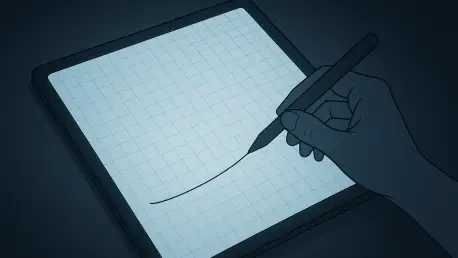
In contrast to the luxury-oriented design of its competitor, Saber adopts a strictly utilitarian, handwriting-first approach that appeals to those who view their tablets primarily as high-performance productivity tools. The interface is intentionally stripped of unnecessary ornamentation, featuring a streamlined toolbar that remains fixed at the bottom of the screen for immediate access. This design choice effectively eliminates the friction of navigating through multi-layered menus or sub-menus, allowing a student or professional to open the application and begin taking notes within seconds. By focusing on the essentials—primarily a high-quality Fountain and Ball pen implementation—Saber provides a faster, more distraction-free start for users who find the feature-heavy environment of modern commercial apps overwhelming. The minimalist philosophy extends to every aspect of the application, ensuring that the software remains lightweight and responsive even on hardware that might struggle with more resource-intensive, AI-driven alternatives.
Security Protocols: Transparency in an Era of Corporate Surveillance
The fundamental divide between proprietary and open-source applications is most evident in how they handle sensitive user information and digital security. As a closed-source product, Goodnotes requires its user base to place a high degree of trust in the corporation’s internal security measures and data-handling policies. While the application utilizes standard cloud encryption for its synchronization services, the underlying source code is not available for public inspection, meaning users cannot independently verify the absence of data-collection scripts or potential vulnerabilities. In an era where data sovereignty has become a primary concern for professionals in legal, medical, and engineering fields, the lack of transparency in a proprietary tool can be a significant deterrent. Users are often tethered to the security infrastructure provided by the developer, with limited options to audit or customize how their personal intellectual property is stored or accessed by the service provider.
Saber addresses these privacy concerns by operating under a model of total transparency and advanced technical security. Because the project is hosted publicly on GitHub, every line of code is open for community auditing, ensuring that no hidden “back doors” or invasive tracking mechanisms exist within the software. Beyond simple transparency, the application employs a robust dual-password end-to-end encryption system, which ensures that notes are protected both while sitting on the device and during the synchronization process across servers. This level of protection is essential for users who handle sensitive information and want the assurance that even the server host cannot read the contents of their notebooks. By prioritizing encryption as a core feature rather than a secondary consideration, the application provides a level of peace of mind that is increasingly difficult to find in the commercial software market, where data often becomes a secondary product for monetization.
Data Sovereignty: Breaking Free From Cloud Ecosystem Silos
A major challenge for modern tablet users is the phenomenon of ecosystem lock-in, where data is held within proprietary cloud silos that make it difficult to migrate or manage independently. Goodnotes relies heavily on established services like iCloud or Google Drive for its synchronization, which, while convenient for many, limits the user’s ability to control their own digital infrastructure. This dependency means that if a service provider changes its terms or if a user wishes to move to a different operating system, the transition can be cumbersome and technically challenging. For users who value the ability to maintain their own archives without relying on a third-party corporation, the traditional commercial model presents a significant hurdle to long-term data ownership. The convenience of these services often comes at the cost of total control over where the data lives and how it is managed over a period of many years.
Saber distinguishes itself by offering a rare level of server neutrality that empowers users to choose exactly how their data is hosted and synced. Instead of being forced into a single cloud provider, users can opt to use the official servers, integrate with a personal Nextcloud instance, or even self-host the data on their own local hardware. This flexibility is a game-changer for individuals and organizations that require strict adherence to data residency requirements or those who simply prefer to maintain a private cloud environment. By allowing users to point the application to their own infrastructure, the project ensures that the user remains the sole owner of their digital library. This architectural freedom is a hallmark of the open-source movement, providing a sustainable path forward for digital note-taking that is not dependent on the long-term viability or pricing whims of a single software company or cloud provider.
Organizational Architectures: Granularity and Digital Archiving
When managing thousands of pages of handwritten notes, the organizational structure of an application becomes just as important as the ink engine itself. Goodnotes utilizes a highly visual folder-based system that allows users to customize their digital workspace with specific colors, icons, and covers. This visual approach is excellent for users who organize their work spatially and need to quickly identify different subjects at a glance through aesthetic cues. Furthermore, the application provides sophisticated bulk-management tools, enabling the easy export of entire folders or notebooks for backup and sharing. This system is designed for high-level management and works exceptionally well for users who have a moderate number of projects that need to be presented or shared in a polished, professional format, maintaining a sense of order that feels like a physical bookshelf of carefully curated journals.
Saber approaches organization with a focus on logical depth and the removal of artificial structural constraints that often plague digital archiving. One of its standout features is the support for infinite folder nesting, allowing users to create incredibly granular hierarchies that match their specific mental models or project requirements. A user can organize their data by decade, year, semester, subject, and individual sub-topic without ever encountering a limit on how deep the folder structure can go. While many casual users may not require this level of complexity, the lack of a depth limit provides a sense of freedom that is essential for complex research projects or long-term academic careers. This structural flexibility ensures that as a user’s library grows from dozens to thousands of notes, the organization can evolve to remain efficient and navigable without requiring a total overhaul of the existing filing system.
Visual Ergonomics: Solving the Dark Mode Dilemma
The visual comfort of the user is a critical factor during long sessions of writing or studying, particularly in low-light environments where screen glare can cause significant strain. In most traditional note-taking applications, including the current version of Goodnotes, the implementation of dark mode is often limited to the interface menus while the digital “paper” remains a bright white. To achieve a true dark experience, users must manually select dark page templates, which creates a significant problem when it comes time to share or print those notes. A note written on a black background in a proprietary app often exports as a solid black block, which is impractical for physical printing and can look unprofessional in standard digital document viewers. This technical limitation forces users to choose between their own visual comfort during the writing process and the long-term utility of the document they are creating.
The engineering behind Saber solves this ergonomic challenge through a sophisticated system of dynamic inversion that manages colors intelligently based on the viewing mode. When a user toggles the “True Dark Mode” feature, the application automatically inverts the colors of the page, the handwriting, and even imported PDF documents to provide a high-contrast, low-strain experience for the eyes. The brilliance of this system lies in its export behavior; while the user sees white ink on a black background for comfort, the application is smart enough to reverse this during the export process. This results in a final PDF that features traditional black ink on a white background, ensuring that the notes remain professional, print-friendly, and compatible with standard document standards. This innovation demonstrates how an open-source project can outpace a commercial leader by identifying and solving a specific technical pain point that directly impacts the daily lives and health of its users.
Strategic Integration: Adopting Sustainable Productivity Tools
The investigation into digital handwriting solutions revealed that the decision between these two platforms rested primarily on the specific functional requirements and ethical priorities of the user. Goodnotes established itself as a luxury tool for those who prioritized a refined aesthetic, advanced artificial intelligence integrations, and high-level collaborative features. The application was particularly effective for users who required math conversion and audio recording alongside their handwriting, providing a comprehensive suite that justified its recurring cost for professional power users. However, the analysis also demonstrated that the complexity of such features often introduced a degree of friction that could distract from the core task of simple, rapid note-taking. For the user base that valued artistic variety and a polished, consumer-grade experience, the proprietary model remained a strong, albeit more expensive, contender in the digital stationery market.
Ultimately, the transition toward Saber was recognized as a viable and highly strategic move for those who prioritized data sovereignty and minimalist efficiency. The study determined that the application’s commitment to end-to-end encryption and its unique implementation of dynamic dark mode provided a superior environment for long-term academic and professional use. Users found that the ability to self-host their data and organize it through infinite folder nesting offered a level of freedom that proprietary systems could not match. To maximize the benefits of this shift, it was recommended that current users began by exporting a single active project into the open-source environment to test the workflow compatibility. This incremental approach allowed individuals to experience the security and speed of the software without immediately abandoning their existing archives. In the final assessment, the move toward an open-source framework was viewed as a necessary step for ensuring that digital records remained private, accessible, and free from the limitations of corporate subscription models.