
The silent partner in modern software development is no longer human, but an algorithm humming away in the background, suggesting code, fixing bugs, and accelerating creation at a pace previously unimaginable. This rapid integration of AI into developer workflows has created a powerful new paradigm, but it has also surfaced a critical tension between the boundless potential of cloud-based assistants and the non-negotiable need for data privacy and intellectual property protection. As developers and organizations navigate this landscape, a more nuanced solution is emerging, one that does not force a choice between power and privacy but instead offers a flexible, hybrid path forward. This evolution marks a significant shift, empowering developers to reclaim control over their most sensitive work without sacrificing the benefits of AI-driven productivity.
Is Your AI Coding Assistant Reading Over Your Shoulder
The modern developer’s environment is increasingly populated by AI assistants, tools that promise to streamline every phase of the software lifecycle. Yet, this convenience introduces a significant dilemmhow does one leverage these powerful services without compromising sensitive intellectual property or the confidentiality of personal projects? The core of this issue lies in the conflict between the seamless utility of cloud-based AI and the fundamental requirement for data sovereignty. When every keystroke and code snippet is potentially transmitted to a third-party server for processing, questions of ownership, security, and confidentiality naturally arise. For enterprises building proprietary technologies or independent developers experimenting with a groundbreaking idea, the risk of data exposure can outweigh the productivity gains.
This scenario frames a new set of considerations for the development community. The reliance on external, cloud-hosted models means placing a degree of trust in the provider’s data handling policies, which may not always align with a project’s security requirements. The desire for control over one’s digital assets is not merely a preference but a professional necessity. Consequently, developers are beginning to demand solutions that allow them to harness the power of large language models within a secure, self-contained environment. This push toward data sovereignty is not a rejection of AI assistance but a call for more adaptable architectures that respect the sanctity of a developer’s workspace.
The Copilot Conundrum Navigating a Cloud First World
The introduction and rapid adoption of AI coding assistants, pioneered by services like GitHub Copilot, have fundamentally reshaped software development workflows. This acceleration has been transformative, automating routine tasks and enabling developers to focus on higher-level problem-solving. This shift, however, has tethered a significant portion of the development process to a cloud-first model. Developers have become accustomed to the instant gratification of AI-generated code, but this convenience comes with tangible trade-offs that are becoming increasingly apparent.
These trade-offs manifest in several real-world concerns for both individual developers and large organizations. Recurring subscription costs create a persistent operational expense, turning a productivity tool into a budgetary line item. More critically, the dependence on a third-party provider introduces a single point of failure and raises valid questions about the long-term security of proprietary codebases. The fear that sensitive algorithms or trade secrets could be inadvertently absorbed into a global training dataset is a significant barrier for entities operating in competitive or highly regulated industries. This conundrum forces a difficult choice between cutting-edge assistance and airtight security.
A Tale of Three Architectures Cloud Local and the Hybrid Future
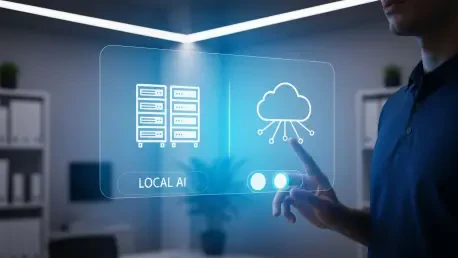
The prevailing cloud-native model offers undeniable benefits, particularly for large, distributed teams requiring seamless integration and access to the most powerful, resource-intensive AI models. In this architecture, data is sent to a provider’s servers for processing, which allows for sophisticated analysis and collaboration at scale. In direct contrast, the local-first alternative has gained significant traction by prioritizing autonomy and security. By running models directly on a developer’s machine or on-premises infrastructure, this approach ensures that all code and data remain within a controlled environment, effectively creating a private digital vault for sensitive workflows.
Comparing these two models reveals a clear set of choices. In terms of privacy, the distinction is stark: cloud solutions process data externally, whereas local solutions keep it on-device. Performance-wise, cloud services often provide access to premium, GPU-heavy models, while local performance is contingent on the user’s hardware. The cost structure also differs, with cloud copilots typically following a subscription model, while many local solutions can be implemented for free using open-source software. The ideal usage pattern follows logically, with cloud copilots excelling at advanced, collaborative tasks and local copilots being the superior choice for secure, private development. It is at the intersection of these models that the hybrid solution appears, offering a flexible framework that empowers developers to strategically combine the best of both worlds, selecting the appropriate tool for each specific task.
The Open Source Tipping Point Fueling Local Adoption
A pivotal shift is occurring, driven by the remarkable advancements in open-source AI. The performance gap that once clearly separated proprietary, closed-source systems from their open counterparts is narrowing at an accelerated pace. Models such as Qwen3 Omni Flash now demonstrate advanced reasoning and code generation capabilities that are highly competitive with top-tier commercial offerings. These models showcase significant gains not only in code but also in logical reasoning and multimodal understanding, proving that state-of-the-art performance is no longer the exclusive domain of large tech corporations.
This convergence of quality has profound implications for developers. It dismantles the long-held assumption that achieving elite AI performance requires sending data to the cloud. With open-source models that can run efficiently on local hardware, developers can now achieve near top-tier results while maintaining complete data privacy. This capability is a game-changer for anyone working on confidential projects, experimental prototypes, or within regulated industries. The open-source tipping point signifies a democratization of powerful AI, enabling developers to build sophisticated, private copilots tailored to their specific needs without incurring subscription fees or privacy risks.
Your First Local Copilot A Practical Guide to a Private Setup
Establishing a private, locally-hosted AI copilot has become remarkably accessible, even for developers without a dedicated high-end GPU. The process involves orchestrating a few key components to create a secure and powerful development assistant. The first step is to set up a local AI service using a framework like Microsoft Foundry Local, Ollama, or LM Studio. These tools act as a foundation, managing the underlying processes required to run language models directly on a personal machine. They handle the complexities of model inference, allowing the developer to focus on integration.
Once the service is running, the next step involves downloading an efficient, open-source model tailored for coding, such as a compact yet capable model like qwen2.5-coder-0.5b. With the model loaded, a user-friendly interface like Open WebUI can be connected to the local service, providing a chat-based environment to interact with and test the AI. The final and most crucial step is integrating this local intelligence directly into the development environment. By using an extension like the AI Toolkit for Visual Studio Code, the local model appears as a selectable option, ready to provide code completions, answer questions, and assist in building applications, all without a single byte of project data ever leaving the local machine.
The transition from a purely cloud-based AI assistance model to a more flexible and secure hybrid landscape represented a fundamental rebalancing of power in the software development world. Cloud copilots had successfully introduced millions of developers to the immense productivity benefits of AI, establishing a new baseline for workflow efficiency. However, the subsequent rise of high-performance local and open-source models addressed the critical needs for privacy, control, and autonomy that the first wave of tools had left unanswered. This evolution provided developers with a spectrum of choices, allowing them to tailor their AI assistance to the specific security and operational demands of each project. Ultimately, the adoption of hybrid architectures was not a rejection of the cloud but a maturation of the developer’s relationship with AI, reflecting a deeper understanding that the most powerful tools are those that adapt to the user’s needs, not the other way around.