
The rapid proliferation of hyper-distributed Java microservices has rendered traditional monitoring methods fundamentally obsolete as modern enterprises grapple with the sheer volume and velocity of telemetry data generated across cloud-native environments. In the current landscape of 2026, where digital transactions occur in milliseconds and system dependencies are measured in the thousands, the inability to distinguish between a minor fluctuation and a catastrophic failure represents a significant business risk. Maintaining high availability and adhering to stringent Service Level Objectives requires a paradigm shift from reactive firefighting to an automated, intelligence-driven approach that prioritizes actionable insights over raw data collection. This transformation is not merely a technical upgrade but a fundamental requirement for operational resilience, ensuring that complex Java Virtual Machine workloads remain transparent and manageable even as they scale across diverse hybrid and multi-cloud infrastructures. By integrating advanced artificial intelligence directly into the observability pipeline, organizations can finally bridge the visibility gap that has long plagued large-scale distributed systems.
Transitioning from Manual Monitoring to Deterministic AI
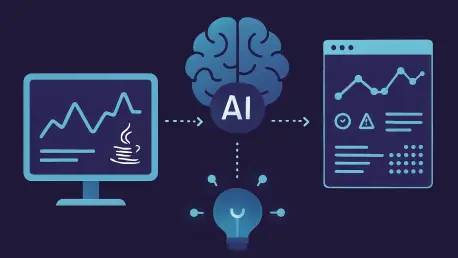
The limitations of traditional monitoring tools are most apparent when Site Reliability Engineering teams are forced to navigate a relentless barrage of disconnected alerts that treat every individual metric spike as an isolated incident. This noise often leads to alert fatigue, where critical signals are buried under a mountain of trivial notifications, significantly delaying the identification of genuine system threats. Dynatrace addresses this challenge through its proprietary Davis AI engine, which moves beyond simple statistical correlation to provide deterministic causation. By utilizing a real-time dependency graph known as Smartscape, the platform maps every component of the technology stack, from the underlying host and virtual machine to specific Java services and end-user requests. This comprehensive mapping allows the AI to understand the precise relationship between various entities, ensuring that when a performance degradation occurs, the system can immediately identify whether the issue originates in the application code, the network layer, or the cloud infrastructure.
This holistic view of the application topology fundamentally changes how engineering teams approach problem resolution by shifting the focus from “what is happening” to “why it is happening.” When a downstream microservice experiences high CPU utilization that causes latency in an upstream Java application, the Davis AI does not simply alert on the slow response time; it recognizes the causal link and clusters all related symptoms into a single, unified problem entity. This process effectively eliminates the need for manual war rooms and extensive log diving, as the root cause is presented with high confidence from the moment the anomaly is detected. By reducing the Mean Time to Repair, the platform allows developers to spend less time on maintenance and more time on innovation. The intelligence-driven approach ensures that every performance issue is contextualized within the broader ecosystem, providing a clear path to remediation that accounts for the complex interdependencies inherent in modern Java architectures and their distributed services.
Diverse Integration Pathways for Java Applications
Achieving comprehensive visibility across a vast enterprise estate requires a flexible instrumentation strategy that can accommodate both legacy monoliths and cutting-edge containerized services. The most robust pathway is through OneAgent auto-instrumentation, a technology that automatically injects itself into the Java Virtual Machine to capture metrics, traces, and logs without requiring developers to modify a single line of source code. This “full-stack” visibility is particularly critical for large-scale environments where manual instrumentation would be prohibitively time-consuming and prone to human error. By providing an out-of-the-box view of the entire transaction flow, OneAgent ensures that no component remains a “black box,” allowing teams to maintain a continuous and accurate representation of their application health regardless of how frequently the underlying code is updated or how many new services are deployed into the production environment.
While automated instrumentation provides the foundation for broad visibility, many organizations are increasingly adopting open standards to maintain flexibility and avoid vendor lock-in. Dynatrace has responded to this trend by providing deep, native support for OpenTelemetry, allowing Java applications to be instrumented using industry-standard APIs and SDKs. This approach enables development teams to export data directly to the observability platform via the OpenTelemetry Protocol, combining the flexibility of open-source tools with the advanced analytical power of a deterministic AI engine. Furthermore, for specialized use cases involving proprietary business logic or unsupported legacy frameworks, the OneAgent SDK and REST APIs offer granular control over data ingestion. These tools allow developers to define custom spans and metadata or push external metrics from CI/CD pipelines, ensuring that the observability dashboard serves as a single source of truth for both technical performance and business-critical key performance indicators.
Operational Efficiency and Security in Modern Instrumentation
A common concern when implementing comprehensive observability is the potential for performance overhead, as the resources required to monitor an application should never jeopardize the stability of the application itself. To mitigate this risk, industry best practices dictate that the overhead of monitoring agents must be kept below 1% of total CPU utilization. Dynatrace achieves this through intelligent sampling techniques and by offloading heavy data processing tasks to its scalable backend rather than performing them on the application host. This ensures that even high-throughput Java applications can be monitored in real time without experiencing measurable latency or throughput degradation. By maintaining this lean footprint, organizations can justify full-stack instrumentation across their entire production environment, ensuring that visibility is never sacrificed for the sake of resource conservation or cost-cutting measures during peak traffic periods.
Beyond resource management, the protection of sensitive information is a paramount concern in an era of stringent data privacy regulations and increasing cyber threats. When instrumenting Java applications, it is essential to ensure that Personally Identifiable Information is never accidentally captured in logs or trace attributes. The platform provides built-in, sophisticated controls that allow teams to mask or redact sensitive data at the point of ingestion, ensuring that compliance with global standards is maintained without compromising the technical depth required for effective troubleshooting. This security-first approach to observability allows engineers to gain code-level insights into application failures while guaranteeing that customer data remains private and secure. By integrating these privacy controls directly into the instrumentation process, organizations can confidently deploy observability tools across highly regulated industries, such as finance and healthcare, where data integrity and confidentiality are non-negotiable requirements.
Streamlining Deployment in Modern Environments
The deployment and lifecycle management of observability tools must evolve in tandem with the infrastructure they monitor, particularly as organizations shift toward highly dynamic, orchestrated environments. In the context of Kubernetes, the “Operator” pattern has emerged as the preferred method for managing the deployment of monitoring agents. By treating the observability stack as a native Kubernetes resource, the Dynatrace Operator automates the installation and updating of agents across the entire cluster. This ensures that every new pod is automatically instrumented the moment it is spun up, eliminating the risk of visibility gaps during rapid scaling events. This level of automation is vital for maintaining a consistent observability posture in environments where containers are frequently created and destroyed, as it removes the manual effort traditionally associated with configuring and maintaining monitoring software across a distributed fleet of nodes.
Modern observability also relies heavily on metadata-driven configurations to provide the necessary context for rapid problem resolution. By leveraging Kubernetes annotations and cloud tags, teams can automatically categorize Java processes by environment, business unit, or application owner. This metadata allows the AI engine to filter alerts and dashboards dynamically, ensuring that the right stakeholders are notified the moment a performance issue is detected. Furthermore, the technical necessity of accurate time synchronization across all hosts cannot be overstated, as consistent timestamps are the foundation of effective event sequencing and behavioral baselining. When combined with automated metadata tagging, synchronized time ensures that the AI can reconstruct the exact timeline of a failure, providing engineers with a clear and unambiguous view of how a problem propagated through the system. This structural discipline allows organizations to move from fragmented monitoring to a unified observability strategy.
Advancing Code-Level Visibility and Custom Business Logic
The technical depth of a modern observability strategy is often defined by its ability to bridge the gap between infrastructure health and specific business outcomes. Through the use of the Dynatrace v2 API and specialized Java SDKs, developers can move beyond standard JVM metrics to capture high-fidelity data related to custom business logic. For instance, a Java-based order processing system can programmatically post metrics such as transaction value or inventory levels directly to the observability platform. This allows the AI engine to correlate technical failures, such as a database timeout, with their direct impact on business revenue or customer satisfaction. By enriching telemetry data with this business context, organizations can prioritize their remediation efforts based on the actual severity of the impact, ensuring that engineering resources are always directed toward the most critical issues affecting the company’s bottom line.
This level of granular visibility is further enhanced by the manual instrumentation capabilities provided by OpenTelemetry in Java. By building custom tracer providers and configuring batch span processors, developers can create detailed spans around specific blocks of code, such as complex algorithmic calculations or external API calls. These spans can be decorated with custom attributes, such as unique order IDs or user session tokens, which provide the Davis AI with the precise detail needed for a deep-dive root cause analysis. When an exception occurs within a manually instrumented block of code, the platform captures the full stack trace and the associated metadata, allowing developers to see exactly what went wrong without having to reproduce the error in a local development environment. This seamless integration of custom tracing and automated analysis represents the pinnacle of modern Java observability, enabling a level of transparency that was previously unattainable in complex, distributed architectures.
Strategic Implementation for Resilient Java Ecosystems
The integration of deterministic artificial intelligence into the Java observability pipeline established a new standard for operational excellence and system reliability. Organizations that successfully transitioned from legacy monitoring to an intelligence-driven approach experienced measurable gains in application uptime and a significant reduction in the manual labor required to maintain complex microservices. By prioritizing automated instrumentation and leveraging open standards like OpenTelemetry, these teams created a flexible and future-proof visibility layer that scaled effortlessly alongside their infrastructure. The consensus among industry professionals confirmed that the move toward metadata-driven context and low-overhead monitoring was the primary driver of improved Service Level Agreement compliance. This strategic shift allowed engineering departments to move beyond the cycle of reactive troubleshooting and focus on proactive performance optimization.
Future considerations for Java development teams should focus on the continued refinement of agentic workflows, where observability data is used to trigger automated remediation scripts or self-healing protocols within the orchestration layer. It was observed that the most successful implementations involved a collaborative effort between developers and site reliability engineers to define clear Service Level Indicators that reflected both technical health and business success. Moving forward, the emphasis should remain on maintaining a lean instrumentation profile while expanding the depth of business-centric telemetry. By following the established deployment patterns and security best practices, organizations ensured that their Java applications remained transparent, secure, and resilient. Ultimately, the adoption of an AI-powered observability platform proved to be the most effective way to manage the inherent complexity of modern software, providing the clarity needed to deliver superior user experiences in a competitive digital market.