


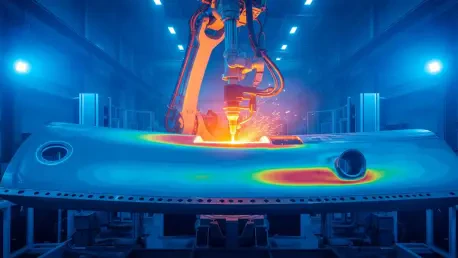

Achieving structural integrity in massive 3D-printed components often involves a costly cycle of trial and error that drains resources and stalls industrial production timelines. This systemic inefficiency has long plagued the additive manufacturing sector, where the sheer scale of parts makes failure an expensive setback. However, the introduction of Aibuild FETS represents a fundamental shift in how engineers manage the complexities of large-format printing by utilizing high-performance GPU acceleration. Rather than waiting days for traditional CPU-based solvers to process thermomechanical data, manufacturers now leverage rapid simulations to visualize potential defects before a single layer of material is deposited. This proactive “shift-left” strategy allows for the identification of structural vulnerabilities in the early design phase, effectively turning what was once a reactive troubleshooting process into a precise predictive science that streamlines the entire workflow.
Advanced Thermal Analysis: Bridging the Gap Between Design and Production
The simulation tool provides deep insights into the physical behavior of materials by tracking six critical performance metrics, including thermal distribution and residual stress patterns. By mapping heat flow throughout the build process, the software identifies areas prone to distortion or geometric warping, which are common issues in Directed Energy Deposition and Wire Arc Additive Manufacturing. Beyond just metals, the system extends its reach to thermoplastic applications like Fused Filament Fabrication, ensuring that interlayer bonding remains consistent to prevent sagging or slumping. This comprehensive analysis covers thermomechanical behavior and crack prediction, allowing engineering teams to adjust process parameters on the fly. By understanding how materials react to intense thermal cycles, users can mitigate internal stresses that would otherwise compromise the long-term durability of the final part, regardless of whether they are working with high-performance alloys or polymers.
Validating Results: The Path to Standardized Manufacturing Excellence
The technical reliability of these rapid computations was confirmed through rigorous validation by the National Institute for Aviation Research, ensuring that speed does not undermine accuracy. This level of certification is vital for industries such as aerospace and defense, where precision is non-negotiable and every micron of distortion matters. Because the software is CAM-agnostic, it integrated seamlessly into existing manufacturing environments, allowing companies to enhance their current software stacks without the need for specialized hardware or complex new workflows. This accessibility helped bridge the gap between experimental prototyping and full-scale industrial production. Engineers refined their strategies to focus on iterative design improvements that reduced waste and significantly shortened the time-to-market for complex components. The move toward hardware-agnostic, GPU-powered simulation provided a clear roadmap for scaling additive manufacturing operations efficiently while maintaining a high standard of quality.







