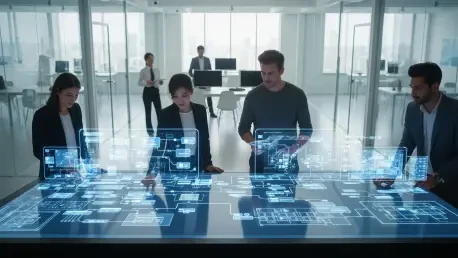

The rapid transition from manual code construction to high-level system orchestration has fundamentally altered the daily reality of software engineering, moving the industry toward a standard of “tenfold” delivery velocity. Rather than spending hours debating syntax or hunting for missing semicolons, modern developers are now operating as curators of complex intelligence. This shift marks a departure from the traditional artisan model of programming, where the focus was on the “how” of writing lines, toward a strategic paradigm focused on the “what” of system design. By leveraging sophisticated Large Language Models and specialized autonomous agents, teams are shipping products with a speed that would have seemed impossible just a few years ago.
Evolution of the AI-Enhanced Software Development Lifecycle
This technological evolution focuses on the move from manual code authorship to high-level system orchestration using Large Language Models and specialized AI agents. In this modern landscape, the engineer functions less like a writer and more like a conductor, managing various streams of automated logic to ensure they harmonize into a stable product. This transition matters because it addresses the inherent human bottleneck in the development cycle: the speed of typing and the limits of individual memory. By automating the foundational layers of code production, the industry has effectively decoupled growth from headcount, allowing smaller teams to manage massive, enterprise-grade architectures.
The core principles of “orchestration over authorship” integrate deeply into the current workflow, where human oversight is focused on quality and scalability rather than the minutiae of character-by-character input. In the broader technological landscape, these workflows represent a decisive move toward extreme efficiency. While traditional methods relied on linear progression—design, then code, then test—the AI-enhanced cycle operates in a parallel, iterative fashion. This redefines how software is conceptualized and shipped, ensuring that the velocity of innovation is no longer tethered to the physical constraints of human manual labor.
Core Components of Modern AI Workflows
AI-Native Architectural Reasoning and Design
This component replaces the traditional “blank slate” design phase with multi-agent systems that stress-test blueprints before implementation. By deploying distinct AI personas, such as “Architects” and “Security Auditors,” teams can simulate complex load scenarios and analyze theoretical time complexity, such as Big O efficiency, in seconds. This unique implementation is significant because it prevents structural technical debt by identifying scalability bottlenecks before a single line of functional code is written. Unlike previous static analysis tools, these agents engage in a dialectic process, debating the merits of different architectural patterns to find the most resilient path forward.
Advanced Context Engineering and RAG Integration
The evolution from simple prompting to sophisticated context engineering ensures that AI agents receive curated, high-relevance data rather than excessive, distracting information. This feature utilizes Retrieval-Augmented Generation (RAG) to provide the AI with full workspace awareness, grounding every suggestion in the project’s specific history and established patterns. Performance is further optimized by including specific constraints, such as library versions and security protocols, to ensure output alignment with existing architectural standards. This differs from generic AI tools because it respects the “tribal knowledge” of a specific codebase, preventing the hallucination of incompatible or deprecated functions.
Bifurcated Pull Request and Review Systems
The modern review process is now divided into mechanical tasks handled by AI and logic verification handled by humans. AI agents manage the heavy lifting of syntax checks, style compliance, and common vulnerability scans, reducing turnaround times from days to mere minutes. This bifurcation allows human developers to ignore the “noise” of formatting errors and focus entirely on the high-level intent and business logic. The “Human-in-the-Loop” requirement remains a critical safeguard, ensuring that while the mechanical 80% is automated, the actual decision-making power remains with the person responsible for the final product’s impact.
Emerging Trends and Technical Innovations
The rise of “Self-Healing Infrastructure” allows CI/CD pipelines to automatically analyze error logs, suggest fixes, and re-run failed builds without human intervention. This innovation is unique because it shifts the role of the DevOps engineer from a reactive firefighter to a proactive systems tuner. Moreover, there is an increasing industry shift toward “Optimization as a Requirement,” where developers no longer accept just “working” code; they demand AI-generated logic that is strictly optimized for both time and space complexity. This push for efficiency ensures that applications remain lean and cost-effective even as they scale to handle millions of concurrent users.
Multi-agent collaboration has become the standard for solving complex logical hurdles that once stumped single-model approaches. By forcing different models to debate solutions, the system can filter out hallucinations and refine logic through a process of digital peer review. This competitive approach to code generation ensures a higher level of reliability, as the “winning” code has already survived a battery of internal challenges. Consequently, the industry is seeing a significant decrease in the number of logic-related bugs that reach production, as the AI agents effectively act as a preliminary filter for human error.
Real-World Applications and Sector Impact
In the Fintech and Enterprise sectors, AI workflows are deployed to manage massive microservices architectures where manual tracking of distributed transactions is physically unfeasible. The ability of AI to map and monitor these complex connections in real-time allows for a level of system transparency that was previously unattainable. Modern DevOps teams are also implementing “Autonomous Testing” to maintain 90% or higher code coverage without the burden of manual test authorship. This eliminates traditional “testing debt,” where quality assurance is often sacrificed in favor of meeting aggressive deadlines.
Security-sensitive industries are utilizing automated guardrail layers, such as NeMo Guardrails, to protect the AI logic layer from malicious prompt injection and data leaks. These systems act as a secondary defense, ensuring that the AI does not inadvertently reveal sensitive information or execute unauthorized commands. By integrating security directly into the AI’s operating environment, companies can maintain high development speeds without compromising the integrity of their data. This approach is particularly vital in sectors like healthcare and defense, where the cost of a single vulnerability can be catastrophic.
Technical Challenges and Risk Mitigation
“Shadow Logic” remains a significant hurdle, where AI might introduce non-standard or deprecated patterns that increase long-term maintenance costs. Because AI models are trained on vast datasets, they occasionally suggest solutions that, while functional, do not align with a company’s specific best practices. Furthermore, the risk of “Code Bloat” arises from the ease of generating logic; if it is easy to create a thousand lines of code, developers may be less inclined to find a more elegant ten-line solution. This requires teams to implement periodic AI-driven refactoring cycles to prune redundant code and keep the system manageable.
Regulatory and security obstacles, such as the potential for accidentally pasting sensitive API keys into public prompts, necessitate strict organizational “Trust but Verify” protocols. Companies must establish clear boundaries for what data can be shared with external models and utilize local or private AI instances where possible. The trade-off for increased speed is the requirement for constant vigilance; the more the system automates, the more critical the remaining human touchpoints become. Managing these risks requires a cultural shift toward a “security-first” mindset where every AI suggestion is scrutinized for its long-term impact on the system’s health.
Future Trajectory and Industry Outlook
Future developments point toward fully autonomous development agents capable of managing entire feature lifecycles with minimal human intervention. These agents will likely move beyond simple coding tasks to handle project management, resource allocation, and user feedback integration. Potential breakthroughs in “Small Language Models” (SLMs) may soon allow for local, private, and highly specialized AI agents that reside entirely within a company’s secure infrastructure. This would eliminate many of the data privacy concerns currently associated with cloud-based LLMs while providing specialized expertise tailored to a specific niche.
The long-term impact suggests a complete professional rebranding of software engineers as “System Architects,” where the primary skill is managing a fleet of AI partners. As the barriers to technical entry continue to lower, the value of an engineer will shift from their ability to write syntax to their ability to conceptualize complex solutions and oversee their execution. This shift will likely lead to a more diverse workforce, as the focus moves from rote memorization of programming languages to higher-level problem-solving and strategic thinking. The role of the human in the loop will become more critical than ever as the complexity of the systems being managed increases exponentially.
Summary and Final Assessment
The transition to AI-powered development workflows represented a fundamental change in the way technology was built, moving from a manual craft to an automated orchestration. This review demonstrated that while the speed and efficiency gains were undeniable, the primary challenge shifted from production to verification. The implementation of architectural reasoning agents and self-healing infrastructure allowed teams to bypass the traditional bottlenecks of testing and deployment, yet it also introduced new risks like shadow logic and code bloat. These trade-offs required a disciplined approach to context engineering and a steadfast commitment to human oversight in the final logic verification.
The final verdict on this technology was that its success depended entirely on the quality of the human-AI partnership rather than the raw power of the models themselves. Engineers who embraced the role of the “System Architect” found that they could deliver complex products with unprecedented reliability and speed. Looking forward, the focus must now shift toward refining the “Trust but Verify” protocols and exploring the potential of local, specialized small language models. The ultimate goal is to move toward a state where the AI handles the complexity of execution, leaving the human free to focus on the creativity and intent that defines the next generation of global software delivery.