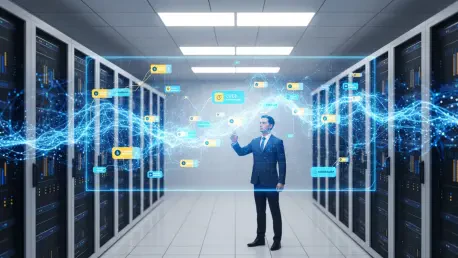

The sudden explosion of AI-driven development tools has fundamentally altered the cadence of software engineering, creating a scenario where code is written at machine speed but remains constrained by human-scale verification processes. As generative models produce thousands of lines of logic in seconds, the traditional manual handoff between writing and testing has become an insurmountable barrier. Organizations that fail to integrate verification directly into their automated workflows are discovering that their productivity gains in coding are quickly negated by a massive backlog of unvetted pull requests. This paradox represents a significant challenge in the current engineering landscape: the ability to generate features has outpaced the ability to ensure their safety and reliability. Consequently, the transition toward embedding AI testing within the CI/CD pipeline is no longer optional but essential for maintaining operational stability.
Addressing the Movement of Development Obstacles
In the contemporary engineering landscape, the primary bottleneck has shifted decisively from the act of code generation to the intensive demands of code verification. For decades, the slowest part of the development lifecycle was the manual labor involved in typing out logic; however, modern AI tools can now produce complex features and fixes almost instantly. This rapid acceleration has left engineering leads buried under an unprecedented volume of pull requests that require thorough scrutiny to prevent regressions. When the speed of creation increases by an order of magnitude without a corresponding evolution in the review process, the result is a congested system where new code sits idle, waiting for a human expert to provide validation. This shift effectively turns the once-efficient development workflow into a faster funnel that leads into the same narrow drain of manual human-led review, stalling the overall pace of modern innovation.
Identifying the New Software Engineering Bottleneck
The consequences of this bottleneck are particularly visible when teams attempt to scale operations using large language models to assist with legacy code migrations or large-scale refactoring. While the AI can refactor thousands of lines in minutes, the burden of ensuring that these changes do not break existing functionality falls squarely on the shoulders of the QA team. This creates a psychological and operational strain, as the volume of potential errors grows exponentially with every automated commit. Furthermore, the reliance on traditional testing methods often leads to a rubber-stamp culture where reviewers, overwhelmed by the quantity of code, might overlook subtle logic flaws that manifest under production conditions. To combat this, the industry is moving toward a model where the verification step is as autonomous as the generation step, ensuring every piece of machine-written code is subjected to a battery of tests that are themselves generated and executed.
Modernizing CI/CD for Deep Verification
Traditional CI/CD pipelines are increasingly viewed as inadequate because they were originally architected as delivery mechanisms rather than comprehensive verification engines. Most existing infrastructure still relies heavily on humans to manually author unit tests or interpret complex log results, a methodology that simply cannot keep pace with the hyper-accelerated output of AI-driven assistants. For a pipeline to remain effective in a world where software is co-authored by machines, it must undergo a fundamental transition toward a state of deep verification. This involves integrating layers of automated analysis that go beyond simple syntax checks and basic coverage metrics. Instead, the pipeline must be capable of understanding the intent of the changes and dynamically adjusting its testing strategy to probe for vulnerabilities or performance regressions that are unique to the new logic. This evolution transforms the pipeline from a passive gate into an active participant.
Building a Resilient Automated Infrastructure
Effective software testing must move beyond isolated code snippets to recognize that software does not function in a vacuum, as its success depends on complex interactions with external databases, third-party APIs, and specific infrastructure configurations. Many of the most high-profile software failures have demonstrated that critical bugs often hide in the subtle gaps between valid components rather than within the logic of a single file or function. When AI generates a fix for a specific module, it may inadvertently disrupt the delicate balance of the broader system architecture. Therefore, the testing layer within the CI/CD pipeline must evolve to include sophisticated integration and end-to-end testing that mimics the production environment as closely as possible. By simulating these real-world interactions early in the development cycle, teams can identify potential points of failure that would otherwise remain hidden until the software is deployed to users.
Accounting for System Interactions and Real-World Scenarios
Furthermore, the move toward resilient infrastructure necessitates the use of digital twins or ephemeral environments that mirror the complexity of the actual runtime conditions. These environments allow the automated testing agents to execute code against a realistic set of data and network constraints, providing a level of assurance that unit tests alone cannot offer. This approach is particularly vital when dealing with distributed systems or microservices architectures, where a change in one service can have cascading effects across the entire network. By validating code against the entire system architecture before it ever reaches the staging phase, organizations can catch integration errors at the source. This shifts the focus from merely verifying that the code works to ensuring that it functions correctly within the system. As these automated environments become more accessible, they provide a safety net that encourages developers to innovate boldly without unforeseen side effects.
Optimizing the Feedback Loop for Continuous Delivery
The integration of AI-driven testing into the continuous integration and deployment pipeline proved to be the turning point for organizations seeking to balance speed with systemic stability. By automating the verification layer, teams successfully bypassed the traditional bottlenecks that once threatened to derail the benefits of generative coding tools. Moving forward, the most successful engineering departments prioritized the creation of adaptive test suites that functioned as living components of the infrastructure. They implemented ephemeral staging environments for every change and leveraged intelligent agents to handle the tedious work of regression analysis and bug fixing. These steps allowed developers to reclaim their time for architectural innovation rather than manual troubleshooting. Ultimately, the industry realized that the only way to sustain machine-speed development was through machine-speed validation, ensuring quality was never sacrificed for velocity.