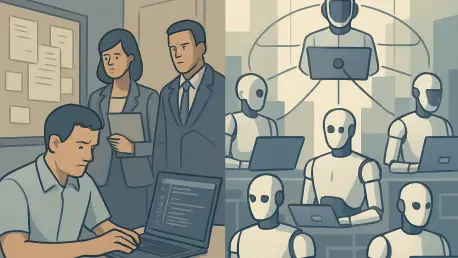

The sudden realization that the most sophisticated large language models in history often sit idle or produce fragmented results within enterprise environments has shifted the industry focus from model parameters to corporate hierarchy. Platform teams are now tasked with creating a ‘paved road’ for agents by centralizing skill registries, context management, and identity permissions. This transition reflects a broader understanding that while coding agents have achieved remarkable individual proficiency, their aggregate impact remains stifled by legacy workflows designed for manual labor. Traditional organizational structures, which prioritize individual ticket completion and siloed code ownership, are fundamentally at odds with the collaborative, high-velocity nature of agentic development. For an organization to truly capitalize on the current wave of technological advancement, leadership must stop treating AI as a sophisticated autocomplete tool and start treating it as a new class of workforce that requires its own specialized management layer. The bottleneck is no longer the intelligence of the model, but rather the rigidity of the human systems that surround it, including outdated security protocols, fragmented documentation, and a lack of standardized interfaces for machine-to-machine interaction. Without a concerted effort to redesign these internal structures, the implementation of AI coding tools will continue to yield only marginal productivity gains rather than the exponential growth originally envisioned.
Navigating the Professional Identity Shift: From Coder to Architect
One of the most significant hurdles to seamless AI integration is a profound emotional and professional identity crisis currently unfolding among veteran software engineers. For decades, the value of a developer was measured by their ability to internalize complex syntax, debug intricate memory leaks, and manually craft elegant logic flows. Now that autonomous agents can generate functional code at a fraction of the cost and time, many engineers feel alienated, fearing they are being relegated to “prompt jockeys” who merely manage machines through natural language prose. This friction creates a psychological bottleneck where human expertise is often pitted against automation in a zero-sum game, leading to resistance during the adoption of agentic workflows. When developers view AI as a replacement for their core craft rather than a powerful extension of their intent, the resulting lack of trust slows down the review process and prevents the organization from reaching a state of high-velocity development.
To resolve this conflict, engineering leadership must pivot the definition of engineering work from manual implementation to high-level system architecture. Instead of tasking human developers with the tedious job of fixing buggy AI output, the new mandate focuses on building the programmatic “harnesses” and automated testing loops that allow agents to operate autonomously with high confidence. This shift ensures that developers remain deeply engaged in solving complex technical problems at a systemic level while delegating rote implementation to AI. By transforming the role of the engineer into an architect of automated systems, organizations can maintain high morale while simultaneously increasing their output. This approach necessitates a cultural rebranding of what it means to be a “senior” developer, moving away from individual technical heroics and toward the creation of scalable, agent-friendly environments that benefit the entire department.
Evolving Team Rituals: The Bifurcation of Planning and Execution
As the software development lifecycle shifts toward orchestration, traditional team rituals like daily stand-ups, sprint planning, and retrospectives must undergo a radical evolution to remain relevant. Planning sessions are increasingly bifurcated into two distinct streams: mechanical tasks and ambiguous challenges. Mechanical tasks, which have clear requirements and well-defined boundaries, are now dispatched to autonomous agents almost immediately after they are identified. In contrast, ambiguous tasks that require human negotiation, ethical considerations, or cross-departmental alignment remain the primary focus of technical leads. This allows human teams to spend significantly less time managing the minutiae of individual code commits and more time refining the strategic environment in which these agents operate. The role of the Scrum Master or Project Manager is similarly transforming into that of a “system orchestrator” who ensures that the flow of context to the AI workforce is uninterrupted and highly accurate.
Furthermore, retrospectives are becoming system-centric rather than person-centric, focusing on the health of the shared development infrastructure rather than individual performance. Instead of discussing individual coding mistakes or missed deadlines, forward-thinking teams now audit their shared context libraries and skill registries to determine why an agent may have failed a specific task. If an agent hits a wall or produces an error, the team views it as a failure of the system’s “harness” rather than a failure of the model itself. This discipline is vital for avoiding the pitfalls of “vibe coding,” where a lack of rigorous, automated testing leads to an unprecedented accumulation of technical debt that can paralyze a project. By adjusting the entire system to prevent recurrences of AI errors, teams create a self-healing development environment that grows more robust with every completed sprint, ensuring that the organization learns as a collective unit.
Redefining Success: Tracking Human Touches and the Shared Multiplier
Traditional engineering metrics such as lines of code, commit frequency, or even token spend have become largely meaningless in an era where machines can generate vast amounts of text in seconds. To accurately gauge the health and efficiency of an AI-integrated organization, leadership must pivot toward more sophisticated KPIs, specifically the “human touches” metric. This metric tracks the number of times a person must manually intervene to correct, guide, or override a machine-generated output. A mature, high-performing organization strives to drive this number down over time, indicating that the systemic harness and the shared context provided to the agents are becoming more robust. High human-touch counts are no longer seen as a sign of diligent oversight but as a symptom of a bottlenecked system where the “paved road” for agents is either broken or poorly defined, necessitating costly human intervention.
Another vital metric for the modern era is the “shared multiplier,” which represents the value of improvements made to central systems that benefit every developer and agent simultaneously. Unlike the productivity of a traditional “10x developer,” whose skills are largely portable and individual, a shared multiplier—such as a highly refined security linter, a custom context retrieval mechanism, or a proprietary skill registry—is a permanent asset of the company. In a market where AI models are rapidly becoming a commodity, an organization’s sustainable competitive advantage will stem from this unique, shared infrastructure. By incentivizing engineers to contribute to these multipliers rather than focusing on their own individual output, companies can foster a culture of collective advancement. This shift in measurement ensures that the organization is building a long-term technical moat that remains effective regardless of which specific AI model is currently leading the market.
The Platform Mandate: Building Infrastructure for Autonomous Agents
Platform engineering teams, which were once primarily responsible for cloud deployment and CI/CD pipelines, now face a new mandate to provide a comprehensive “paved road” for autonomous agents. This specialized infrastructure involves the management of skill registries that define what an agent can and cannot do, as well as complex context management systems that ensure agents have the right information at the right time. Furthermore, platform teams must handle identity and permissions specifically for non-human actors, ensuring that agents have the least-privileged access necessary to complete their tasks without compromising security. By offering a catalog of pre-approved agentic workflows and standardized environments, platform teams provide the necessary flexibility for innovation while maintaining a rigorous framework for compliance. This centralized approach prevents the fragmentation of AI adoption across different departments, which often leads to “shadow AI” and inconsistent security practices.
This infrastructure-heavy strategy ensures that AI adoption is not just a series of isolated experiments but a scalable corporate capability. By centralizing the tools, identities, and audit logs of autonomous agents, companies can scale their development capacity horizontally without being overwhelmed by the resulting complexity. The ultimate goal for many platform teams is to move toward a “dim factory” model of software development, where the level of automation is strategically dictated by the risk tolerance and complexity of specific domains. In high-risk areas like core financial logic, the “lights” are kept on with heavy human supervision, while in lower-risk areas like internal documentation tools, the factory can run in the “dim,” with agents handling the vast majority of the workload. This modular approach to automation allows the organization to allocate its most expensive resource—human intelligence—to the areas where it provides the highest strategic value.
Modernizing Technical Talent: Hiring for Judgment and Technical Taste
The rise of agentic development has rendered traditional technical assessment methods, such as LeetCode-style whiteboard interviews, largely obsolete. When an agent can solve a complex algorithmic puzzle in milliseconds, testing a candidate’s ability to memorize syntax or implement a sorting algorithm from scratch provides very little insight into their potential value to a modern firm. New hiring frameworks must instead focus on a candidate’s ability to maximize AI leverage while maintaining exceptionally high “technical taste” and architectural judgment. Interviews are now evolving to test whether a developer can effectively critique code they did not write, diagnose subtle architectural failures in a complex system, and design the automated testing loops required to keep agents on track. This requires a deeper understanding of software principles than ever before, as the engineer must act as a high-level reviewer and strategist rather than a tactical coder.
The most valuable talent in this modern landscape is the “multiplier” engineer who prioritizes the health of the shared harness over their own isolated tasks. These individuals are adept at capturing technical tribal knowledge—the “why” behind specific architectural decisions—and integrating it into the company’s AI systems so that future agents can benefit from that context. Successful organizations had to recognize that the ability to collaborate with and manage an AI workforce is a distinct skill set that requires both technical depth and a high degree of organizational empathy. By focusing on the development of the system rather than the output of the individual, leadership transformed the technological shift of the mid-decade into a sustainable, long-term competitive advantage. The transition was finalized when the industry accepted that the bottleneck was never the AI’s inability to code, but rather the human inability to let go of the keyboard.