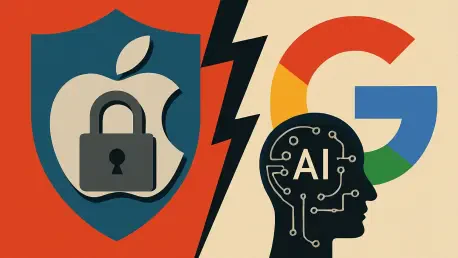

For years, Apple has carefully cultivated an image as the unwavering champion of user privacy, building a fortress around personal data that has become a cornerstone of its brand identity and a key differentiator in a data-hungry tech landscape. This commitment was set to be the bedrock of its next-generation AI strategy, a system designed to deliver intelligence without compromising the sanctity of user information. However, recent developments and a deepening partnership with Google, a company whose business model is fundamentally built on data, are raising serious questions about the future of this privacy-first approach. As the race for AI dominance intensifies, a potential paradigm shift appears to be underway within Cupertino, suggesting that the company may be confronting an uncomfortable choice between its long-held principles and the sheer computational power required to create a truly competitive virtual assistant. The very foundation of trust Apple has built with its users now seems to be teetering on the edge of this strategic crossroads.
The Foundation of a Private Ecosystem
Apple meticulously laid the groundwork for its artificial intelligence ambitions with the “Private Cloud Compute” framework, a sophisticated system engineered to reassure users that their data would remain secure and under their control. This hybrid model was strategically designed to balance performance with privacy, processing simpler AI tasks directly on the user’s device to keep sensitive information localized. For more complex requests, data was to be sent to Apple’s own private cloud servers, but only after being encrypted and stripped of any personal identifiers, ensuring that even Apple could not build a profile on the user. This privacy-centric architecture was not merely a background feature; it was the central pillar of the company’s plan to power upcoming enhancements for a revamped Siri in iOS 26.4, including advanced in-app actions and personal context awareness. The engine behind this was a massive 1.2-trillion-parameter custom Gemini model, slated to run exclusively on these proprietary, privacy-hardened servers.
This carefully constructed narrative of a self-contained, secure AI ecosystem was presented as the definitive solution to the industry’s privacy problem, a way for users to have intelligent features without becoming the product. The commitment to running its most powerful models on its own infrastructure was a clear signal to the market and its customer base that Apple was willing to invest heavily to uphold its privacy promises. By creating this walled garden for AI processing, Apple aimed to differentiate itself starkly from competitors who routinely process vast amounts of user data on their servers to train and refine their models. The Private Cloud Compute framework was positioned as the tangible proof of this commitment, a technical marvel that would allow Siri to become significantly smarter while respecting the digital sanctity of its users, thereby solidifying Apple’s reputation as the industry’s most trustworthy tech giant.
A Widening Crack in the Fortress
The first indication that this privacy-focused strategy might be shifting came from a revelatory report by tipster Mark Gurman, which disclosed that Apple is developing a powerful new Siri chatbot for its upcoming iOS 27 release. This next-generation assistant is expected to possess capabilities far beyond its current iteration, including performing web searches, generating original content, and accessing on-screen information to provide contextual help. Critically, the report alleged that this significantly more advanced version of Siri would not run on Apple’s in-house infrastructure but would instead be powered by Google’s own cloud and its specialized Tensor Processing Units (TPUs). This news immediately sent ripples of concern through the privacy community, as it suggested a fundamental departure from the self-reliant model Apple had so publicly championed and raised the prospect of user queries being processed by a third party, even one as prominent as Google.
These concerns were dramatically amplified by official statements made during a recent Google earnings call, where the company formally declared it had become Apple’s “preferred cloud provider.” This specific terminology implies a relationship that extends far beyond a simple service agreement for hosting iCloud data or a single, isolated feature. It suggests a deeply integrated and expansive partnership, creating a direct and unavoidable conflict with Apple’s carefully crafted narrative of a private, self-contained AI ecosystem. While Gurman had previously theorized that Apple might adopt a dual-cloud strategy—using its own Private Cloud Compute for its foundational models while leveraging Google’s infrastructure for the more demanding new Siri—the “preferred provider” status hints at a much more significant reliance. The core of the issue is that as this new, Google-powered Siri is expected to become the central AI feature in iOS 27, Apple’s own privacy framework risks being overshadowed and marginalized.
A Recalibrated Future
The strategic alliance with Google fundamentally altered the trajectory of Apple’s AI development, marking a pivotal moment where the pragmatic need for advanced capabilities appeared to outweigh the company’s foundational privacy principles. By outsourcing the heavy computational lifting for its flagship virtual assistant, Apple tacitly acknowledged that its in-house infrastructure was not yet prepared to compete at the highest level of generative AI. This decision effectively sidelined the Private Cloud Compute framework, once heralded as the future of private AI, relegating it to a supporting role rather than the main stage. The move suggested that the market pressures and the rapid pace of AI innovation had forced a compromise that would have seemed unthinkable just a few years prior, changing the conversation from how Apple would protect data to how much it was willing to concede for a smarter Siri.