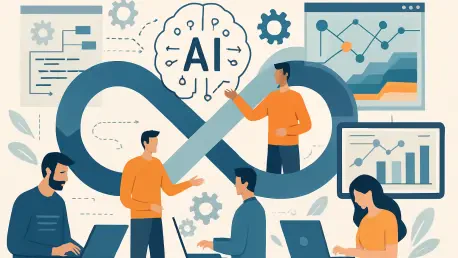

The integration of Artificial Intelligence into software delivery has reached a definitive turning point where it acts as a force multiplier rather than a replacement for human expertise, fundamentally altering the way engineering teams approach the entire software development lifecycle. High-maturity DevOps frameworks have emerged as the essential foundation for successful AI adoption, with approximately 70 percent of organizations acknowledging that their existing disciplined delivery models are what allow them to scale these new capabilities effectively. Instead of automating DevOps out of existence as once feared, AI is reinforcing the need for structured workflows, proving that the more refined an organization’s processes are, the more value they can extract from machine learning. This shift suggests that the era of experimental AI implementations is giving way to a more calculated approach where success is predicated on operational excellence. As firms navigate this transition, the focus has moved from simple code generation to the orchestration of data pipelines.
The Maturity Divide: Why Platform Engineering Matters
A significant performance gap has emerged between organizations based on their operational maturity and how effectively they embed AI across the software development lifecycle. High-maturity teams are nearly four times more likely to weave AI into their daily workflows compared to their lower-maturity counterparts, who often struggle with fragmented processes and inconsistent environments. To bridge this gap and overcome persistent bottlenecks such as cross-team coordination and skills shortages, leading firms are increasingly adopting Internal Developer Platforms and platform engineering. These strategies provide the standardized environments and unified pipelines necessary to control costs and boost productivity in an increasingly complex technical landscape. By abstracting away the underlying infrastructure complexities, platform engineering allows developers to consume AI services through self-service portals, which significantly reduces the cognitive load and minimizes the risk of configuration errors that often plague manual deployments.
The shift toward hybrid delivery models is also defining the current era, as organizations seek a balance between innovation and governance. Most high-maturity groups now utilize a combination of DevOps and platform engineering to ensure that AI adoption remains auditable and secure. This hybrid approach extends to infrastructure as well, with a majority of enterprises maintaining a mix of cloud and on-premises environments rather than moving everything to a single provider. By avoiding a total migration to the public cloud, companies retain better control over sensitive workloads and proprietary datasets while still leveraging the massive scalability required to power resource-intensive AI models. This balanced strategy helps mitigate the risks of vendor lock-in and provides the flexibility needed to comply with evolving data residency regulations. Furthermore, maintaining on-premises capacity allows for more predictable baseline costs, which is crucial for organizations running large-scale training jobs.
Strategic Shifts: Evolution of Roles and Quality Engineering
AI is fundamentally reshaping professional roles within the DevOps ecosystem by automating tedious tasks and allowing engineers to focus on high-level system design. The traditional boundaries of Quality Assurance are blurring as teams transition toward a quality engineering model, where the focus shifts from executing manual tests to managing quality analytics and orchestrating complex environments. In this new paradigm, developers are taking more responsibility for authoring tests directly, and business analysts are becoming more involved in technical validation to ensure that software outputs align closely with commercial objectives. This redistribution of labor is not merely an efficiency play; it represents a cultural shift where quality is seen as a collective responsibility rather than a final gate. Engineers now spend more time designing the systems that test the software than they do testing the software itself, leading to more robust architectures and fewer production incidents.
This transformation is particularly visible in the rise of specialized roles like the AI Infrastructure Engineer, who bridges the gap between traditional systems administration and data science. These professionals are tasked with managing the unique requirements of machine learning workloads, such as GPU scheduling and specialized networking for high-speed data transfer. As execution becomes more automated, the nature of human labor is shifting toward strategic oversight and the management of technical debt that can accumulate from AI-generated code. Approximately 87 percent of engineering leaders believe that AI tools will allow their teams to move away from tedious scripting and focus on directing business outcomes. By delegating the repetitive aspects of the CI/CD pipeline to intelligent agents, organizations are able to accelerate their release cycles without sacrificing the mental well-being of their staff, ultimately creating a more sustainable and innovative work environment for developers.
Risk Management: Governance Challenges and the Confidence Gap
Despite widespread optimism regarding the potential of AI, a notable gap exists between the perceived reliability of these tools and their actual integration into secure workflows. While many leaders express confidence in AI outputs, only a minority have deeply embedded these practices across all delivery stages, often leaving significant vulnerabilities in governance and auditability. Many organizations still rely on manual compliance checks, which create dangerous bottlenecks in high-velocity environments and expose the firm to regulatory risks. For AI to be truly effective, security and automated audit trails must be baked into the Continuous Integration and Continuous Deployment pipelines from the start. This requires a transition from reactive security patching to proactive, policy-based governance where the AI itself is used to monitor and enforce compliance standards. Without this automated layer, the speed gained from AI code generation is often lost during the lengthy manual review processes.
Addressing this confidence gap requires a concerted effort to improve data transparency and model explainability across the organization. Security teams are finding that while 52 percent of developers have embedded secure coding practices into their workflows, nearly half of the workforce still lacks the specific training needed to identify subtle AI-generated vulnerabilities. This has led to the implementation of more rigorous “shift-left” security strategies, where automated scanning tools are used to validate every snippet of code produced by an LLM before it ever reaches a staging environment. Moreover, the integration of Large Language Models into the development process has necessitated new forms of monitoring that track not just system performance, but also the drift and accuracy of the models being used. By treating AI as a first-class citizen in the observability stack, teams can gain the visibility needed to trust these tools in production environments where the stakes are highest.
Future Outlook: Economic Realities and Sustainable Engineering
The financial implications of AI-driven DevOps presented a complex challenge throughout the current period, as the gains in efficiency were often offset by soaring infrastructure costs. The massive compute power required to sustain AI workflows made cloud expenses and energy consumption primary factors in adoption decisions across the industry. To ensure that the productivity benefits of AI were not neutralized by rising bills, organizations were forced to implement strict cost attribution models and FinOps practices tailored for machine learning. These models allowed teams to track the return on investment for specific AI features, ensuring that resource allocation remained aligned with business value. This economic reality necessitated a more disciplined approach to engineering, where resource management was treated with the same level of importance as code quality or deployment speed, leading to a more mature and fiscally responsible technology landscape.
Moving forward, the focus for engineering leaders shifted toward creating sustainable systems that could scale without linear increases in operational overhead. Organizations that successfully navigated this transition prioritized the automation of audit trails and the standardization of development environments through platform engineering. The next step for the industry involved deeper collaboration between security, operations, and data science teams to ensure that AI governance was a seamless part of the delivery process. Actionable next steps for firms included investing in cross-functional training to close the AI skills gap and deploying specialized monitoring tools to manage model performance in real time. Ultimately, the integration of AI into DevOps proved that the strongest organizations were not those with the most advanced tools, but those with the most disciplined engineering cultures. This foundation allowed them to turn the raw power of AI into a sustainable competitive advantage.