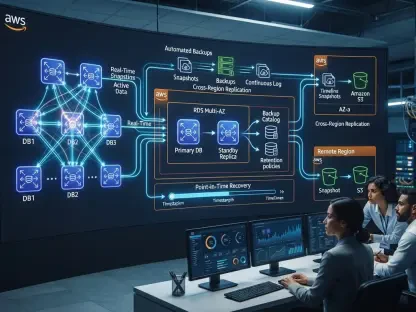

Continuous Data Migration Service replication keeps a golden main branch within two minutes of live production data without requiring manual snapshots or exports. This capability has become the cornerstone of modern engineering workflows in 2026, where the speed of deployment is often limited by the agility of the underlying data infrastructure. Traditionally, developers faced a significant delay when attempting to test their code against production-grade datasets, often waiting for hours as large databases were cloned or restored. By utilizing a serverless architecture that decouples storage from compute, teams can now maintain a golden copy of their production environment that is updated in real-time. This ensures that every testing cycle begins with a high-fidelity dataset, reducing the risk of bugs that only appear under specific production conditions. As organizations continue to adopt ephemeral environments for every pull request, the synchronization of data has evolved from a luxury into a fundamental requirement for maintaining a high-velocity development pipeline.
1. Maintaining Synchronized Production Replicas
Linking a live production database to a branching-capable primary branch requires a robust replication strategy that operates without impacting source performance. Using tools like AWS DMS, a change data capture process continuously streams updates from an Amazon Aurora PostgreSQL cluster into the main branch, ensuring the testing baseline is always current. This setup initializes with a full load followed by incremental updates, ensuring that any new record or schema modification in production reflects in the testing repository within moments, creating a reliable and up-to-date source of truth.
This automated synchronization ensures that the starting point for every test environment is not a week-old backup but a nearly live replica. By avoiding manual snapshots, teams eliminate the operational overhead that typically plagues database administration during peak hours. Consequently, the data architecture becomes a dynamic asset, allowing developers to trust that their testing environment accurately mirrors the state of the real-world system and provides immediate feedback on schema changes. This high level of data freshness significantly improves the accuracy of automated testing cycles.
2. Implementing One Branch per Pull Request
Adopting a policy of one branch per pull request ensures that every developer works in a completely isolated environment, preventing cross-test interference. This isolation is critical for maintaining the integrity of the CI/CD pipeline, as it allows for independent reads and writes without the risk of race conditions or data contamination from other active projects. Each PR branch functions as a standalone database, enabling teams to simulate complex user interactions and data workflows in parallel without ever compromising the stability of the shared staging area or the primary golden main branch.
By spawning each branch directly from the continuously updated main branch, the organization guarantees that every developer has access to the freshest data available. This practice simplifies the debugging process, as any failures can be attributed to the specific code changes within the pull request rather than external data modifications. The result is a more predictable and stable development workflow where ephemeral namespaces are perfectly aligned with their corresponding database states. This structure supports high-concurrency environments where multiple features are developed simultaneously.
3. Generating Instant PR Branches via API
Creating an isolated database environment for every pull request is facilitated by copy-on-write technology, which allows for near-instantaneous provisioning. When a developer initiates a pull request, the CI/CD pipeline triggers an API call to generate a metadata clone that shares storage pages with the parent branch, requiring no physical data duplication. Because the system only writes new storage pages when data is modified on the branch, the initial creation process avoids the heavy input-output operations associated with traditional cloning, making it an ideal solution for agile teams.
This efficiency allows a new branch to be ready in under sixty seconds, regardless of whether the source database is a few gigabytes or several terabytes in size. By decoupling the branch creation from the volume of data, organizations can support hundreds of concurrent PRs without incurring the latency of traditional disk cloning. This ensures that the testing phase can begin immediately after code is pushed, removing one of the most persistent bottlenecks in the DevOps lifecycle. Rapid provisioning directly correlates with higher developer productivity and faster iteration cycles.
4. Prioritizing New Branches Over Reusing Old Ones
Efficiency in modern data workflows is best achieved by favoring the creation of new branches over the manual syncing of existing ones. If a test environment requires more recent data from production to validate a specific fix, it is more effective to simply discard the current branch and spin up a fresh one from the continuously updated main repository. This ensures that the developer is always working against the most accurate representation of the production environment, minimizing the chances of missing critical edge cases that may have been introduced by recent data changes.
Since the provisioning process is nearly instantaneous, this approach is far more reliable than attempting to reconcile schema drift or stale data within a long-lived environment. This strategy encourages developers to treat database instances as truly ephemeral assets, reducing the complexity of maintaining persistent staging areas. By prioritizing freshness and speed, the engineering team ensures that every validation step is performed against the most relevant data, further enhancing release confidence. This method also reduces the technical debt associated with managing long-running test databases.
5. Executing Automated Tests and Compute Scaling
Testing application logic against a production replica allows for the safe execution of destructive operations and complex schema migrations in isolation. Within its dedicated branch, the application can perform heavy write operations or alter table structures without any risk of affecting the primary golden copy or the live production system, providing a safe sandbox for innovation. This isolation allows for the validation of database migrations under real-world loads, ensuring that any potential performance issues or locking conflicts are identified long before they reach the production stage.
To optimize costs, these branches utilize compute resources that automatically scale down to zero when idle, ensuring that organizations only pay for active processing. Even with dozens of branches provisioned, only those currently running test suites consume compute power, making the architecture highly cost-efficient. This combination of isolation and autoscaling allows for rigorous automated testing at a fraction of the cost associated with traditional dedicated staging environments. This financial efficiency enables teams to run more comprehensive test suites without exceeding their cloud budgets.
6. Removing the Branch and Enforcing TTL
Managing the lifecycle of ephemeral database branches is essential for preventing resource bloat and maintaining a clean infrastructure. Once a pull request is merged or closed, the CI/CD pipeline issues an automatic command to delete the branch, reclaiming storage metadata and ensuring that abandoned environments do not persist beyond their useful lifespan. This proactive cleanup is integrated directly into the development workflow, ensuring that the database footprint remains proportional to the number of active projects and preventing the gradual accumulation of unnecessary cloud costs.
As a critical safety measure, enforcing a mandatory Time-to-Live (TTL) setting ensures that branches expire and self-destruct automatically if a manual cleanup step fails. This policy prevents the accumulation of long-lived branches that could eventually consume excessive storage as they deviate from the main branch. By treating expiration as a requirement rather than an option, the team maintains an optimized cloud footprint while ensuring the system remains responsive and organized. This automated lifecycle management is vital for maintaining the long-term health of large-scale development platforms.
7. Establishing Security and Private Networking
Maintaining a high standard of security is paramount when replicating production data into testing environments to protect sensitive corporate assets. All data transfers between the production Aurora cluster, the Lakebase branching project, and the CI/CD environment occur over private networking, ensuring that no information is ever exposed to the public internet during the replication process. This architectural choice is essential for meeting compliance requirements and protecting against unauthorized access to proprietary data while still allowing developers the flexibility they need.
By utilizing VPC peering or private link connections, organizations maintain a secure perimeter where data movement is restricted to trusted internal segments. This architecture allows teams to leverage the benefits of high-fidelity testing without compromising the isolation of their production systems. Furthermore, audit logs track all network activity, providing a transparent record of data movement that satisfies both internal security policies and external regulatory requirements. This focus on private connectivity ensures that the agility gained through branching does not come at the expense of security.
8. Deploying Service Principals for Identity Management
Identity management for automated pipelines is handled through service principals, which eliminate the need for static, long-lived database passwords. These unique service identities are provisioned through SCIM and integrated with central SSO providers, allowing CI runners to request short-lived OAuth tokens that are automatically refreshed during long test executions. This approach drastically reduces the risk of credential leakage and ensures that each automated process has only the permissions necessary to perform its specific task within the ephemeral database environment.
For human users, federation with an identity provider like Okta ensures that developers can sign in with their standard corporate credentials for interactive debugging. This dual approach to identity management provides granular control over who can access specific branches while maintaining a clear audit trail for every query. By modernizing authentication, the engineering team ensures that security is baked into the developer experience rather than serving as a hindrance to productivity. This identity-centric model provides the visibility needed to monitor and secure a highly dynamic development environment.
9. Establishing a Framework for Future Data Agility
The transition to a database branching model fundamentally reshaped how engineering organizations managed their deployment cycles. By eliminating the latency associated with traditional database cloning, teams successfully increased their release velocity and reduced the incidence of production defects caused by environmental discrepancies. The shift to a serverless, copy-on-write architecture allowed for a more sustainable and scalable approach to handling production-grade data in ephemeral namespaces. This evolution in data management established a new standard for speed and reliability in modern software delivery.
For organizations looking to build upon this success, the next logical step involves expanding these branching capabilities to support autonomous AI agents and automated data annotation tools. By monitoring storage per branch and strictly enforcing TTL policies, teams can maintain a lean infrastructure while continuing to innovate at the edge of software development. This strategy ensures that the infrastructure remains a powerful enabler of progress, providing a secure and scalable foundation for the next generation of intelligent software. Embracing these advanced data management strategies will empower engineers to ship code with unprecedented confidence.