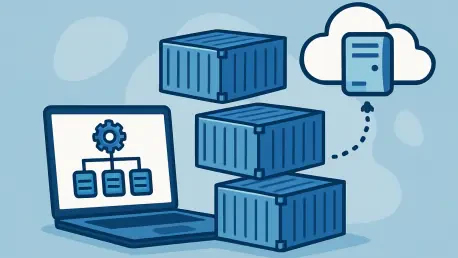

The transition from traditional physical servers to virtual instances felt like a revolution, but it was merely a prelude to the surgical precision offered by modern containerization techniques. Software development has moved beyond the era of massive, slow-moving monolithic architectures toward a landscape defined by agility and environmental consistency. This shift represents more than a change in tools; it is a fundamental reconfiguration of how code is packaged, transported, and executed across the global digital infrastructure. By decoupling the application from the underlying operating system, containerization has solved the persistent discrepancy between a developer’s local machine and the high-stakes production environment.
Modern deployment is no longer a localized event but a continuous flow of micro-updates that sustain the digital services people rely on daily. As organizations strive for higher velocity, the containerized model has become the industry standard, offering a way to manage complexity without sacrificing performance. This review examines the mechanisms that have made this possible, evaluating the current state of the technology while identifying the friction points that still challenge even the most sophisticated engineering teams.
The Evolution of Cloud-Native Deployment
The trajectory of cloud-native deployment began with a desperate need to move away from the “heavy” nature of virtual machines. While virtualization allowed multiple operating systems to run on a single piece of hardware, it introduced significant overhead because each instance required its own full kernel and set of system resources. Consequently, scaling an application meant waiting minutes for a new virtual machine to boot, which proved inadequate for the rapid fluctuations of modern internet traffic. The industry required a more granular approach that could offer the same isolation as a virtual machine but with the speed and efficiency of a native process.
As microservices began to replace monolithic codebases, the traditional deployment methods became a bottleneck. Managing hundreds of independent services, each with its own specific dependencies and runtime requirements, was impossible using manual configuration scripts. This pressure gave rise to the philosophy of “infrastructure as code,” where the environment is defined and versioned just like the application logic. This evolution transformed the role of the operations engineer, shifting the focus from maintaining individual servers to designing automated systems capable of managing thousands of ephemeral units of software.
Core Pillars of the Container Ecosystem
Standardized Packaging with Docker
Docker fundamentally changed the software delivery pipeline by introducing the concept of an immutable image. By utilizing Linux kernel features such as namespaces and control groups (cgroups), it creates an isolated space where an application can run with its own filesystem, network stack, and process tree. This implementation is unique because it allows multiple containers to share the same host kernel while remaining completely invisible to one another. The primary benefit here is the elimination of “dependency hell,” where different applications on the same server might require conflicting versions of the same library.
The efficiency of this approach cannot be overstated, as a Docker image contains only the application and the minimal files required to run it. When a container starts, it does not go through a full boot sequence; it simply initiates the application process within its isolated environment. This results in startup times measured in milliseconds rather than minutes. For developers, this means the exact same binary used during testing is the one that reaches the customer, providing a level of reliability that was previously unattainable in diverse computing environments.
Production Orchestration with Kubernetes
If a container provides the unit of software, then an orchestrator is the conductor that ensures these units work together harmoniously at scale. Kubernetes has emerged as the dominant force in this space, primarily because it moves away from imperative management—telling the system what to do—and toward a declarative model. In a declarative system, a developer defines the “desired state,” such as having five copies of a specific service running at all times. Kubernetes then employs a continuous reconciliation loop, constantly checking the actual state against the desired state and taking corrective action if they do not match.
This self-healing capability is what differentiates a professional production environment from a simple testing lab. If a hardware node fails or a container crashes, the orchestrator automatically identifies the gap and redeploys the missing components on healthy infrastructure. Moreover, it handles the complex networking involved in service discovery, ensuring that different parts of a large application can find and communicate with each other regardless of where they are physically running. This abstraction allows developers to focus on writing features rather than worrying about the underlying plumbing of the data center.
Emerging Trends and Technological Innovations
The current landscape is rapidly moving toward an even higher level of abstraction through serverless containerization. Technologies like AWS Fargate and Knative are redefining the operational boundary by removing the need for teams to manage the underlying clusters of servers. In this model, the infrastructure becomes invisible, scaling automatically based on incoming requests and charging only for the exact duration the code is running. This shift is significant because it allows smaller organizations to leverage the power of massive-scale orchestration without needing a dedicated team of site reliability engineers.
Furthermore, the rise of the Service Mesh, exemplified by platforms like Istio, is addressing the security and observability challenges inherent in distributed systems. As the number of containers grows, managing the communication between them becomes a major security risk. A Service Mesh injects a dedicated “sidecar” proxy into every container, handling encryption, authentication, and traffic routing at the network level. This implementation allows for sophisticated strategies like “canary deployments,” where a new version of a feature is slowly rolled out to a tiny percentage of users to ensure stability before a full release.
Real-World Applications and Sector Impact
In the financial services sector, the adoption of containerized deployment has been a catalyst for digital transformation. Legacy banking systems, which were once updated only a few times a year, are being broken down into microservices that can be deployed dozens of times a day. This allows institutions to respond to market changes or security threats with unprecedented speed. By using containers, these organizations can maintain a high degree of security isolation while ensuring that a failure in one service—such as a mobile payment module—does not take down the entire core banking system.
The e-commerce industry similarly relies on these technologies to handle the extreme volatility of shopping events like Black Friday. During peak times, the orchestration layer can scale up thousands of additional containers in seconds to handle the surge in traffic, then spin them down just as quickly when the demand subsides. This elasticity is not just about performance; it is a financial strategy that prevents companies from paying for idle server capacity. At the edge of the network, containers are also enabling IoT devices to process data locally, reducing the latency involved in sending information back to a central cloud server.
Operational Hurdles and Implementation Challenges
Despite the clear advantages, the complexity of managing a containerized ecosystem can be a significant deterrent for many teams. The learning curve for Kubernetes is notoriously steep, often referred to as the “Kubernetes tax.” Misconfigurations in network policies or resource limits can lead to catastrophic failures that are difficult to diagnose. Because the environment is ephemeral—containers are created and destroyed constantly—traditional logging and monitoring tools often fail to provide a clear picture of what happened during a specific incident.
Security also remains a moving target, as the shared kernel architecture of containers presents a different attack surface than virtual machines. If a container is compromised and the host kernel has an unpatched vulnerability, an attacker could potentially “escape” the container and gain access to the host or other containers on the same machine. Additionally, the supply chain of container images is a major concern; using unverified base images from public registries can introduce malware or outdated libraries into a production environment. Organizations must therefore implement rigorous image scanning and signing processes to mitigate these risks.
Future Trajectory of Containerization
The next phase of this technological journey involves the democratization of stateful workloads within containers. Historically, databases and other applications that require persistent storage were kept outside of clusters because containers are naturally temporary. However, advancements in storage orchestration are making it possible to run complex, data-heavy applications with the same ease as stateless web services. This will lead to truly “all-in-one” clusters where the entire application stack, from the front-end to the deep storage layer, is managed through a single orchestration interface.
We are also seeing the early stages of AIOps integration, where machine learning models are used to manage the orchestration layer itself. Rather than waiting for a traffic spike to occur, these systems can analyze historical data to predict when demand will increase, preemptively scaling resources before the user experiences any slowdown. This move toward “autonomous infrastructure” will likely reduce the operational burden on human engineers, allowing them to shift their focus from maintenance to higher-level architectural design and innovation.
Summary and Final Assessment
The shift toward containerized application deployment proved to be a defining moment for the software industry, effectively bridging the gap between development speed and operational stability. By standardizing the environment through Docker and automating the management of that environment through Kubernetes, organizations successfully mitigated the risks associated with scaling complex digital services. This transition allowed for a more modular approach to building software, where individual components were updated and scaled independently, fostering a culture of continuous improvement and resilience.
Ultimately, the technology matured to a point where it became the indispensable backbone of the modern cloud ecosystem. While the operational complexity remained a formidable challenge, the benefits of portability, resource efficiency, and automated recovery outweighed the initial investment for most mid-to-large scale enterprises. The industry moved toward a future where infrastructure was treated as a fluid, intelligent resource rather than a static collection of servers. This journey solidified containerization as a permanent fixture in the technological landscape, setting the stage for the next generation of autonomous and edge-based computing.