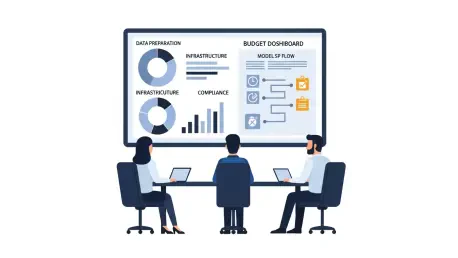

Budget officers counted line items, mission owners pressed for speed, and security leaders flagged opaque risks that could not pass an audit, and together they confronted a straightforward reality: the biggest model on the market was rarely the right fit for a high‑stakes federal workload. As agencies pushed AI deeper into casework, field support, and contact centers, the price of chasing general intelligence with proprietary, internet‑trained systems rose faster than anticipated. Licensing turned out to be the least of it. Data preparation often consumed 20–30% of total spend, infrastructure upgrades added 15–25%, and compliance in regulated missions drove costs as much as 50% higher than baseline. Against that backdrop, a different pattern gained traction—smaller, open‑weight models that could be inspected, governed, and tuned for a narrow job without sending sensitive data off‑premises.
The Case for Glass Box Models: Cost, Compliance, and Control
The shift began with financial clarity. Program leads stopped treating the model license as the budget’s center of gravity and started costing the full pipeline—collection, labeling, redaction, lineage tracking, deployment, and monitoring. When analysts tallied those elements, data work alone routinely ate a quarter of the plan, and modernization of storage, networking, and accelerators layered on another 15–25%. Add elevated compliance for health, finance, or national security missions—often 50% above standard controls—and headline pricing lost significance. Smaller open‑source models altered that calculus. They ran efficiently on existing hardware, fit inside authority‑to‑operate boundaries, and reduced external dependencies. Policy signals reinforced the move: recent White House guidance favored explainability, portability, and reduced vendor lock‑in, making transparent stacks not just cheaper but easier to justify.
Transparency then moved from preference to prerequisite. Proprietary “black box” LLMs trained on vast, unvetted web corpora offered limited visibility into training sets, weighting, and failure modes, constraining audit trails and complicating bias remediation. For agencies handling classified intelligence, veterans’ health records, or benefits eligibility—domains where provenance and explainability mattered—such opacity strained oversight. Open‑weight models provided the alternative. Engineers could examine prompts, responses, and attention patterns; attach retrieval logs; and document why a decision was made. Inspectable pipelines enabled role‑based access, reproducible builds, and red‑team exercises that met internal review and inspector general expectations. This approach traveled well through procurement, too: open licenses supported competitive sourcing, while modular components lowered exit costs if performance, security, or budget conditions changed.
Mission-Tuned and Deployable: Bringing AI to the Data
Performance arguments no longer leaned on raw parameter counts. For focused tasks—summarizing case files, routing FOIA requests, extracting entities from maintenance logs, or flagging anomalous claims—compact models fine‑tuned on agency corpora often matched or surpassed general LLMs. The test that mattered was task completeness under constraints, not encyclopedic recall. A “dictionary‑level” baseline plus targeted fine‑tuning frequently produced more stable outputs, fewer hallucinations, and tighter latency windows. Fraud teams saw this clearly: when trained on internal adjudication rules, historical decisions, and known attack patterns, small classifiers and instruction‑tuned models surfaced subtle coordination and policy edge‑cases faster than broad models distracted by web noise. Predictability improved acceptance. Stakeholders could review confusion matrices, calibrate thresholds, and correct drifts with curated updates rather than relearning a sprawling black box.
This approach naturally led to where the work lived. Agencies kept models beside sensitive data—in secure on‑prem clusters, air‑gapped facilities, and tactical edge kits—shrinking risk and trip time. Lightweight architectures deployed on Kubernetes through platforms such as OpenShift AI offered a consistent path from lab to production, with admission controls, GPU pooling when available, and fallbacks to CPUs. Optimization stacks inspired by the Neural Magic toolchain pruned and quantized models so they ran on existing x86 nodes, a practical win for field bureaus that lacked dedicated accelerators. Community projects like InstructLab broadened who could refine behavior: domain experts encoded policies and exemplars while governance teams enforced review gates. In operations, these choices paid off. Wildfire crews received on‑scene summarization and planning aids without routing imagery to third parties, and battlefield units gained decision assistance with sub‑second latency inside approved comms. The next steps were concrete and time‑bound: inventory sensitive use cases, fund data readiness as a first‑class milestone, select open weights with clear licenses, pilot at the edge on current hardware, and measure total cost quarterly with compliance included. Taken together, those moves laid out a pragmatic path that favored smaller, transparent, mission‑adapted systems and left agencies with control over spend, security, and outcomes.