
The immense computational power once exclusive to sprawling, climate-controlled server farms is undergoing a profound decentralization, finding a new home in a compact chassis designed for the modern desktop. NVIDIA’s DGX Spark, a system powered by the innovative Grace Blackwell architecture, is at the forefront of this transformation, evolving from a standalone piece of powerful hardware into a comprehensive and highly responsive ecosystem. Through a multi-faceted strategy combining continuous software optimization, support for new data formats, and strategic collaborations, the platform is making large-scale artificial intelligence model interaction both practical and efficient for individual developers and creators. This shift democratizes access to high-performance AI, empowering a new generation of users with capabilities that, until recently, were confined to enterprise-level data centers, fundamentally changing the landscape of local AI development, inference, and content generation. The maturation of this ecosystem signals a pivotal moment where the barrier to entry for cutting-edge AI work is dramatically lowered.
Unlocking Next-Generation Performance
The core of the DGX Spark’s enhanced capability lies in a sophisticated new software release that, when combined with specific model-level optimizations, delivers a significant leap in performance. A central pillar of this advancement is the platform’s native support for the NVIDIA NVFP4 data format, a novel precision format engineered to drastically reduce the memory footprint of next-generation models while simultaneously boosting throughput. To illustrate its impact, running the complex Qwen-235B model on a dual DGX Spark configuration using NVFP4 and speculative decoding yields a performance increase of up to 2.6 times compared to the already efficient FP8 precision. However, the benefits extend beyond raw speed, directly addressing critical memory constraints. While the Qwen-235B model saturates the combined memory of two systems using FP8, quantizing to NVFP4 reduces memory consumption by approximately 40%. This substantial reduction is achieved while maintaining high accuracy, effectively delivering FP8-equivalent results with significantly more available memory, which translates to a more fluid and productive development experience that enables multitasking and the simultaneous operation of other demanding workloads.
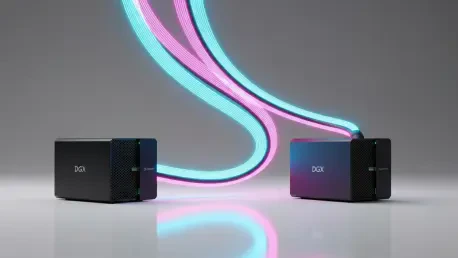
This software prowess is built upon a solid hardware foundation meticulously designed for local large model development and demanding AI tasks. The DGX Spark system itself features a substantial 128GB of unified memory, all contained within a compact desktop form factor that belies its immense power. For projects that require even greater scale, the platform’s architecture is inherently scalable; two DGX Spark systems can be seamlessly interconnected to deliver a combined 256GB memory pool. This multi-node connectivity is facilitated by high-performance ConnectX-7 networking, which provides a massive 200 Gbps of bandwidth between the units. Such a high-speed, low-latency connection is essential for resource-intensive distributed workloads, such as multi-node model training and large-scale inference. This ensures that communication between the two systems is never a bottleneck, allowing developers to treat the combined hardware as a single, powerful resource for tackling incredibly large and complex models without ever needing to leave their desk or rely on remote cloud infrastructure.
A Versatile Tool for Developers and Creators
NVIDIA’s strategy for augmenting the DGX Spark platform extends beyond its own software stack, relying heavily on a symbiotic relationship with the open-source community to drive performance and expand usability. A prime example of this synergy is evident in recent updates to the popular Llama.cpp library, a widely used tool for running large language models. These collaborative updates have yielded an average performance uplift of 35% when running mixture-of-experts (MoE) models on the DGX Spark. This optimization directly enhances both throughput and efficiency for popular open-source workflows, demonstrating a clear commitment to supporting and accelerating the tools that developers are already actively using. By contributing to and optimizing these community-driven projects, NVIDIA ensures that performance gains are accessible to a broader audience, fostering an environment of shared innovation and making the DGX Spark an even more compelling platform for the open-source AI development community, which thrives on accessible and powerful hardware.
Beyond its role as a premier developer platform, the DGX Spark is positioned as an invaluable asset for creative professionals across various industries. The system’s architecture allows artists, designers, and content creators to offload computationally demanding AI generation tasks, thereby freeing up their primary laptop or PC to remain responsive for other critical creative work like editing, rendering, or design. Its generous 128GB of unified memory is more than sufficient to run large-scale creative models like GPT-OSS-120B or the 90GB FLUX 2 at full precision, ensuring the highest possible quality for generated outputs without compromise. Leading diffusion models, including FLUX.2 from Black Forest Labs and Qwen-Image from Alibaba, are also leveraging the NVFP4 format to significantly reduce their memory footprint and improve performance on the platform. The system is particularly well-suited for the memory- and compute-intensive task of AI video generation, with new models like the LTX-2 audio-video generator from Lightricks featuring NVFP8-optimized weights that deliver substantial performance gains, making high-quality, desktop-based video creation a practical and accessible reality.
Building a Robust and Accessible Ecosystem
To bolster the ecosystem and ensure a consistently reliable user experience, DGX Spark and related OEM GB10-based systems have been integrated into the NVIDIA-Certified Systems program. This crucial certification validates system performance, stability, and management features across a wide gamut of accelerated AI, high-performance computing, and professional graphics workloads. By undergoing this rigorous validation process, these systems provide users with a trusted and dependable foundation for their most ambitious projects, removing the uncertainty often associated with configuring high-performance hardware and software. To further accelerate user onboarding and productivity, NVIDIA is releasing a comprehensive new set of “DGX Spark playbooks.” These practical, hands-on tutorials are designed to demystify the platform’s advanced capabilities and showcase the power of the Blackwell GPU. The playbooks cover a diverse range of cutting-edge applications, including running NVIDIA’s Nemotron 3 Nano 30B MoE model for LLM experimentation, building and training robotics applications with Isaac Sim, and deploying GPU-accelerated workflows for specialized fields like quantitative finance and genomics.
The final piece of the platform’s evolution centered on dissolving the physical boundaries of the desktop itself through significant improvements in accessibility and hybrid deployment. A pivotal update to NVIDIA Brev allowed users to register their local DGX Spark, which made it securely accessible from any location and enabled seamless, secure access sharing with team members. This functionality was instrumental in facilitating powerful hybrid deployment models, where sensitive or proprietary tasks could be processed on a local model running on the DGX Spark, while more general reasoning tasks were intelligently routed to frontier models in the cloud, a workflow expertly demonstrated by the NVIDIA LLM Router example. This integration of remote access, collaborative tools, and hybrid cloud capabilities, which reached its official release in the spring of 2026, ultimately provided the “last mile” of accessibility. It transformed the DGX Spark from a powerful local machine into a versatile and connected node in a modern, distributed workflow, empowering users with personalized and private AI applications that were both powerful and practical.