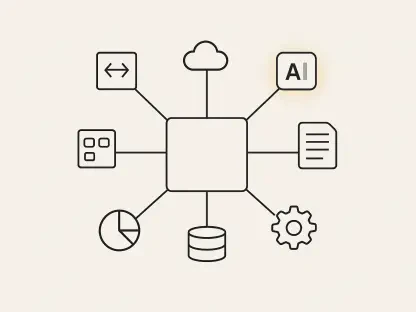

The modern enterprise data landscape is a sprawling, complex ecosystem where monolithic relational databases now share the stage with a diverse cast of NoSQL solutions, creating a fragmented and challenging environment for developers. This reality has catalyzed a strategic shift toward unified data access models, a growing trend designed to abstract away the underlying complexity. This analysis explores this movement, examining how it simplifies development, enhances application portability, and aligns data operations more closely with business logic, with a particular focus on the evolution of Jakarta Data as a key driver of this unification in Enterprise Java.
The Evolution from Siloed Persistence to Unified Abstraction
Charting the Trend: The Move Beyond Traditional ORM
For years, Object-Relational Mapping (ORM) frameworks, epitomized by the Jakarta Persistence API (JPA), were the undisputed standard for data access. They provided a robust bridge between object-oriented code and relational databases. However, this model was built for a world dominated by SQL. As industry adoption of NoSQL databases—including document, key-value, and graph stores—surged, the relational-centric nature of traditional ORM became a significant limitation, forcing development teams to juggle multiple, disparate data access patterns within a single application.
In response to this fragmentation, the enterprise software community began to seek a higher level of abstraction. Jakarta EE’s introduction of Jakarta Data marked a pivotal moment in this trend. This specification was conceived not to replace JPA but to create a standardized, application-level data access layer that could span diverse data stores. Its purpose is to provide a common programming model, moving the developer’s focus away from the specific query language or API of the underlying database and toward a more universal, domain-oriented approach.
The Repository Pattern in Practice
At the heart of this unified model lies the repository pattern, a well-established concept from Domain-Driven Design (DDD) that decouples the application’s business logic from the technical details of data storage. A repository acts as an in-memory collection of domain objects, allowing developers to interact with data in a way that feels natural and intuitive. This abstraction is key to achieving a consistent data access strategy across a polyglot persistence architecture.
For handling common data operations, this trend manifests through the use of built-in repository interfaces. For instance, a developer can define an interface that extends a base like CrudRepository to instantly gain standard Create, Read, Update, and Delete (CRUD) methods. This simple declaration drastically reduces boilerplate code and ensures that fundamental data interactions are handled consistently, regardless of whether the data resides in a relational PostgreSQL database or a NoSQL MongoDB collection. Consequently, the application becomes more maintainable and less coupled to a specific persistence technology.
Moreover, the unification trend fully supports complex, domain-specific requirements through custom repositories. Instead of being limited to generic CRUD operations, developers can define repository interfaces with methods that directly reflect business processes, such as findAllProductsReadyForShipment() or findOverdueInvoicesByCustomer(). This approach transforms the data access layer into an expressive reflection of the application’s domain. It shifts the conversation from technical storage commands to business logic, resulting in code that is not only cleaner and more readable but also easier for new team members to understand and for domain experts to validate.
Industry Insights on the Unification Strategy
Industry experts consistently emphasize that unified data models like Jakarta Data are not intended to replace powerful, store-specific tools like Jakarta Persistence. Instead, they function at a more abstract level, complementing rather than supplanting existing technologies. Jakarta Persistence, for example, remains the ideal solution for applications that require fine-grained control over relational database interactions, SQL semantics, and transactional persistence contexts. The unification strategy carves out a different, yet equally important, role.
The primary objective of this trend is to reorient the developer’s mindset from the mechanics of data storage to the expression of domain logic. In traditional data access, a significant portion of a developer’s effort is spent writing and optimizing SQL or native NoSQL queries, a task that tightly couples the application logic to the database technology. Unified models abstract these technical details behind a clean, domain-centric interface. This shift liberates developers to focus on solving business problems, leading to more robust and business-aligned software.
Ultimately, this approach consolidates common data interaction patterns into a single, standardized, and type-safe programming model. By providing a consistent way to define repositories, query data, and handle persistence, it promotes code that is significantly easier to read, maintain, and test. This standardization also enhances portability; an application built on a unified data access model can, in theory, be migrated from one type of data store to another with minimal changes to the business logic, a crucial advantage in today’s fast-evolving technology landscape.
Future Trajectory: What’s Next for Unified Data Access
Deepening Integration with Stateful Repositories
A key evolution in the unified data access trend is the introduction of stateful repositories, a development highlighted by advancements such as those seen in Jakarta EE 12 M2. Initially, many unified models favored a stateless approach where developers were required to explicitly call save or update methods to persist changes. Stateful repositories, in contrast, are aware of a persistence context, similar to the EntityManager in JPA. This awareness allows them to automatically track and manage entity state transitions, persisting changes transparently at the end of a transaction.
This enhancement effectively bridges the gap between the simple, explicit-save model and the more traditional, context-aware persistence model familiar to many enterprise developers. It offers teams greater flexibility, allowing them to choose the persistence style that best aligns with their application’s architecture and transactional complexity. The future will likely see further refinement of this dual-model approach, empowering developers with the ability to mix and match persistence strategies to fit the specific needs of different parts of their application.
The Emergence of a Common Query Language
One of the most significant challenges in data unification is creating a consistent way to query across fundamentally different types of databases. The prevailing trend is to address this by separating query logic into a distinct, portable specification, such as the emerging Jakarta Query. This decouples the act of defining a query from the repository pattern itself, allowing for a more focused and powerful query standard.
This movement involves the definition of a common query language, such as Jakarta Common Query Language (JCQL). This language is strategically designed as a logical subset of well-known languages like Jakarta Persistence Query Language (JPQL), making it immediately familiar to a broad audience of developers. At the same time, it is abstract enough to be implemented by providers for both SQL and various NoSQL databases. Future developments are expected to focus on expanding the capabilities of these common query languages, standardizing advanced features like cursor-based pagination to handle large, dynamic datasets with greater efficiency and consistency.
Conclusion: A Cohesive Vision for a Polyglot World
The trend toward unified data access models represented a critical maturation of enterprise application development. It was a direct and effective response to the complexities introduced by the widespread adoption of polyglot persistence. By embracing high-level abstractions, this approach provided a clear and powerful strategy for taming data complexity in a world where a single application might rely on multiple, diverse data stores.
Through the widespread adoption of the repository pattern and the development of common query standards, developers gained a cohesive framework for interacting with data. This shift allowed them to focus more on implementing business logic and less on the technical minutiae of specific database technologies. The continued evolution of specifications like Jakarta Data empowered development teams to build applications that were more portable, maintainable, and centered on their business domain, ensuring they were well-equipped for the future of the data-driven enterprise.