
For years, the DevOps movement has walked a tightrope, balancing the relentless demand for faster software delivery against the critical need for unwavering operational stability, a conflict that artificial intelligence is now decisively resolving. This integration marks a significant evolution, moving far beyond the simple automation of scripts and tasks. AI-driven DevOps represents a paradigm shift toward intelligent, adaptive, and predictive capabilities embedded across the entire software delivery lifecycle. It introduces a new level of sophistication where systems not only execute commands but also learn from data, anticipate problems, and optimize their own performance. This analysis explores the data fueling this transformation, examines the key patterns emerging in development, testing, CI/CD, and operations, and considers the future outlook for engineering teams navigating this new landscape.
The Data-Driven Ascent of AI in DevOps
Quantifying the Impact Growth and Adoption Metrics
The adoption of artificial intelligence within DevOps is no longer a niche experiment but a rapidly accelerating mainstream movement. Industry forecasts paint a clear picture of this trajectory, with projections indicating that over half of all enterprise engineering teams will actively utilize AI agents within their delivery pipelines by 2027. This rapid integration is not driven by hype but by tangible, measurable results that provide a compelling competitive advantage. The transition from speculative technology to essential toolkit is happening at an unprecedented pace as organizations recognize the strategic value of intelligent software delivery.
Early adopters are already reaping substantial rewards, establishing a high bar for performance and efficiency. Data from these pioneering organizations reveal impressive gains, including a 20-30% increase in overall delivery speed and a remarkable 40% reduction in release defects. Furthermore, individual developer productivity has seen a significant boost, with studies showing that engineers using AI assistants complete coding tasks up to 55% faster. These metrics underscore a critical trend: AI is evolving from a helpful utility into a core component of high-performing engineering cultures, fundamentally changing how software is built, tested, and deployed.
Real-World Implementations AI in Action
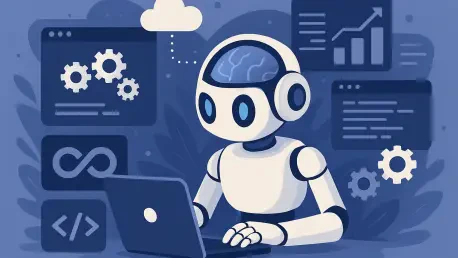
In practice, this trend is manifesting through a new generation of sophisticated tools. AI programming assistants such as GitHub Copilot and Amazon CodeWhisperer have become invaluable assets, functioning as always-on “junior pair programmers.” They provide real-time code suggestions, generate boilerplate logic, and help identify potential bugs during the creative process, allowing developers to offload repetitive work and concentrate on solving complex architectural challenges. This human-machine collaboration is streamlining the entire development phase, turning abstract concepts into functional code with greater speed and fewer errors.
Simultaneously, the operational side of DevOps is being transformed by AIOps platforms. These systems ingest vast amounts of telemetry data from production environments to proactively monitor system health, distinguish critical signals from background noise, and dramatically reduce the alert fatigue that plagues on-call engineers. By enabling automated remediation and intelligent incident analysis, AIOps shifts operations from a reactive fire-fighting model to a proactive, preventative posture. Concrete case studies validate this impact, with companies reporting significant business outcomes, including up to a 30% reduction in costly deployment rollbacks and a marked decrease in mean time to recovery (MTTR) following incidents.
The Evolving Paradigm From Automation to Autonomy
The integration of AI into DevOps signifies a fundamental evolution from reactive, human-driven processes to proactive, AI-augmented systems. This shift is redefining the role of the engineer and the nature of the software delivery pipeline itself. Instead of merely executing predefined tasks, intelligent systems are beginning to anticipate needs, identify risks, and make informed decisions, fundamentally altering the dynamics of software creation and maintenance.
Expert consensus frames AI as a powerful “force multiplier.” Its ability to analyze massive datasets, recognize complex patterns, and execute repetitive tasks with flawless precision frees human engineers from tedious, low-value work. This allows them to redirect their expertise toward strategic initiatives, creative problem-solving, and sophisticated architectural design. The result is a more engaged, innovative, and impactful engineering workforce, focused on delivering business value rather than managing operational overhead.
This trend is best understood as a progression from simple automation to genuine autonomy. While automation involves executing a predetermined script, autonomy implies the ability to learn, adapt, and make intelligent decisions based on changing conditions. This is clearly visible in emerging patterns like self-healing tests that automatically adjust to minor code changes and self-optimizing CI/CD pipelines that reconfigure workflows for maximum efficiency.
Success in this new era hinges on creating a symbiotic relationship between human expertise and machine intelligence. The most effective emerging pattern is one of “AI as co-developer, human as quality guardian.” In this model, AI provides the speed, scale, and analytical power, while human engineers provide the critical oversight, strategic direction, and ethical judgment. This partnership ensures that the velocity gained through AI does not come at the expense of quality, security, or compliance, creating a balanced and sustainable path forward.
Transforming the Software Lifecycle Key AI-Driven Patterns
The future of DevOps is being actively shaped by a set of powerful, AI-driven patterns that deliver both unprecedented speed and enhanced safety across every stage of the software lifecycle. These patterns are not isolated improvements but interconnected components of a more intelligent and resilient delivery ecosystem. By integrating AI into core workflows, organizations can achieve a powerful synthesis of agility and stability that was previously unattainable.
The benefits of adopting these patterns are multifaceted, leading to significant increases in developer productivity, higher software quality, and dramatically improved system resilience in production. However, this transformation also introduces a critical new challenge: establishing robust governance models. As AI begins to generate code, make deployment decisions, and manage infrastructure, organizations must develop new frameworks to ensure the security, compliance, and ethical use of these AI-generated assets and autonomous actions.
Development and Code Creation The Rise of the AI Co-Developer
In the development phase, AI assistants are accelerating the creation of code by handling routine tasks, generating boilerplate, and identifying potential bugs in real time. This allows developers to maintain their creative flow and focus on higher-order challenges, such as designing elegant system architectures and implementing complex business logic. The AI co-developer acts as an intelligent partner, augmenting the developer’s skills and amplifying their output.
This acceleration, however, must be managed with disciplined engineering practices. The speed and convenience offered by AI-generated code must be balanced with rigorous peer reviews and comprehensive automated testing. By treating AI-generated code with the same level of scrutiny as human-written code, teams can leverage the productivity gains without compromising on quality or introducing unforeseen risks. This ensures that velocity and stability remain in harmony.
Quality Assurance and Testing Achieving Quality at Unprecedented Speed
AI is revolutionizing quality assurance by making testing faster, smarter, and more resilient. When a test fails, AI-powered tools can autonomously perform root cause analysis by sifting through logs, code changes, and execution data to pinpoint the source of the failure. This capability can reduce the time spent on debugging by up to 80%, freeing developers to focus on fixing issues rather than finding them.
Moreover, AI is solving the long-standing problem of brittle test suites. Self-healing tests can automatically adapt to minor, non-breaking changes in the application’s user interface or underlying code, which would traditionally cause automated tests to fail. This intelligence drastically reduces the test maintenance burden and minimizes the false positives that can erode confidence in the CI/CD pipeline, ensuring that quality signals remain reliable and actionable.
CI CD and Deployment The Intelligent Release Co-Pilot
The CI/CD pipeline is transforming from a static sequence of scripts into an intelligent release co-pilot. AI-augmented pipelines utilize real-time quality gates that can predict the risk associated with a new change, while predictive failure detection analyzes historical data to flag and halt potentially problematic deployments before they reach production. This proactive approach creates a safer and more efficient path to release.
Furthermore, these intelligent pipelines feature autonomous build optimization, learning over time to allocate resources and sequence tasks for the fastest possible execution. Automated compliance and governance agents are also becoming standard, enforcing security policies, checking for license violations, and ensuring regulatory adherence without requiring manual intervention. This creates a release process that is not only faster but also inherently more secure and compliant.
Operations and Monitoring Building Self-Healing Resilient Systems
In the realm of operations, AIOps is enabling the creation of self-healing, highly resilient systems. By leveraging machine learning, AIOps platforms can perform intelligent anomaly detection, distinguishing between normal fluctuations and genuine incidents. They also correlate thousands of individual alerts into single, context-rich events, effectively eliminating the alert fatigue that can lead to human error.
The true power of AIOps lies in its proactive capabilities. Predictive incident warnings give teams advance notice of potential problems, allowing them to intervene before downtime occurs. When an issue does arise, automated remediation workflows can trigger self-healing actions, such as restarting a service or rolling back a deployment. Combined with AI-driven root cause analysis, these capabilities create systems that can diagnose and resolve many classes of problems autonomously, dramatically reducing mean time to recovery.
Conclusion The New DevOps Frontier
The integration of artificial intelligence is proving to be a fundamental paradigm shift for DevOps, not merely another incremental tool. It enables organizations to finally resolve the central tension between development velocity and operational stability, achieving both simultaneously. The patterns emerging from this trend, such as the AI co-developer, intelligent quality assurance, autonomous pipelines, and proactive AIOps, are quickly becoming the standard for high-performing engineering teams. Adopting these capabilities is no longer optional for those seeking a competitive edge. The future of software delivery lies in this sophisticated human-machine partnership, a new frontier where moving fast is no longer synonymous with breaking things, but with intelligently innovating and resolving issues with unprecedented speed and precision.