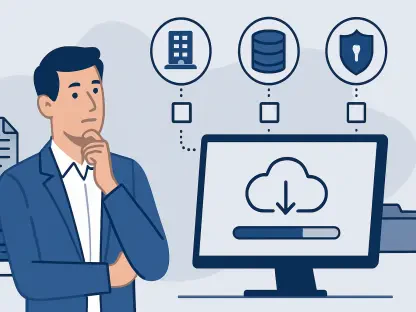

Modern enterprises are currently navigating a complex digital landscape where the incredible efficiency gains promised by artificial intelligence often conflict with the fundamental necessity of protecting proprietary internal datasets. As organizations integrate advanced linguistic models into their daily operations, the risk of sensitive information leaking into public training sets has become a central concern for legal and security departments alike. This tension has forced a pivot in strategy, moving away from direct data interaction with third-party cloud services toward a more isolated and controlled methodology. Instead of uploading sensitive spreadsheets or legal documents to external servers, savvy businesses are now utilizing these powerful models strictly as software architects to build custom, localized tools. This shift effectively creates a protective barrier, allowing the intelligence of the model to design the logic while keeping the actual data processing strictly within the confines of the company’s own secure internal infrastructure.
Establishing Data Sovereignty Through Local Code Execution
The transition toward using artificial intelligence as a code generator rather than a direct data processor represents a significant milestone in the evolution of enterprise data sovereignty. By instructing a model to write a specialized Python script or a local automation routine, a developer can create a functional tool that performs complex data analysis on a local machine without any records ever leaving the premises. This approach replaces the inherent vulnerability of data transmission with the comparative safety of code generation, as the resulting scripts operate entirely on isolated hardware. Consequently, the sensitive records, financial projections, and customer identities that constitute a firm’s competitive advantage remain under the absolute control of internal IT systems. This methodological change ensures that even if the cloud-based assistant is compromised, the actual proprietary data remains untouched, as it was never part of the conversation between the user and the external large language model during the tool’s initial creation phase.
Beyond the immediate benefits of data containment, this strategy provides a level of transparency and auditability that black-box cloud processing simply cannot match in a modern regulatory environment. When a company uploads a file to a remote server for analysis, the logic applied to that data is often opaque, making it difficult to verify the accuracy or security of the operation. In contrast, when an AI generates a local script, human developers can meticulously review every line of code to ensure it follows internal security protocols and contains no hidden backdoors or logical fallacies. This human-in-the-loop verification process acts as a rigorous filter, transforming the raw output of the AI into a vetted corporate asset that is both reliable and compliant with industry standards. As a result, the ability to inspect and test the generated software before execution builds a foundation of trust, allowing organizations to leverage high-speed automation while maintaining the same strict oversight traditionally reserved for manually written proprietary software.
Navigating Operational Risks and Governance Requirements
While the advantages of local execution are compelling, the implementation of such a decentralized software strategy introduces a unique set of operational challenges that require careful management. One of the most significant hurdles is the increased demand for technical literacy among non-technical staff who must now understand how to execute and monitor locally generated scripts safely. Without a standardized framework for managing these tools, there is a substantial risk of shadow IT proliferating throughout the organization, where employees use unvetted scripts that lack long-term support or official documentation. Furthermore, software written by an artificial intelligence lacks the traditional lifecycle management of commercial products, such as routine security patches and compatibility updates for evolving operating systems. Organizations must therefore establish clear governance policies to prevent the accumulation of technical debt, ensuring that every AI-generated tool is properly cataloged and remains functional as the underlying corporate infrastructure changes over time.
To successfully bridge the gap between rapid innovation and rigorous governance, forward-thinking organizations moved to treat artificial intelligence as a creative partner rather than a direct data processor. They recognized that the true strategic value of these models lay in their ability to act as architects, enabling the rapid prototyping of independent tools that remained fully auditable and locally controlled. By prioritizing the generation of functional code over the direct processing of sensitive records, these firms effectively bypassed the massive infrastructure costs and privacy risks associated with large-scale private cloud deployments. Leaders established internal repositories for vetted scripts, ensuring that the knowledge gained during the development process became a permanent part of the corporate library. This proactive stance allowed businesses to harness the full potential of automated reasoning while maintaining an ironclad grip on their most valuable digital assets. Ultimately, the integration of AI-built software became a cornerstone of modern cybersecurity, proving that high-level productivity does not have to come at the expense of absolute data privacy.