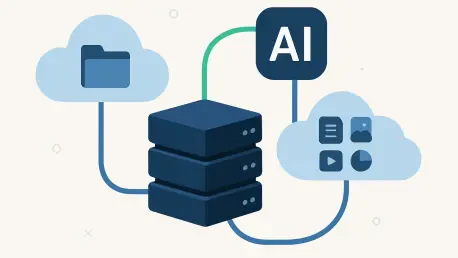

Modern enterprises are currently struggling to navigate a paradox where they possess vast oceans of unstructured data but remain unable to feed this intelligence into generative AI models without compromising security or architectural integrity. This gap often leads to fragmented silos where valuable insights remain trapped within legacy storage systems, shielded by layers of complex permissions that typical large language models cannot interpret accurately. Panzura has addressed this specific friction point by launching Panzura Nexus, a specialized management layer designed to bridge the distance between distributed file data and Microsoft Copilot. By utilizing technology developed through the integration of Moonwalk Universal, the platform provides a direct pipeline from the Panzura CloudFS environment to the AI-driven productivity tools used by millions. This solution represents a shift from static storage toward an active, intelligent data ecosystem that allows teams to query their own proprietary documentation with the same ease as searching the public web, all while maintaining rigorous governance.
Bridging the Gap Between Filesystems and Artificial Intelligence
Technical Integration Through Event-Driven Architectures
The technical sophistication of the Nexus platform is rooted in its event-driven ingestion pipeline, which facilitates a seamless flow of information from storage to the cloud. By utilizing a dedicated Microsoft Graph connector, the system delivers unstructured metadata and user permissions directly into the Microsoft 365 environment, bypassing the need for outdated batch processing methods. This integration allows users to engage with their organization’s files using natural-language queries without the need for complex extract, transfer, and load pipelines or the configuration of intermediary data lakes. Because the system is designed to operate within the native framework of the cloud filesystem, it maintains a level of performance that traditional indexing services often struggle to match. The architecture is built to handle the high throughput required by modern distributed teams, ensuring that the heavy lifting of data preparation is managed automatically in the background while users focus on high-level analysis.
This specific approach to data ingestion captures discrete file events as they occur in real time, including file creations, deletions, renames, and directory modifications. By tracking these changes at the source, the system ensures that the information available to Copilot is continuously synchronized with the live filesystem, preventing the AI from hallucinating or referencing outdated versions of documents. This synchronization is critical for industries like engineering or legal services, where even a slight discrepancy between a draft and a final version can lead to significant operational errors. The event-driven nature of the pipeline also reduces the computational overhead on the primary storage controllers, as it only processes incremental changes rather than scanning the entire directory structure repeatedly. This efficiency allows organizations to scale their AI initiatives across petabytes of data without experiencing the latency or cost spikes typically associated with massive data indexing projects in the enterprise space.
Security Protocols and Permission Synchronization
Data security and corporate governance are the primary hurdles preventing widespread AI adoption, yet the Nexus architecture addresses these concerns through deep integration with existing access controls. A common challenge in enterprise AI implementation is the potential for large language models to bypass established file permissions, inadvertently exposing sensitive information to unauthorized employees. Nexus solves this by exporting CloudFS user permissions and Access Control Lists directly to the Microsoft environment, ensuring that the AI only generates responses based on files that a specific user is authorized to access. This near real-time enforcement of permissions means that if a user’s access to a document is revoked in the filesystem, that change is immediately reflected in the AI’s reasoning capabilities. This creates a secure “sandbox” where the model can only “see” what the user is legally permitted to see, maintaining the integrity of the organization’s internal data privacy policies.
Beyond just synchronizing permissions, the platform provides administrators with a comprehensive dashboard that offers granular visibility into how data is being utilized by the AI. This management interface allows IT teams to monitor upload rates, object counts, and specific filtering options based on user identities or file extensions. By providing this level of transparency, the system empowers administrators to audit AI interactions and ensure that high-value assets are being indexed correctly and securely. For instance, an organization might choose to exclude specific folders containing sensitive payroll information while prioritizing the indexing of technical manuals and project specifications. This selective control allows for a tailored AI experience that aligns with the specific risk profile of the company. The result is a robust governance framework that encourages experimentation with generative tools because the underlying data layer is managed with the same rigor as a traditional banking or healthcare database environment.
Strategic Evolution of Enterprise Data Pipelines
Expanding Beyond CloudFS to Multi-Vendor Ecosystems
The current implementation of Nexus is strategically positioned as a foundational element for more advanced workflows that transcend the boundaries of a single storage provider. While the platform currently focuses on the Panzura CloudFS environment, there is a clear trajectory toward supporting other third-party filesystems, which would provide a unified and secure data pipeline for Copilot regardless of the underlying hardware or cloud storage vendor. This vendor-agnostic vision is essential for modern enterprises that often operate in multi-cloud environments or maintain a mixture of on-premises and cloud-native storage solutions. By centralizing the data ingestion process, companies can avoid the “lock-in” effect of proprietary AI tools, instead choosing a management layer that acts as a universal translator between their diverse data estates and the cognitive capabilities of Microsoft’s large language models. This flexibility is a key differentiator in a market where agility is the primary currency.
As the system evolves from 2026 to 2028, the focus will likely shift toward optimizing these cross-platform pipelines to handle increasingly complex data types beyond simple text documents. The integration of Moonwalk Universal’s technology has already laid the groundwork for this expansion, allowing for the sophisticated management of legacy data infrastructure that was never originally designed for the AI era. By creating a standardized way to present unstructured data to the Microsoft Graph, the system effectively future-proofs an organization’s storage investment. This means that as new AI models are released or existing ones are updated, the data remains ready for consumption without requiring a full re-architecture of the storage environment. This long-term stability allows IT leaders to commit to AI roadmaps with confidence, knowing that their underlying data pipeline is capable of adapting to the rapid pace of technological change without introducing new security vulnerabilities.
Enabling Agentic Workflows Within Copilot Studio
The data ingested through this secure pipeline is destined to serve as the primary knowledge source for custom AI agents developed within Microsoft Copilot Studio, marking a transition toward agentic workflows. These specialized agents can be programmed to perform specific tasks, such as summarizing project timelines or identifying contradictions in legal contracts, by drawing directly from the synchronized data pool provided by Nexus. For organizations running on Microsoft Azure, this creates an end-to-end native AI ecosystem that eliminates the need for third-party infrastructure, allowing enterprises to extract actionable intelligence from their massive volumes of unstructured data while maintaining strict security standards. The ability to build these custom agents on top of a verified and secure data stream represents the next stage of corporate productivity, where AI does not just answer questions but actively assists in the execution of complex business processes based on real-world file data.
The integration of these capabilities into the Microsoft commercial marketplace ensures that the solution is easily accessible for organizations looking to modernize their data strategy immediately. By reducing the barrier to entry for high-level AI integration, the platform encourages a more democratic approach to technology where even mid-sized enterprises can leverage the same tools as global conglomerates. The focus remains on turning “dark data”—the vast majority of enterprise information that is currently unsearchable and underutilized—into a strategic asset that drives competitive advantage. As these AI agents become more autonomous, the importance of a reliable and secure data feed becomes even more paramount. The infrastructure provided here ensures that as the world moves toward more sophisticated autonomous systems, the data powering those systems remains accurate, accessible, and governed by the highest standards of corporate security and compliance.
Actionable Strategies for Data Governance and AI Adoption
To capitalize on these advancements, organizations should have conducted a thorough audit of their current unstructured data footprints to identify high-value datasets for AI ingestion. It was essential for IT leaders to establish clear data classification policies before connecting their filesystems to Copilot, ensuring that sensitive information was correctly tagged and excluded from general indexing. Implementation teams were encouraged to start with small, focused pilot programs involving specific departments, such as technical support or research and development, to demonstrate the immediate ROI of natural-language querying. This phased approach allowed for the refinement of permission structures and the optimization of filtering rules in a controlled environment. Moving forward, the focus must remain on maintaining a clean data hygiene practice, as the quality of AI-generated insights was directly proportional to the accuracy of the underlying metadata and file structures. Companies that prioritized these foundational steps found themselves better positioned to integrate more advanced agentic workflows as their internal AI maturity increased over time.