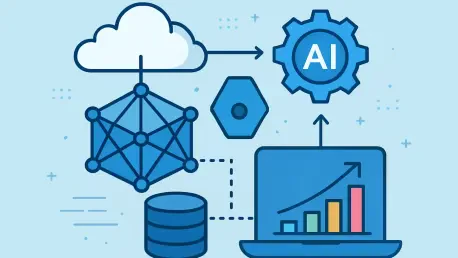

Enterprises are finding that the once-celebrated centralized data lake has become a cumbersome liability in the race for generative artificial intelligence dominance. While the early part of the decade focused on sheer volume, the current landscape of 2026 demands precision, context, and agility that monolithic structures simply cannot provide. These massive repositories often turn into stagnant data swamps where engineering teams are overwhelmed by endless requests for access and transformation. To solve this, technical leaders are turning to the Data Mesh, a decentralized sociotechnical approach that treats data as a first-class product. By leveraging the advanced serverless capabilities of Google BigQuery, organizations are finally dismantling the bottlenecks that have long hindered machine learning workflows. This shift is not merely a change in tooling but a fundamental reimagining of how data is owned, managed, and consumed across the modern enterprise to ensure AI excellence.
1. The Transition to Decentralized Architecture
Traditional data models rely on a single central team to manage the entire pipeline, which frequently leads to significant delays and degraded information quality. The Data Mesh model addresses this by redistributing responsibility across four core principles, starting with distributed domain ownership. In this framework, data is managed by the departments that understand it best, such as Finance or Marketing, rather than a generic IT group. This ensures that the people closest to the source are responsible for its accuracy and relevance. Furthermore, information is treated as a product, meaning it is a high-quality deliverable with specific service-level agreements and documentation. By shifting the focus from simply storing data to delivering refined products, companies can ensure that their AI models are trained on the most reliable and contextually accurate information available, reducing the risk of hallucinations or errors in automated decision-making.
Building on the foundation of domain ownership, the Data Mesh requires an autonomous infrastructure and automated shared governance to function at scale. A central platform team provides the necessary BigQuery environment, but business units maintain full control over their specific data assets. This self-service capability allows individual departments to innovate quickly without waiting for a central authority to approve every schema change or ingestion task. Meanwhile, global security and quality standards are enforced through automated tools rather than manual reviews. This federated governance ensures that while domains operate independently, they still adhere to the organization’s overarching compliance and security policies. This balance between autonomy and control is essential for fostering an environment where AI can thrive across multiple departments simultaneously, enabling the parallel development of machine learning applications that were previously restricted by architectural silos.
2. Mapping Technology to the Mesh
Google BigQuery’s unique architecture is specifically designed to support the separation of storage and processing, making it an ideal candidate for implementing a Data Mesh. This separation allows different business units to interact with the same underlying data without the need for physical duplication, which reduces both storage costs and the complexity of synchronization. Within this ecosystem, BigQuery Datasets act as the primary containers for specific data products, providing a logical boundary for management and security. By organizing data into these discrete units, departments can clearly define what is internal and what is ready for external consumption. This structure mirrors the organizational reality of a modern business, where different teams have distinct needs but must still collaborate within a unified cloud environment. The ability to scale compute resources independently for each domain ensures that one team’s heavy analytical load never impacts another’s.
To facilitate the discovery and sharing of these decentralized assets, Google Cloud provides specialized tools like the Analytics Hub and Dataplex. The Analytics Hub enables secure sharing of data across the organization through a centralized exchange, allowing consumers to find and subscribe to verified data products without complex move-and-copy operations. This creates a marketplace-like experience that accelerates the time-to-insight for data scientists and AI researchers. Complementing this, Dataplex centralizes the management of governance and discovery, providing a unified fabric that spans across multiple BigQuery projects and datasets. It allows administrators to set global policies while giving domain owners the visibility they need to manage their own assets effectively. Together, these technologies provide the technical backbone for a robust Data Mesh, ensuring that data is not only high-quality and domain-owned but also easily accessible to those who need it to drive business value through AI.
3. Creating Data Products and Establishing Ownership
In a decentralized model, departments must handle the entire lifecycle of their information, treating it as a product rather than a byproduct of operations. Establishing a data product begins with initializing the domain container, which involves setting up a specific BigQuery dataset within the department’s dedicated project. This container serves as the production environment where raw data is ingested, cleaned, and refined into a usable format. A true data product includes not just the refined datasets but also the associated metadata, documentation, and security permissions required for safe consumption. By clearly defining these boundaries, the department takes full accountability for the data’s integrity. This localized ownership ensures that any issues are resolved by the experts who understand the underlying business logic, leading to faster remediation and higher overall confidence in the data used for critical machine learning models.
Once the internal infrastructure is ready, the department must generate a controlled interface to share its assets with the rest of the company. This is achieved by building secure views or authorized datasets that expose only the required information, strictly adhering to privacy standards and the principle of least privilege. After creating this interface, the domain team uses Identity and Access Management to grant administrative rights to their own members while providing specific consumer access to authorized service accounts or other departments. This granular control prevents unauthorized data leakage while ensuring that AI consumers have the exactly scoped access they need to perform their work. By providing a clear, documented path for data consumption, domain owners transform their raw information into a reliable resource that can be integrated into various enterprise applications, effectively turning their department into a high-value contributor to the company’s AI ecosystem.
4. Implementing Global Governance with Dataplex
Maintaining data integrity across a decentralized landscape requires a shift from manual oversight to automated governance using tools like Google Dataplex. To prevent the mesh from devolving into a series of disconnected silos, the organization must first establish clear quality metrics that define the standards for completeness, accuracy, and validity. For instance, rules can be set to ensure that primary keys like customer IDs are never null and that financial figures stay within realistic ranges. These metrics serve as the benchmark for every data product within the network. By formalizing these expectations, the central governance team provides a roadmap that domain owners can follow to ensure their products are “AI-ready.” This standardization is crucial because machine learning algorithms are exceptionally sensitive to data quality; even minor inconsistencies in training data can lead to significant biases or failures in the final model’s performance.
Once the standards are defined, the next step involves automating validation through scheduled workflows that scan data against the established rules. Dataplex allows for the continuous monitoring of compliance, generating a “Quality Score” for every data product in the mesh that is visible via a central dashboard. This transparency encourages domain owners to maintain high standards and allows data consumers to quickly assess the reliability of a dataset before incorporating it into their AI projects. If a dataset’s score drops below a certain threshold, automated alerts can notify the domain owners to take corrective action immediately. This proactive approach to data health reduces the burden on central IT and shifts the focus toward a culture of continuous improvement. Ultimately, automated governance ensures that the decentralized architecture remains a cohesive and trustworthy foundation for the company’s most advanced analytical and artificial intelligence initiatives.
5. Powering Machine Learning through the Mesh
A well-implemented Data Mesh dramatically accelerates the work of AI teams by allowing them to “shop” for verified data products in a central catalog. Instead of spending months requesting access and cleaning raw files from disparate sources, data scientists can browse the Analytics Hub to find high-quality, domain-certified datasets. These products are already optimized for consumption, meaning they come with clear schemas and lineage information. Once a required product is located, it can be plugged directly into Vertex AI for model development. This seamless integration between the data layer and the AI platform eliminates the friction that typically stalls machine learning projects. By providing a curated environment of reliable data, the organization enables its AI teams to focus on building innovative features and optimizing model performance rather than wrestling with foundational data engineering tasks.
The power of the mesh is most evident when training models that require data from multiple departments, such as joining Sales information with Marketing engagement metrics. Using BigQuery ML, teams can execute complex joins across different domain projects without moving the underlying files, maintaining data gravity and security. This ability to aggregate across domains while keeping data in its original project ensures that permissions are respected and that the most up-to-date information is always used. The training process runs directly within the BigQuery infrastructure, leveraging its massive parallel processing capabilities to handle even the largest datasets efficiently. This approach not only speeds up the development cycle but also ensures that the models are built on a holistic view of the business. By leveraging the mesh in this way, enterprises can develop more sophisticated, cross-functional AI applications that drive significant competitive advantages in the marketplace.
6. Strategy for Phased Deployment
Transitioning to a Data Mesh is a complex journey that requires a structured roadmap to ensure long-term success. The first phase involves spotlighting pilot programs by selecting two or three departments that have both high-value data and a clear business need for AI integration. These early adopters serve as the testing ground for the decentralized model, allowing the organization to refine its processes in a controlled environment. Once the pilots are identified, the central platform team must configure the technical foundation, deploying the necessary BigQuery and Dataplex environments using automated templates. This technical setup ensures that all domains start with a consistent infrastructure that is already pre-configured for security and performance. By focusing on a few key areas initially, the organization can demonstrate early wins and build momentum for a broader rollout across the entire enterprise.
Following the initial setup, the focus shifts toward standardizing governance and expanding AI integration across the organization. This involves launching automated quality tracking and universal metadata tagging to ensure that all new data products adhere to global standards from the moment they are created. As the technical and cultural foundations solidify, the model is scaled by allowing additional machine learning teams to utilize the established data products. The success of the pilot programs provides a blueprint that other departments can follow, reducing the learning curve and accelerating the adoption of the mesh. This phased deployment allows the organization to manage the change carefully, addressing potential roadblocks as they arise and ensuring that the shift to decentralization is sustainable. Ultimately, this structured approach transforms the data landscape into a dynamic, product-oriented ecosystem that fuels continuous innovation in artificial intelligence.
7. Overcoming Potential Obstacles
One of the primary challenges in a decentralized architecture is maintaining consistency across different departments that may use varying naming conventions or definitions for similar data points. To address these consistency issues, the organization must enforce a set of global master dimensions, such as a universal customer ID or product code, that all domains must use when exposing their data products. This ensures that while departments have the freedom to manage their internal data as they see fit, the external interfaces remain interoperable. Additionally, financial oversight is a common concern as decentralized teams might inadvertently overspend on cloud resources. To mitigate this, administrators can implement BigQuery quotas and reservations for each department, ensuring that no single domain consumes an unfair share of the organization’s compute budget while providing predictable costs for the entire enterprise.
Another significant obstacle is the skills gap that often exists within business units that are not traditionally focused on data engineering. To bridge this gap, the central platform team must provide easy-to-use, self-service templates and comprehensive documentation that simplify the process of creating and managing data products. By lowering the technical barrier to entry, the organization empowers domain experts to take ownership of their data without requiring them to become cloud infrastructure specialists. Training programs and internal communities of practice can also help foster a culture of data literacy and collaboration across the company. By proactively addressing these technical and organizational hurdles, businesses can ensure that their transition to a Data Mesh is smooth and that all departments are equipped to contribute to the company’s AI excellence. This holistic approach ensures that the architecture remains robust, cost-effective, and accessible to everyone.
The transition to a decentralized architecture on Google BigQuery provided a scalable answer to the data bottlenecks that once slowed down enterprise innovation. By treating information as a product and empowering individual domains to take ownership, organizations successfully bridged the gap between raw data collection and actionable machine learning insights. The implementation of automated governance through Dataplex ensured that this newfound autonomy did not come at the cost of security or quality standards. Moving forward, technical leaders should focus on refining their master data dimensions to further improve cross-domain interoperability. Future considerations involve exploring even deeper integrations between the Data Mesh and emerging generative AI tools to automate the creation of metadata and documentation. By following this roadmap, companies maintained a competitive edge and established a sustainable foundation for the next generation of intelligent applications.