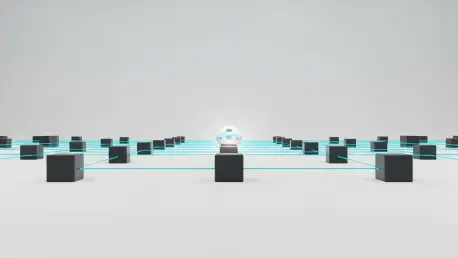

The total dissolution of the traditional enterprise network perimeter has created a scenario where critical corporate data and high-value workloads are now scattered across a diverse landscape of public clouds, private data centers, and remote branch locations. This geographical expansion has effectively shattered the classic “castle-and-moat” security model, leaving IT teams struggling to maintain visibility and control over a fragmented surface area that grows more complex with every new cloud instance or remote office. The Hybrid Mesh Firewall architecture has emerged as the definitive answer to this challenge, providing a method to separate the management of security policies from the physical or virtual points where those policies are actually enforced. By decoupling these layers, organizations ensure that protection follows the data through every transition, rather than being tied to a specific hardware appliance or localized network segment. This evolution represents a strategic shift from managing individual security products to orchestrating a holistic security ecosystem that functions as a single, resilient entity.
Bridging the Divide Between Distributed Computing Environments
Establishing Architectural Parity Through a Unified Software Core
The fundamental challenge in securing a hybrid environment involves the inherent differences between physical appliances in a data center and virtual instances running in a public cloud. To solve this, the most effective implementations utilize a unified codebase, such as Junos OS, which ensures that the same security logic is applied regardless of the underlying infrastructure. Unlike older models that rely on management overlays to mask the differences between disparate products, this approach maintains architectural parity by running identical software on high-performance hardware, virtual machines, and containerized environments. This consistency eliminates the “translation layers” that frequently introduce human error and policy misalignments during deployment. When a security engineer configures a firewall rule, the system interprets and executes that command with absolute precision across every node in the mesh, ensuring that a microservice in the cloud receives the same level of rigorous inspection as a physical server in a headquarters building.
Eliminating Technical Inconsistencies Across Multi-Cloud Fabrics
Maintaining a uniform security posture across multi-cloud fabrics requires more than just shared software; it demands a synchronization of intent and action that spans the entire digital footprint. In many legacy setups, security teams often face “policy drift,” where rules in one environment gradually diverge from those in another due to manual updates and differing administrative interfaces. A hybrid mesh architecture prevents this drift by providing a single point of truth for all security configurations, which simplifies the entire security lifecycle from initial provisioning to long-term maintenance. By removing the need to learn and manage separate operating systems for different cloud providers, organizations can significantly reduce the training burden on their staff and accelerate the deployment of new services. This level of software harmony provides the necessary foundation for a comprehensive zero-trust strategy, as it allows for the consistent application of identity-based access controls and deep packet inspection across every single connection point within the global network.
Maximizing Operational Efficiency and Localized Threat Defense
Orchestrating Global Policies via Centralized Management Directors
Managing a sprawling network of hundreds or even thousands of firewall nodes is practically impossible without a sophisticated orchestration layer that centralizes command and control. With a centralized management director, administrators can define a complex security policy once and push it to every enforcement point worldwide with a single, synchronized action. This capability is vital for reacting to modern cyber threats that move at machine speed, as it allows security teams to close vulnerabilities or block malicious actors across the entire infrastructure in seconds. Beyond rapid deployment, the system employs automated optimization tools to maintain the health and performance of the firewall mesh over time. Many enterprises find themselves buried under thousands of redundant or outdated rules that create hidden security gaps and degrade hardware performance. The architecture identifies these “zero-hit” policies through continuous monitoring, allowing administrators to remove unnecessary clutter with one click, thereby keeping the attack surface as small as possible.
Implementing Localized Intelligence to Neutralize Edge-Based Threats
Effective threat defense in 2026 requires more than just centralized control; it necessitates the deployment of intelligent processing directly at the network edge. Modern hybrid mesh firewalls incorporate local AI inference on the nodes themselves to handle advanced threats, such as zero-day exploits and sophisticated malware, without relying on a constant connection to a central cloud brain. This edge-based intelligence allows for the real-time behavioral analysis of encrypted traffic, identifying suspicious patterns that might indicate a breach in progress while maintaining the privacy of the data. By processing security intelligence locally, the system ensures that high levels of protection remain active even if a specific branch site loses its wide-area network connection. This decentralized enforcement model prevents the “bottleneck effect” often seen in centralized security architectures, where all traffic must be backhauled to a central data center for inspection. Instead, traffic is secured at its point of origin, reducing latency and improving the user experience for remote employees.
Evaluating Business Resilience and Regulatory Alignment
Sustaining High Performance During Intensive Traffic Inspections
Enterprise security must be capable of scaling alongside business growth without becoming a hindrance to network throughput or application performance. Independent testing of hybrid mesh architectures has demonstrated that these systems can maintain an extremely high exploit block rate even when subjected to the heavy processing demands of modern encrypted data streams. This performance is achieved through the use of dedicated hardware acceleration and optimized software pathways that allow for deep packet inspection at line rates. Furthermore, by enforcing strict microsegmentation across the entire mesh, the architecture prevents attackers from moving laterally through the network if they manage to gain an initial foothold. This containment strategy is essential for protecting sensitive business assets, as it ensures that a security incident in one small corner of the network cannot escalate into a full-scale corporate breach. The ability to maintain high-speed connectivity while providing granular, localized protection allows organizations to adopt new technologies and expand their digital operations with complete confidence.
Automating Compliance Reporting for Complex Global Mandates
The increasing complexity of global data protection regulations, such as DORA or NIS2, has made the documentation of security controls a primary concern for modern enterprises. In a fragmented environment, gathering the necessary data to prove compliance to auditors is a grueling process that often takes weeks of manual effort and cross-departmental coordination. However, a hybrid mesh firewall provides a standardized data stream and a single source of truth that simplifies the entire auditing process. Security teams can generate comprehensive reports that detail exactly how data flows are protected across every cloud and on-premises site, providing a clear audit trail that satisfies even the most rigorous regulatory requirements. This transparency not only reduces the risk of non-compliance penalties but also improves overall corporate governance by providing leadership with a clear view of the organization’s risk profile. By automating the collection and reporting of security metrics, the architecture frees up valuable IT resources to focus on strategic initiatives rather than administrative tasks, directly contributing to the long-term agility of the business.
Strategizing for Sustainable Growth in an Evolving Threat Landscape
The transition to a unified security model was characterized by a fundamental realignment of how infrastructure and protection were viewed within the corporate hierarchy. Organizations that moved away from siloed security products discovered that they could scale their digital capacity dynamically, adding new cloud regions or remote sites without needing to redesign their underlying security framework from scratch. This historical shift facilitated a much closer collaboration between DevOps teams and security administrators, as the unified codebase allowed security to be integrated directly into the deployment pipeline of new applications. The evidence gathered from these implementations indicated that the reduction in operational complexity led to faster response times and a more resilient defense against emerging threats. As the technological landscape continued to change, the flexibility of the hybrid mesh model allowed enterprises to remain proactive rather than reactive, ensuring that their security posture was always ahead of the next wave of innovation. This approach established a sustainable path for network integrity, where the cost of security was balanced by the immense value of business continuity and data protection.