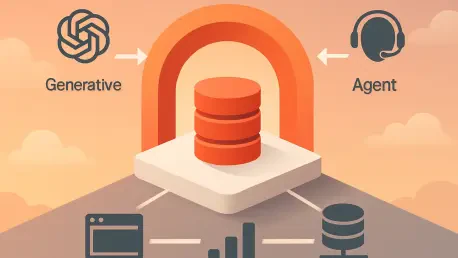

The transition from static large language models toward autonomous agents marks a definitive shift in how modern enterprises leverage artificial intelligence to automate complex, multi-step business workflows across various departments. Databricks has responded to this evolution by officially launching the Unity AI Gateway, a sophisticated control plane designed to integrate the management of generative models directly into the existing Unity Catalog governance framework. This strategic move addresses the inherent risks associated with “agentic AI,” where systems are empowered to query internal databases, modify source code, and interact with external APIs without the need for constant manual oversight from human operators. By centralizing these interactions, organizations can finally apply rigorous permissions and auditing to autonomous systems that were previously operating in a governance vacuum. The focus is no longer just on the output of a model, but on the entire lifecycle of an agent’s actions and its subsequent impact on corporate data assets.
Bridging the Visibility and Control Gap
High-speed agentic workflows frequently occur at a pace that renders traditional auditing tools and manual security reviews completely obsolete, creating what many industry experts describe as a visibility vacuum. As an agent executes several distinct tasks in a matter of milliseconds—such as retrieving a customer’s history and then generating a tailored response—the underlying interactions often remain hidden from security teams. The Unity AI Gateway solves this transparency crisis by offering a centralized management layer that functions across multiple model providers including Anthropic, OpenAI, and Google, as well as open-source alternatives like Llama. This unified approach allows administrators to configure security settings once and have them applied consistently across all deployed models, regardless of the specific infrastructure or provider being used. Such a strategy prevents the fragmentation of security policies that typically plagues multi-cloud environments, ensuring a standard level of oversight.
Beyond the core language models, the Gateway extends its governance reach to the various tools and secondary APIs that agents utilize to perform their specialized tasks in the real world. By integrating support for the Model Context Protocol (MCP) and internal proprietary APIs, the system ensures that every “arm and leg” of the AI agent is governed with the same strictness as the model’s “brain.” This identity-centric security model is crucial because it tethers an agent’s permissions directly to the specific user who initiated the request, preventing the common risk of privilege escalation. If an employee does not have the clearance to access certain records within a Salesforce instance or a private database, the agent acting on their behalf will also be restricted from that data. This ensures that autonomous systems do not become accidental backdoors for unauthorized information retrieval, maintaining a consistent and hardened security posture across the entire digital landscape.
Implementing Fine-Grained Permissions and Secure Tool Use
Managing the risks of over-privileged agents requires more than just general access logs; it necessitates a granular permission system that can evaluate every individual call made by a model. The Unity AI Gateway provides this level of control by facilitating secure connections to external platforms and internal repositories, ensuring that each interaction is authenticated and documented. This framework is further strengthened by the inclusion of intelligent guardrails that utilize “LLM judges” to analyze prompts and responses in real time to identify potential policy violations. One of the most critical functions of these guardrails is the automatic detection and redaction of personally identifiable information (PII) before it is sent to external model providers. By masking sensitive data like social security numbers or private contact details, the Gateway helps organizations comply with strict data residency and privacy regulations while still benefiting from the power of leading global AI services without compromising user trust.
The proactive nature of these guardrails also addresses the growing threat of prompt injection attacks and “jailbreak” attempts, which seek to manipulate an AI agent into bypassing its safety protocols. By employing a “prompt plus model” approach, the Unity AI Gateway can detect malicious intent within a query before it is processed by the underlying LLM, thereby preventing the exfiltration of proprietary training data or the execution of unauthorized commands. These security layers are not static; they allow for custom logic defined by the organization, ensuring that the AI’s behavior aligns perfectly with specific corporate values and unique regulatory requirements. Consequently, the gateway acts as a dynamic shield that evolves alongside new vulnerability patterns, offering a level of protection that simple regex-based filters could never achieve. This ensures that even as agents become more autonomous, their operational boundaries remain firmly established and resistant to external manipulation or accidental misuse.
Advanced Observability and Production Reliability
Transitioning an AI initiative from a conceptual prototype to a production-grade application requires a deep understanding of operational costs and performance metrics across the entire stack. The Unity AI Gateway addresses this need by consolidating all logging data into Unity Catalog system tables, creating a single source of truth for finance, engineering, and security departments. This integration allows organizations to move away from tracking abstract token counts and instead focus on actual dollar costs attributed to specific users, teams, or model providers. By tagging endpoints and monitoring resource consumption in real time, companies can implement precise budget management strategies and prevent the “runaway” costs often associated with unoptimized agentic chains. This financial visibility is a prerequisite for any business looking to calculate the true return on investment for their AI deployments, as it provides the granular data necessary to justify scaling operations and identifies areas where model switching could yield better cost efficiency.
For engineering teams, the Gateway offers significant technical advantages by capturing full request and response payloads within inference tables, which are essential for debugging the complex logic of multi-step AI agents. To maintain high availability in a production environment, the system includes built-in architectural safeguards such as automatic failover and rate limiting. If a primary model provider experiences an outage or a specific API key hits its rate limit, the Gateway can seamlessly route traffic to a secondary model or a different provider without requiring manual intervention or code changes. This reliability is further enhanced by the use of OpenAI-compatible APIs, which offer developers a standardized interface that simplifies the process of switching backend models as new technologies emerge. This portability ensures that the enterprise is never locked into a single vendor, providing the flexibility to pivot between different large language models based on performance, cost, or evolving security requirements.
Establishing a Resilient Framework for Continuous Growth
The introduction of the Unity AI Gateway successfully shifted the focus of enterprise AI from simple experimentation to rigorous, governed production environments. Organizations that adopted this centralized framework gained the ability to monitor agentic behavior with unprecedented precision, ensuring that autonomous systems remained within established safety boundaries. The integration with the Unity Catalog proved that governance was no longer a secondary consideration but a fundamental component of the data lifecycle. Leaders utilized these tools to establish a culture of transparency where every model interaction was audited and every expenditure was justified through detailed cost attribution. By moving toward a model-agnostic architecture, businesses effectively mitigated the risks of vendor lock-in and prepared themselves for the rapid iteration of the AI market. This development allowed teams to prioritize innovation while maintaining a hardened security posture, demonstrating that safety and speed are not mutually exclusive when managed through a unified and intelligent control plane.