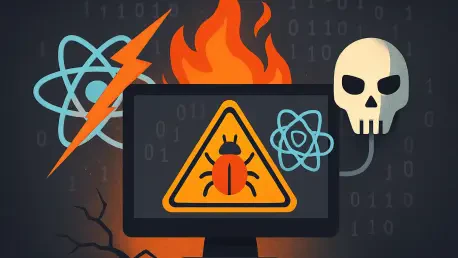

A newly disclosed critical vulnerability, identified as CVE-2025-55182, is posing a severe threat to a vast portion of the modern web, as it affects the widely used React framework and its ecosystem. With a CVSS score of 10.0, this pre-authentication remote code execution (RCE) flaw allows unauthenticated attackers to gain complete control over vulnerable servers with a single, specially crafted HTTP request. The vulnerability’s discovery on December 3rd, 2025, has sent shockwaves through the development and cybersecurity communities, given that React underpins over 40% of the top 10,000 websites, including enterprise applications, e-commerce giants, and mission-critical business systems. Organizations utilizing affected versions of React.js or the popular Next.js framework are now in a race against time to apply patches as security researchers have already observed active exploitation attempts in the wild. The ease of exploitation, combined with the ubiquity of the affected software, makes this one of the most significant security events of the year.
1. Understanding the Technical Breakdown
The core of CVE-2025-55182 lies within the data deserialization process of React Server Components (RSCs), a modern feature designed to improve performance by rendering components on the server. The vulnerability exists specifically in the core payload decoding mechanism that processes incoming HTTP requests destined for endpoints running these server components. When the framework translates a request into a server-side function call, it deserializes the data payload without enforcing adequate security validation or sanitization. This oversight creates a direct and dangerous pathway for threat actors. By crafting a malicious payload, an attacker can trick the deserialization logic into executing arbitrary code with the same privileges as the server process itself. What makes this flaw exceptionally dangerous is its accessibility; no prior authentication or user interaction is required. A single, well-formed HTTP POST request targeting any Server Function endpoint is sufficient to achieve a full system compromise, bypassing traditional security perimeters with alarming ease and efficiency.
The scope of this vulnerability extends far beyond the core React library, impacting a wide array of packages and popular frameworks that have adopted React Server Components. Specifically, the affected packages include react-server-dom-webpack, react-server-dom-parcel, and react-server-dom-turbopack, all within the version range of 19.0.0 through 19.2.0. Consequently, any framework built on top of these components is also vulnerable. This includes Next.js, one of the most popular production frameworks for React, specifically affecting versions 15.x and 16.x. The ripple effect continues to other significant tools in the ecosystem, such as React Router with RSC APIs, Expo for universal application development, the full-stack framework Redwood SDK, the minimalist framework Waku, and various Vite and Parcel plugins designed to integrate with server components. This broad attack surface means that a significant portion of the modern web development landscape is at risk, requiring security teams to conduct thorough inventories of their frontend and full-stack applications to identify any instance of these vulnerable dependencies.
2. Assessing the Potential for Catastrophic Impact
A pre-authentication remote code execution vulnerability like CVE-2025-55182 represents the apex of attacker capabilities, granting adversaries the power to inflict devastating damage. The most immediate and severe consequence is a complete infrastructure compromise. Upon successful exploitation, an attacker gains remote access to the server with the privileges of the running Node.js process. This level of access is tantamount to having a direct shell on the machine, enabling full filesystem read/write capabilities, the ability to harvest sensitive credentials stored on the server (such as database connection strings, API keys, and environment variables), and the power to install persistent access mechanisms like backdoors or web shells. From this initial foothold, the attacker can use the compromised server as a command-and-control center, effectively making it a zombie in a larger botnet or a launchpad for further malicious activities, all while remaining undetected by conventional security monitoring tools that are not specifically looking for this exploit.
Beyond the initial breach, the potential for cascading failures and secondary impacts is enormous. With full control over the server, data exfiltration becomes a trivial task for the attacker. Sensitive customer databases containing personally identifiable information (PII), financial records, intellectual property, proprietary business logic, and internal documentation can all be siphoned off the compromised system. Such a data breach can lead to severe regulatory fines under frameworks like GDPR and CCPA, irreparable reputational damage, and loss of customer trust. Furthermore, the compromised React server can serve as a pivot point for lateral movement within the corporate network. Attackers can leverage the server’s trusted position to scan for and attack other internal systems, databases, cloud resources, and developer environments. This allows them to escalate their privileges, move deeper into the network, and potentially gain access to the organization’s most critical assets, turning a single web server compromise into a full-blown enterprise-wide security incident.
3. An Urgent Three-Tiered Remediation Strategy
The highest priority for any organization running affected software is to patch immediately and decisively. The vendors have released updated versions that address the deserialization flaw, and applying these updates is the only definitive way to eliminate the vulnerability. For those using the core library, the recommendation is to upgrade to React versions 19.0.1+, 19.1.2+, or 19.2.1+. For the vast number of teams using the Next.js framework, a comprehensive set of patched versions is available, requiring an upgrade to one of the following: 15.0.5+, 15.1.9+, 15.2.6+, 15.3.6+, 15.4.8+, 15.5.7+, or 16.0.7+. Given the active exploitation of CVE-2025-55182, this remediation step should not be delayed. Development and security teams must coordinate to test and deploy these patches in their production environments as an emergency change. The risk of business disruption from a potential exploit, such as ransomware deployment or a massive data breach, far outweighs the operational overhead associated with an expedited patching process. Delaying this action leaves critical systems exposed to an easily executable, high-impact attack.
In scenarios where immediate patching is not feasible due to complex dependencies or legacy system constraints, organizations must rapidly implement a series of compensating controls to mitigate the risk. The first line of defense is to deploy robust Web Application Firewall (WAF) rules specifically designed to inspect incoming HTTP requests for suspicious serialization patterns characteristic of the exploit. Secondly, if the application’s functionality permits, disabling Server Functions entirely can temporarily close the attack vector until a patch can be applied. Furthermore, implementing strict network egress controls on the affected servers can prevent attackers from establishing reverse shells or exfiltrating data, even if they manage to execute code. Comprehensive and verbose logging should also be enabled on all Server Function invocations to create an audit trail that can aid in threat hunting and incident response. For long-term security posture improvement, organizations should adopt a defense-in-depth strategy. This includes running Node.js processes with the least possible privileges, isolating applications in containers with restricted capabilities, deploying runtime application self-protection (RASP) solutions to detect and block attacks in real time, and maintaining a rigorous schedule of vulnerability scanning and dependency patching.
4. Navigating the Aftermath and Fortifying Defenses
The emergence of CVE-2025-55182 and the subsequent flurry of activity provided a stark reminder of the inherent risks within the modern software supply chain. Analysis of the situation revealed that threat intelligence teams had been actively monitoring this vulnerability since its disclosure, diligently analyzing telemetry, dissecting proof-of-concept exploits circulating in the security community, and developing detection signatures for enterprise environments. Active exploitation attempts were observed in the wild shortly after the vulnerability became public knowledge, with many attacks aligning closely with the publicly available exploit code. Threat response teams were engaged in continuous hunting for any valid exploitation attempts, confirming the immediate and tangible nature of the threat. This rapid weaponization of a disclosed flaw underscored the narrowing window organizations have to respond before facing real-world attacks.
Further investigation into the attack patterns showed that threat actors were not indiscriminate in their targeting. Organizations within the financial services, technology, and e-commerce sectors appeared to be primary targets, receiving a higher volume of targeted reconnaissance scans and direct exploitation attempts. This focus suggested that attackers were prioritizing high-value targets where a successful breach could yield significant financial gain or access to sensitive intellectual property. The incident served as a critical lesson in digital resilience. Organizations that weathered the storm most effectively were those with pre-existing, robust security programs that included comprehensive asset inventories, rapid patching protocols, and layered defenses. The event highlighted that in an interconnected digital ecosystem, proactive security measures were no longer optional but a fundamental requirement for survival and operational integrity.