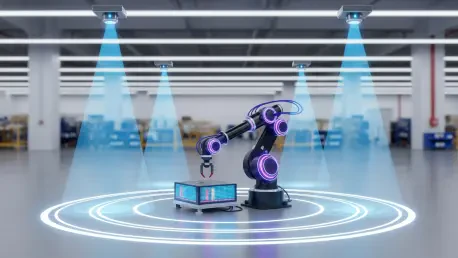

In the current industrial landscape of 2026, manufacturers are increasingly abandoning the bulky steel enclosures that once defined industrial automation in favor of sophisticated digital monitoring systems that respond to human movement with millisecond precision. This shift is driven by the need for greater floor space optimization and more flexible production lines that can adapt to changing product demands without constant hardware reconfiguration. While the iconic yellow cage served as a definitive safety measure for decades, the advent of high-resolution LiDAR and 3D vision systems has introduced a new paradigm where protection is active rather than passive. These virtual safety zones utilize complex algorithms to calculate the proximity of human operators to moving machinery, ensuring that operations cease or slow down before any contact can occur. This transition represents a change in how human-robot collaboration is managed, moving away from isolation toward integrated workspaces.
Evolution of Industrial Safety Systems
Limitations of Conventional Physical Barriers
Traditional perimeter fencing has long been the gold standard for industrial safety, but its presence creates significant bottlenecks in high-speed manufacturing environments. These static cages consume valuable real estate and force human workers to navigate around obstacles, which often leads to inefficient material flow and increased downtime during maintenance cycles. When a technician needs to access a robot within a physical cage, the entire system must typically undergo a lockout-tagout procedure that halts production for several minutes or even hours. This rigid approach is increasingly incompatible with the modular nature of 2026-era production facilities, where robots frequently move between different workstations or require frequent tool changes. Furthermore, the installation and modification of steel barriers involve high labor costs and lack the scalability needed for agile operations. Relying on physical separation limits the potential for direct human intervention.
Integration of High-Resolution Sensing Hardware
To replace heavy steel with invisible light, engineers are deploying a combination of Time-of-Flight cameras and safety-rated laser scanners that create a comprehensive 360-degree awareness around the robotic workcell. These sensors are capable of detecting a person’s entry into a predefined warning zone, triggering the robot to reduce its operational speed or shift its path to avoid the intruder. Unlike the binary nature of a physical gate—which is either open or closed—these virtual zones can be divided into multiple layers of protection that offer nuanced responses based on the distance and speed of an approaching object. This granular control allows for a safer, more fluid interaction where humans can replenish materials or inspect components while the robot continues to work at a safe pace nearby. The reliability of these systems has reached a point where they meet the same stringent safety requirements as physical interlocks, providing a robust and versatile digital alternative.
Operational Advantages of Virtual Zone Implementation
Enhancing Speed and Safety Through Real-Time Analysis
The core advantage of virtual safety zones lies in their ability to process vast amounts of spatial data in real time to distinguish between actual threats and non-hazardous movements. Advanced software platforms now utilize edge computing to analyze point clouds from multiple sensors, ensuring that there are no blind spots even when a worker is partially obscured by equipment. If the system detects a breach of the innermost safety radius, it triggers an instantaneous emergency stop through a fail-safe communication protocol such as PROFIsafe or CIP Safety over EtherNet/IP. Beyond simple stopping, many modern systems implement Speed and Separation Monitoring (SSM), which allows the robot to vary its velocity dynamically based on the current risk profile. This prevents the jarring starts and stops that characterize traditional safety circuits, reducing mechanical wear and improving the overall cycle time of the production line. As these algorithms become more predictive, they anticipate human paths.
Strategic Outcomes of Digital Perimeter Adoption
Implementing these advanced systems required a comprehensive risk assessment that moved beyond individual machines to the entire workspace ecosystem. Organizations that successfully adopted virtual zones prioritized the validation of sensor coverage and ensured that all software configurations adhered to the latest ISO safety standards for collaborative robotics. It was discovered that the initial investment in high-performance sensing hardware was quickly offset by gains in operational flexibility and a reduction in downtime associated with physical barrier maintenance. Managers focused on training personnel to interact safely with dynamic perimeters, emphasizing the importance of respecting digital warning lights that replaced physical gates. Future-oriented implementations even began exploring augmented reality to make invisible zones visible to the human eye, bridging the gap between digital safety and physical perception. This evolution proved that safety and productivity were harmonized through technology.