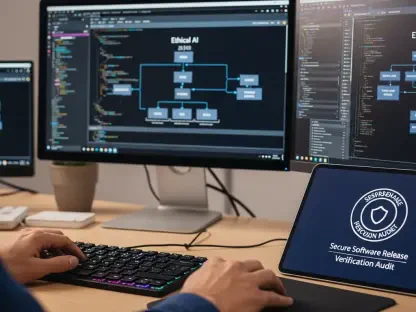

The friction between rapid development and stringent enterprise governance often creates significant bottlenecks in data engineering, where a single AWS Glue pipeline’s journey from development to production can be delayed by days of manual, checklist-driven reviews. In many organizations, this final gatekeeping step requires a senior engineer to dedicate four to six hours per use case, painstakingly cross-referencing CloudFormation templates, inspecting job scripts, and manually comparing everything against a static document of internal best practices. This reactive, time-consuming process not only slows down innovation but also pulls highly skilled engineers away from high-value architectural work. A more modern approach involves shifting governance left, embedding these critical checks directly into the development workflow to catch issues proactively, reduce costs, and empower developers with immediate, expert-level feedback, transforming a manual hurdle into an automated, self-service utility. This paradigm shift ensures that pipelines are not just functional but production-ready from the very beginning.
1. The Architectural Blueprint for Automated Governance
The foundation of this automated governance solution is a Retrieval-Augmented Generation (RAG) architecture, a pattern specifically chosen to address the inherent limitations of general-purpose Large Language Models (LLMs). While powerful, standard LLMs lack awareness of an organization’s unique internal standards, coding conventions, and infrastructure best practices. A RAG-based approach solves this by grounding the AI’s reasoning process in a curated knowledge base. Instead of relying on the model’s generalized training, the system retrieves a specific “Enterprise Best Practices Checklist” from a document stored in Amazon S3 at runtime. This checklist is then injected into the prompt alongside the code to be reviewed. Consequently, the AI’s evaluation is strictly constrained to the provided standards, ensuring that its feedback is relevant, accurate, and aligned with enterprise policies. This technique transforms the LLM from a creative generator into a precise, context-aware reasoning engine tailored for a specific governance task, eliminating the risk of hallucinated or inconsistent feedback.
A core design principle guiding this architecture is the sequence of validation: deterministic infrastructure checks must precede probabilistic code analysis. The logic is straightforward: a code review becomes meaningless if the underlying infrastructure is misconfigured or absent. Therefore, the system is engineered to first verify the tangible, deployed infrastructure against enterprise standards before any code is passed to the generative AI. The high-level workflow begins when a developer executes a local command-line interface (CLI) command, specifying a particular use case. The system then automatically discovers all associated AWS Glue jobs and initiates a series of infrastructure validations, confirming job existence, deployment status via CloudFormation, and the presence of expected crawlers. Only after these infrastructure checks pass successfully does the system proceed to the GenAI-powered code review. It retrieves the relevant standards via RAG, analyzes the code, and generates a detailed Markdown report for each job, creating a fully automated, infrastructure-aware governance pipeline.
2. A Step-by-Step Implementation Guide
The automation process begins with the dynamic discovery of AWS Glue jobs, a critical feature that ensures the system remains scalable and decoupled from rigid naming conventions. Instead of requiring developers to manually specify job names, the utility leverages the AWS Glue Data Catalog to automatically identify all jobs associated with a given use case or development lifecycle stage. This method allows the review process to adapt seamlessly as data pipelines grow and evolve across different environments, from development to production. By querying the Data Catalog, the system can discover resources based on metadata and tags, ensuring that the governance checks are always applied to the correct set of components without any code changes or manual updates. This decoupling is essential for maintaining a low-friction, high-automation environment where governance keeps pace with development, rather than impeding it through brittle, hardcoded configurations that require constant maintenance.
Following the discovery phase, the system executes the most critical and often overlooked part of the review process: infrastructure validation. Before a single line of code is analyzed, the solution performs a series of automated checks to confirm the structural integrity and compliance of the deployed environment. For each discovered Glue job, it programmatically verifies several key conditions. First, it confirms that the job actually exists and is in a deployed state within the target AWS account. Next, it validates that the job was provisioned using AWS CloudFormation, a common enterprise requirement for ensuring infrastructure-as-code principles are followed. Finally, it checks for the existence of any required dependencies, such as specific AWS Glue crawlers that are expected to feed data into the job. If any of these deterministic checks fail, the process halts and reports the infrastructure issue immediately, preventing wasted effort on reviewing code that would ultimately fail in a misconfigured environment and providing developers with immediate, actionable feedback on their infrastructure deployment.
3. Grounding the Review and Measuring the Impact
Once all infrastructure checks have passed, the system transitions to the code review phase, utilizing the RAG approach to ensure a grounded and reliable analysis. The enterprise’s comprehensive checklist of coding standards and best practices is maintained as a simple document in an Amazon S3 bucket. At runtime, the system retrieves this checklist along with the target Glue job’s script from its metadata. Both the script and the standards are then injected directly into a prompt sent to a Claude Sonnet 3.5 LLM hosted on Amazon Bedrock. This method forces the LLM to perform its evaluation strictly within the constraints of the provided enterprise-defined rules. The model does not invent new standards or offer generalized advice; instead, it reasons exclusively based on the grounded context. This design offers a significant advantage: governance rules can be updated and evolved simply by modifying the S3 file, with no changes required to the underlying review application code, making the entire system agile and easy to maintain.
The practical results of implementing this RAG-automated workflow demonstrated a profound transformation in efficiency and productivity. The manual review process, which previously consumed approximately four hours of a senior engineer’s time, was reduced to just three to four minutes, marking a 98% acceleration. This dramatic reduction in direct review expenses, with nominal API and compute costs, translates to a greater than 99% cost saving. Consistency also saw a major improvement, moving from human-dependent, subjective feedback to 100% policy-aligned, standardized evaluations that eliminate bias. Furthermore, the system institutionalized best practices, ensuring that every review was of a consistently high quality. Finally, the audit trail shifted from scattered, one-to-one review comments to structured Markdown artifacts, providing high-fidelity visibility for all stakeholders. This shift from a slow, expert-driven manual process to a fast, deterministic, self-service workflow reallocated senior engineering talent toward higher-impact architectural challenges.
4. Evolving Governance into a Service
This implementation proved that enforcing enterprise standards did not have to remain a manual, burdensome task that created bottlenecks. By leveraging a RAG approach with Amazon Bedrock, it was possible to create a living governance engine that executed in minutes and was integrated directly into the development phase. Senior engineers were freed to concentrate on innovation and complex architecture, as the time-consuming chore of checklist verification was completely eliminated. The success of this model was rooted in several key factors: an infrastructure-first validation approach, the use of grounded GenAI to ensure correctness and auditability, and the decoupling of standards from the application code, which allowed for agile updates. The next logical step in its evolution is integration into a continuous integration and continuous deployment (CI/CD) pipeline, enabling automated review triggers on every GitHub Pull Request to make governance a seamless, invisible part of the development lifecycle.