
The rapid evolution of autonomous systems has reached a critical juncture where raw computational power must be balanced by an uncompromising commitment to functional safety within the physical world. As robots and automated machinery transition from highly controlled experimental settings into the unpredictable complexity of warehouses, construction sites, and medical facilities, the demand for Physical AI has never been more urgent. This paradigm shift requires a foundational architecture that can process massive datasets in real-time while maintaining strict deterministic performance. The introduction of the Advantech MIC-735 industrial-grade edge AI system represents a definitive step toward this goal, providing a unified platform where high-performance inference and safety protocols coexist seamlessly. By prioritizing safety as a core architectural requirement rather than an elective add-on, this new initiative enables developers to deploy intelligent machines that can interact safely and reliably with human workers in mission-critical environments.
Architectural Innovation and Safety Standards
Strategic Partnerships: Collaborative Security Ecosystems
The collaboration between Advantech, Fort Robotics, and Nvidia is grounded in a shared vision of creating a transparent and standardized safety environment for autonomous operations. Central to this effort is the utilization of the Nvidia Halos AI Systems Inspection Lab, which stands as the first facility globally to receive the prestigious ANSI National Accreditation Board (ANAB) accreditation specifically for AI systems. This accreditation ensures that every component of the safety stack—from the underlying silicon to the high-level software algorithms—undergoes rigorous validation against international standards for functional safety and cybersecurity. By aligning their technical roadmaps, these three companies have established a baseline of trust that is essential for industries where equipment failure could lead to catastrophic consequences. The resulting ecosystem simplifies the compliance process for end-users, allowing them to focus on operational efficiency rather than navigating complex regulatory hurdles alone.
At the heart of this secure architecture lies the Nvidia IGX Thor platform, which serves as the computational engine for the MIC-735 and provides the necessary hooks for deep-seated safety integration. This platform facilitates a full-stack safety system known as Nvidia Halos, which unifies hardware, software, and pre-trained AI models into a cohesive defensive perimeter. Unlike traditional systems that treat safety as a separate, isolated layer, this integrated approach allows for continuous monitoring of autonomous vehicle and robotic operations in real-time. The framework is designed to detect anomalies and mitigate risks before they escalate into incidents, providing a level of end-to-end protection that was previously unattainable in distributed edge computing environments. By satisfying the most demanding industrial regulatory requirements, the MIC-735 offers a reliable blueprint for the next generation of certified autonomous machinery that must operate with absolute precision.
Implementation: Integrating Outside-In Safety Controls
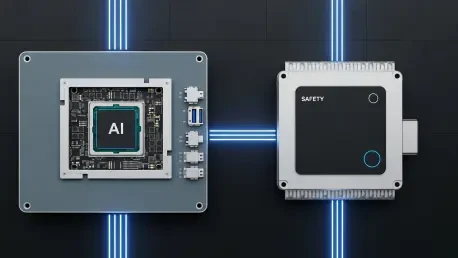
Fort Robotics brings a specialized layer of outside-in functional safety to the platform, addressing the critical need for external control mechanisms in autonomous fleets. By integrating the Fort Nano Safety Controller Pro and the Fort Endpoint Controller directly into the MIC-735 hardware, the system gains the ability to process safety-critical commands with deterministic reliability. This means that when a safety trigger occurs—such as a remote emergency stop signal—the system guarantees a response within a fixed, predictable timeframe. This capability is essential for managing large-scale robotic deployments across wide areas where wireless or IP network latency might otherwise introduce dangerous delays. This architecture ensures that even if the primary AI processing encounters an unexpected state, the dedicated safety controller remains active and capable of bringing the machine to a safe stop, thereby maintaining a fail-safe environment for all nearby personnel and infrastructure.
The management of these safety protocols is further enhanced by a dynamic and secure API that allows for both local and global fleet oversight. For example, operators can utilize devices like the Safe Remote Control Pro for immediate, line-of-sight intervention, while simultaneously maintaining global control through the Endpoint Controller interface. This dual-layered approach enables organizations to scale their robotic operations without compromising on the granularity of their safety measures. As machines move through complex environments, the platform can dynamically adjust safety parameters based on the specific task or the presence of human workers in the immediate vicinity. By providing these tools as part of a unified platform, Advantech and Fort Robotics have significantly reduced the engineering burden for robotic developers, who no longer need to design and certify custom safety architectures from the ground up, effectively accelerating the time-to-market.
Technical Power and Industrial Longevity
Hardware Capability: High-Performance Computing in Rugged Environments
To handle the intense computational demands of modern edge AI, the MIC-735 is engineered to deliver performance levels reaching up to 2,070 FP TFLOPS. This massive throughput is necessary for the real-time processing of high-bandwidth sensor data, which is the lifeblood of autonomous navigation and obstacle avoidance. The hardware is built to withstand the punishing conditions of industrial settings, featuring a ruggedized chassis that remains fully operational across a wide temperature range from -30°C to +60°C. This thermal resilience is critical for applications in logistics yards, outdoor construction sites, or unconditioned factory floors where traditional computing hardware would likely fail. Furthermore, the inclusion of high-speed connectivity options, such as 5G and SFP28 4×25 GbE ports, ensures that the system can maintain a continuous stream of data communication with cloud-based management systems, facilitating a truly interconnected industrial network.
Navigating complex and dynamic environments requires more than just raw power; it requires the precise synchronization of diverse sensor inputs to create an accurate digital representation of the physical world. The MIC-735 leverages Nvidia Holoscan technology and the Holoscan Sensor Bridge to align data from cameras, LiDAR, and ultrasonic sensors with microsecond precision. This synchronization is vital because even a slight temporal misalignment between a camera frame and a LiDAR point cloud can lead to errors in spatial perception, which is a significant risk factor in high-speed autonomous operations. By providing the AI with a perfectly aligned and high-fidelity view of its surroundings, the platform enables more sophisticated path planning and decision-making capabilities. This technological synergy allows robots to operate with greater confidence in environments where human and machine paths frequently intersect, ultimately leading to higher productivity and safety.
Software Frameworks: Comprehensive Ecosystems and Lifecycle Support
The software foundation of the platform is built upon the Nvidia AI Enterprise-IGX stack, which offers developers a comprehensive suite of tools and libraries to accelerate the deployment of Physical AI. This ecosystem includes Nvidia Isaac for robotics-specific modeling and Nvidia Metropolis for advanced vision AI, providing pre-optimized frameworks that reduce the complexity of developing sophisticated autonomous behaviors. Additionally, the integration of Nvidia NIM microservices allows for the efficient scaling of AI inference across different hardware configurations, ensuring that applications remain performant as they are deployed across diverse fleets. By utilizing these standardized software components, developers focused their efforts on creating unique value-adds for their specific industries rather than spending months on the underlying infrastructure. This shift toward modular and interoperable software stacks became a key driver in the democratization of advanced robotics.
Recognizing that industrial infrastructure represents a significant long-term investment, the MIC-735 was designed with a commitment to long-term viability and operational support. The platform featured a 10-year lifecycle, which was an essential requirement for sectors like factory automation and heavy logistics where equipment remained in active service for a decade or more. This longevity ensured that organizations standardized their operations on a single hardware architecture without the threat of component obsolescence or the need for frequent hardware refreshes. Throughout this period, the system continued to receive critical security updates and software patches, maintaining its safety certifications and performance standards as the technology landscape evolved. This forward-looking approach gave industrial leaders the confidence to invest in autonomous technologies, knowing that their foundational systems were built to endure. Stakeholders focused on implementing fleet-wide upgrades that maximized the utility of their hardware.