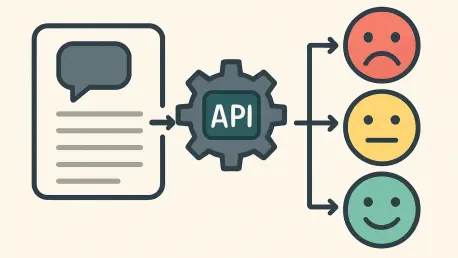

The digital universe is saturated with opinions expressed every second across countless platforms, creating a deluge of unstructured data that holds immense strategic value for any organization. Manually processing this constant stream of social media chatter to gauge public perception is an impossible task, yet ignoring it means operating without a clear understanding of the market. This is where sentiment analysis Application Programming Interfaces (APIs) have become indispensable tools, providing an automated and scalable method for quantifying subjective information. By classifying online mentions as positive, negative, or neutral, these powerful platforms transform the chaotic noise of public discourse into structured, actionable insights. For modern businesses, sentiment analysis is no longer a niche analytical exercise; it is a fundamental component of strategic planning, guiding critical decisions in customer service, product innovation, brand management, and competitive intelligence. The transition from anecdotal evidence to data-driven understanding is what separates reactive companies from proactive industry leaders, and APIs are the engines driving this transformation.
A Comparative Look at Leading API Solutions
Navigating the landscape of sentiment analysis APIs reveals a spectrum of solutions, from comprehensive, all-in-one platforms to highly specialized tools. Among the most robust is the Data365 social media API, which offers a unified framework for analyzing sentiment across a wide array of major networks, including Instagram, Twitter, Reddit, TikTok, and LinkedIn. Its core strength lies in its built-in sentiment scoring, where every retrieved post is automatically tagged with a positive, negative, or neutral classification, complete with a confidence score. For global brands, its extensive multi-language support—covering English, Spanish, French, German, Japanese, and Chinese—is a critical feature for accurately assessing an international footprint. Data365 moves beyond basic classification with advanced emotion detection, identifying nuances like joy, anger, and sadness to enable more empathetic marketing. Furthermore, its aspect-based sentiment analysis provides granular insights into specific facets of a product or service, such as opinions on price versus quality. In contrast, MonkeyLearn positions itself as a specialist in broader text analysis. While it offers powerful pre-built sentiment models, its primary value is the ability for users to train custom machine learning models on their own data for superior accuracy, making it a versatile tool for analyzing sentiment across social media, customer surveys, and support tickets.
For organizations with extensive needs and resources, enterprise-grade platforms offer unparalleled depth and precision. Brandwatch stands out as a sophisticated social listening platform with highly advanced sentiment analysis capabilities. Its extensive data coverage pulls from major social platforms as well as news sites, blogs, and forums, providing a holistic view of online conversations. The platform’s AI-powered sentiment detection can be enhanced with human validation to ensure the highest level of accuracy, a feature crucial for high-stakes brand monitoring. Brandwatch excels at dissecting sentiment at both the overarching conversation level and by specific topics, allowing for segmentation by demographics, geography, and time. Its powerful visualization tools and intuitive dashboards simplify the interpretation of complex trends. An alternative for businesses already integrated into a specific social media management ecosystem is Hootsuite Insights, which is powered by Brandwatch technology. This solution brings powerful sentiment analysis directly into the familiar Hootsuite workflow, creating a unified environment for publishing, monitoring, and analysis. While it offers similar capabilities to the standalone Brandwatch platform, it is primarily accessed through a dashboard interface, making it a convenient but less programmatically flexible option for marketing teams prioritizing a single, integrated platform.
The Power of Cloud and AI Giants
The world’s leading technology companies provide formidable sentiment analysis tools as part of their broader artificial intelligence and cloud service portfolios. IBM Watson Natural Language Understanding (NLU) is an enterprise-grade solution engineered for high precision and scalability. Its sentiment analysis function is remarkably nuanced, capable of detecting sentiment at both the overall document level and for specific targeted phrases within the text. Beyond sentiment, the API can identify emotions, entities, keywords, and abstract concepts, offering a multi-layered understanding of any given text. Built on IBM’s robust machine learning models, Watson NLU supports thirteen languages and is designed to handle high volumes of requests with consistent, reliable performance. Its pricing is typically based on the number of text units analyzed, and while a free tier is available, costs can scale with extensive production use, positioning it as a powerful option for large enterprises that require deep, sophisticated text analytics integrated into their workflows. The strength of such a platform lies not just in its sentiment analysis capabilities but in its potential to be part of a larger, interconnected AI strategy within an organization.
Similarly, other major cloud providers leverage their vast machine learning expertise to deliver accessible and accurate sentiment analysis. The Google Cloud Natural Language API provides a nuanced sentiment score ranging from -1.0 (highly negative) to 1.0 (highly positive), which is complemented by a magnitude score indicating the emotional strength of the text, regardless of its polarity. This allows for a more detailed understanding of the intensity behind an opinion. The API supports multiple languages and integrates seamlessly with other services in the Google Cloud ecosystem, making it a compelling choice for developers and businesses already leveraging Google’s infrastructure. In the same vein, Microsoft Azure Text Analytics, part of the Azure Cognitive Services suite, is an excellent option for organizations invested in the Microsoft ecosystem. It provides a classification of positive, negative, neutral, or mixed sentiment, complete with confidence scores for each category. Its standout feature is its vast language support, covering 94 languages for extensive international coverage. Additionally, its “opinion mining” feature facilitates detailed aspect-based sentiment analysis, identifying which specific attributes users are discussing and their feelings toward each one, providing highly actionable product feedback.
From Data to Decisions Best Practices for Implementation
The strategic application of sentiment analysis extends across multiple business functions, empowering data-driven decisions that can significantly impact the bottom line. It allows marketing teams to quantify public opinion on campaigns, helps customer service prioritize urgent negative feedback for rapid response, and guides product development by highlighting which features are beloved and which are disliked. Moreover, it facilitates in-depth competitive analysis by benchmarking brand perception against industry rivals. By converting a sea of subjective comments into objective, measurable metrics, these APIs provide a direct conduit to the collective voice of the customer, transforming it from background noise into a strategic asset. However, the path to accurate insights is not without its challenges. Algorithms often grapple with the complexities of human language, including sarcasm, context-dependent slang, and regional idioms, which can lead to misclassification. Posts containing mixed sentiment—such as a review that praises a product’s design but criticizes its battery life—also pose a significant challenge for automated systems, underscoring the need for a thoughtful and refined implementation strategy to ensure the reliability of the output.
To truly harness the power of sentiment analysis and translate raw data into actionable intelligence, organizations found success by adopting a set of implementation best practices. The most effective approach blended automated API analysis with periodic human review, which served as a crucial quality assurance step to catch contextual errors and nuances that algorithms missed. For businesses operating in specialized fields like finance or healthcare, training custom models on domain-specific data proved essential for improving accuracy, as generic models often misinterpreted industry-specific jargon. Furthermore, a focus was placed on analyzing trends over time rather than reacting to isolated sentiment scores, as this provided a more stable and meaningful view of public perception. Finally, the deepest insights were uncovered by segmenting sentiment data by key attributes such as demographics, geographic location, or product lines. By following these established guidelines, organizations successfully navigated the complexities of language and technology, effectively transforming the vast and varied landscape of public opinion into a cornerstone of their strategic decision-making process.