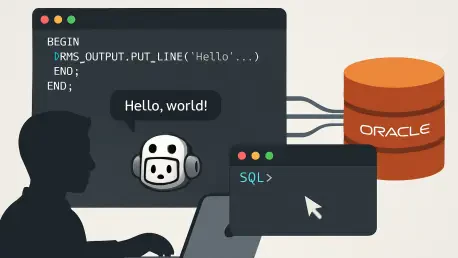

The boundary between human intent and machine execution is dissolving as the Model Context Protocol transforms how engineers engage with complex database environments directly from their development editors. For decades, the workflow for an Oracle developer has been defined by a repetitive cycle of context switching, moving between a code editor to write logic and a heavyweight database management tool to validate it. This fragmentation does not just sap time; it breaks the cognitive flow necessary for high-level problem-solving. The SQLcl MCP integration for GitHub Copilot addresses this specific friction by turning the command-line interface into a sophisticated AI agent, allowing the database to become a conversational participant within the IDE.
By leveraging an open standard, this integration represents a pivot away from proprietary, siloed AI extensions toward a more modular ecosystem. Instead of building a specialized AI for every tool, the Model Context Protocol (MCP) provides a universal language for AI assistants to interact with local resources. This review examines how the marriage of SQLcl and GitHub Copilot shifts the paradigm from syntax-heavy administration toward intent-based development, fundamentally changing the daily experience of interacting with Oracle’s enterprise-grade data structures.
Introduction to SQLcl MCP and the AI-Database Integration
The convergence of generative AI and traditional database administration has reached a critical milestone with the implementation of the Model Context Protocol within SQLcl. This system functions by positioning SQLcl as a secure intermediary agent that interprets the natural language instructions processed by GitHub Copilot. It is not merely a text generator; it is an active bridge that allows the AI to “reach out” and touch the database schema, fetching real-time metadata and executing queries without the user ever leaving the Visual Studio Code interface.
At its core, this integration is a response to the growing complexity of modern data architectures. As organizations move toward decentralized microservices and hybrid cloud environments, the overhead of managing connections and remembering specific syntax for dozens of different tables becomes a bottleneck. By utilizing a standardized communication layer, the system moves the needle toward “Intent-Based Development,” where the focus shifts from the “how” of writing a SQL join to the “what” of discovering business insights or verifying data integrity.
Technical Architecture and Core Functionality
The Model Context Protocol Implementation: A Secure Communication Layer
The architecture of the MCP implementation relies on a structured JSON-RPC messaging system that operates over standard input and output channels. This design is significant because it establishes a clear security boundary that many other AI-integrated tools lack. GitHub Copilot, acting as the client, never possesses a direct connection string or network route to the Oracle database. Instead, it sends a structured request to the local SQLcl instance, which validates the request before communicating with the database.
This “air-gapped” approach to AI interaction ensures that sensitive credentials and raw data packets remain within the local environment’s control. The MCP act as a plug-and-play layer, meaning that as LLMs evolve or as users switch between different AI models, the underlying database logic and security protocols remain constant. It effectively decouples the intelligence of the AI from the execution of the database command, providing a level of modularity that is essential for enterprise security compliance.
SQLcl 24.3 and the Embedded MCP Server: Performance Without Overhead
Starting with the release of version 24.3, SQLcl transitioned from being a simple interactive shell to a background server capable of hosting AI-driven requests. This is achieved through the sql mcp command, which activates a listener that requires no complex network configuration or open ports. Because the system utilizes existing JDBC connections and Oracle Wallets, it inherits all the performance optimizations and security hardening already present in the Oracle ecosystem.
The technical brilliance of this implementation lies in its invisibility. The embedded server handles the heavy lifting of connection pooling and result set serialization, allowing the AI to focus on parsing the user’s intent. For the developer, the setup is nearly zero-touch, provided they have a functioning SQL Developer connection registry. This leverage of existing infrastructure means the adoption curve is exceptionally shallow for teams already deep within the Oracle stack.
Innovations in Database Interaction and Emerging Trends
The most visible trend highlighted by this technology is the migration from graphical user interfaces (GUIs) to conversational interfaces. While GUIs are excellent for visualizing complex schemas, they often require too many clicks for routine tasks like finding a specific column name or checking the last five entries in an audit log. The ability to maintain focus within a single pane of glass in VS Code reduces the “cost of curiosity,” encouraging developers to verify their assumptions about data more frequently during the development cycle.
Furthermore, recent innovations in “Tool Use” or “Function Calling” allow the AI to exhibit a level of autonomy. If a user asks a vague question about a table, the AI can independently decide to call the schema-information tool before attempting to write a query. This multi-step reasoning process mimics the behavior of a human developer, where the AI gathers its own context rather than forcing the user to provide every detail in the initial prompt.
Real-World Applications and Use Cases
In high-velocity sectors like fintech and retail, the SQLcl MCP integration serves as a powerful tool for rapid data exploration. A developer working on a billing service can ask the chat to “show the top ten customers by revenue in the last quarter,” and receive a formatted table within seconds. This eliminates the need to write boilerplate SQL for validation, allowing the engineer to stay in the flow of writing application code while confirming that the underlying data matches their expectations.
Database administrators also find utility in “Schema Inspection on the Fly.” Instead of opening a separate management console to generate DDL statements or describe table structures, they can use natural language to request these details. This is particularly valuable during the documentation phase of a project, as the DDL generated by the AI through SQLcl can be immediately piped into a README file or a migration script, ensuring consistency across the development lifecycle.
Technical Challenges and Adoption Obstacles
Despite the advancements, technical hurdles remain, particularly regarding the “context window” limitations inherent in modern Large Language Models. When a query returns thousands of rows, the sheer volume of data can overwhelm the AI’s ability to process the information, leading to truncated results or higher latency. While asynchronous query handling attempts to mitigate this, there is still a fundamental tension between the vastness of enterprise data and the narrow “vision” of current AI interfaces.
Security remains a primary concern for many organizations. Even with the local execution model, there is a lingering worry that sensitive data used to prompt the AI might be logged by cloud providers or used for future model training. Furthermore, the dependency on a specific SQL Developer connection registry can be a point of failure for users who prefer manual connection strings or who work in environments where local storage is highly restricted.
Future Outlook and Evolutionary Trajectory
The trajectory of this technology suggests a move toward even more sophisticated semantic queries. We can anticipate deeper integration with Oracle’s AI Vector Search, allowing the MCP server to handle queries that combine structured SQL data with unstructured semantic information. This would allow a user to ask questions like “find products similar to this description that are also currently in stock,” blending the worlds of relational logic and vector embeddings seamlessly.
Another potential breakthrough lies in the concept of “Self-Healing SQL.” Future iterations of the MCP server could potentially catch syntax errors or performance bottlenecks in the AI-generated SQL and automatically suggest indexing improvements or query rewrites based on the database’s actual execution plan. This would transform the tool from a simple executor into an active performance consultant, democratizing high-level database tuning for less experienced developers.
Assessment of the SQLcl MCP Ecosystem
The evaluation of the SQLcl MCP for GitHub Copilot revealed a powerful productivity multiplier that effectively dismantled the barriers between code and data. It successfully reduced the friction of switching environments, allowing for a more fluid and intuitive development experience. By adopting an open protocol like MCP, Oracle ensured that its tools remain relevant in an AI-first world without sacrificing the security and performance standards that define its enterprise reputation.
The implementation proved to be a significant step toward a future where the database is no longer a siloed entity but a conversational partner. While limitations regarding large-scale data rendering and context windows persisted, the overall impact on the industry pointed toward a more democratic and efficient data landscape. Developers who embraced this integration found themselves spending less time on the mechanics of SQL and more time on the logic of their applications, marking a successful shift toward the next generation of database management.