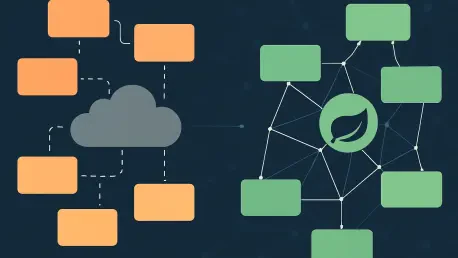

The architectural rigidity of synchronous request-response cycles has long acted as a silent anchor, dragging down the performance of enterprise-grade microservices that require fluid scalability. While the RESTful paradigm served the industry well during the initial shift to the cloud, the sheer volume of data and the demand for instantaneous reactivity in 2026 have pushed these traditional models to their breaking point. The emergence of the Spring Boot Event Mesh represents a fundamental pivot in how developers conceive of service boundaries and data flow. Rather than relying on a fragile web of direct HTTP calls, this technology introduces a decoupled, resilient fabric that allows applications to communicate through discrete events. This shift is not merely a change in protocol; it is a reconsideration of how distributed systems maintain consistency and performance without sacrificing developer productivity or operational simplicity.
Introduction to Event-Driven Mesh in Spring Boot
The concept of an event-driven mesh in the Spring Boot ecosystem has evolved as a direct response to the “latency chain” problem, where a single slow downstream dependency could paralyze an entire request thread. At its core, an event mesh is a distributed infrastructure layer that facilitates the transmission of events between producers and consumers, regardless of where they reside in a network. Unlike a traditional service mesh that manages synchronous traffic like mTLS and load balancing for REST, an event mesh focuses on the asynchronous delivery of state changes. Within a Spring Boot context, this is realized through abstraction layers like Spring Cloud Stream and specialized binders that mask the complexity of the underlying transport layer.
This technology has emerged as a cornerstone of modern cloud-native development because it addresses the inherent brittleness of tight runtime coupling. In a standard REST environment, every service must be operational and reachable at the exact moment a request is made. The event mesh replaces this requirement with a persistent, buffered communication medium where the producer of information does not need to know who the consumer is, or if they are even currently online. By leveraging the familiar Spring Boot programming model, developers can implement complex reactive patterns with minimal boilerplate, effectively lowering the barrier to entry for high-performance distributed computing.
Architectural Components and Implementation Strategies
Asynchronous Pub/Sub Foundations
The primary engine driving the Spring Boot Event Mesh is the asynchronous publish-subscribe model, which fundamentally alters the lifecycle of a typical application transaction. In this setup, a service emits an event—such as an “OrderCreated” signal—and immediately returns a success status to the user, delegating the heavy lifting to downstream processors. This mechanism is unique because it utilizes a non-blocking approach to data dissemination. The significance of this implementation lies in its ability to absorb massive spikes in traffic. While a REST API might return 504 Gateway Timeout errors under heavy load, an event mesh simply buffers the messages, allowing the system to process them at a sustainable pace without losing a single byte of data.
From a performance perspective, the pub/sub foundation within Spring Boot 3 and beyond leverages the efficiency of Virtual Threads and reactive streams. This allows the system to handle thousands of concurrent event listeners with a fraction of the memory footprint required by legacy thread-per-request models. The implementation is unique compared to basic message brokers because it integrates deeply with the Spring application context, providing automatic lifecycle management and transparent serialization. This means that a developer can switch from an in-memory event bus to a globally distributed mesh with simple configuration changes, making the system incredibly adaptable to shifting business requirements and traffic patterns.
Integrated Messaging Support: Kafka, RabbitMQ, and NATS
The versatility of the Spring Boot Event Mesh is largely a result of its sophisticated support for diverse messaging backends, specifically Kafka, RabbitMQ, and NATS. Kafka serves as the high-throughput backbone for event sourcing and log-based streaming, where the persistence of the event log allows for powerful features like “time travel” or replaying events to rebuild state. RabbitMQ, in contrast, offers a more traditional but highly flexible routing mechanism through its exchange and binding model, making it ideal for complex workflows that require granular control over message delivery. NATS provides a lightweight, ultra-low-latency alternative that excels in edge computing and decentralized environments where speed and simplicity are the primary metrics.
What makes the Spring Boot implementation superior to manual integration is the use of specialized binders that normalize behavior across these disparate technologies. For instance, a developer can use the same @StreamListener or functional consumer approach regardless of whether the message is moving through a Kafka partition or a NATS subject. This abstraction allows for a “write once, deploy anywhere” strategy, which is critical for organizations moving toward multi-cloud or hybrid-cloud architectures. By interpreting the specific strengths of each broker, Spring Boot allows teams to choose the right tool for a specific use case—Kafka for data consistency, RabbitMQ for complex routing, and NATS for raw speed—all while maintaining a unified developer experience.
Evolution of API Communication Trends
The technological landscape is currently witnessing a massive departure from the “REST-first” mentality that dominated the previous decade. As organizations scale, they are discovering that the synchronous nature of REST creates an “all-or-nothing” reliability model that is increasingly difficult to defend. The trend is moving toward “event-first” design, where the API becomes a gateway for triggering workflows rather than a mechanism for executing them. This shift is being driven by the need for better observability and the rise of real-time user experiences. When a system is built on an event mesh, every action is naturally recorded as a stream of data, which simplifies the integration of modern AI-driven analytics and monitoring tools that require live data feeds.
Moreover, the industry is seeing a convergence between service meshes and event meshes. While they were once viewed as competing technologies, they are now being used in tandem to provide a comprehensive connectivity layer. The service mesh handles the “north-south” traffic and basic “east-west” security, while the event mesh manages the actual business logic flow. This evolution reflects a broader industry realization: not all data is created equal. High-priority, user-facing requests still benefit from the directness of REST/gRPC, but the background operations that power the modern enterprise are far better suited for the decoupled, streaming nature of an event-driven mesh.
Real-World Applications and Sector Impact
In the financial services sector, the adoption of the Spring Boot Event Mesh has revolutionized how transaction processing and fraud detection are handled. In a traditional system, a payment request might have to wait for several synchronous checks—identity verification, balance lookup, and fraud scoring—before being approved. By utilizing an event mesh, a bank can accept the transaction event and simultaneously fire off parallel processes to handle these checks. This reduces the latency of the user-facing application while ensuring that every security protocol is executed. If the fraud detection service identifies a problem, it emits its own “FraudDetected” event, which can trigger an immediate reversal or a hold on the account.
The retail and logistics industries have also seen a profound impact. Modern e-commerce platforms use event meshes to synchronize inventory across global warehouses in real time. When a customer in Tokyo buys the last item of a specific SKU, an event is published that instantly updates the availability status for customers in New York and London. This prevents the common problem of overselling and allows for more efficient supply chain management. These real-world implementations demonstrate that the event mesh is not just a technical luxury; it is a critical requirement for any business that operates at global scale and needs to maintain a consistent state across geographically distributed data centers.
Technical Challenges and Adoption Obstacles
Despite the clear advantages, the transition to an event-driven mesh is not without significant hurdles. One of the most prominent technical challenges is managing eventual consistency. In a synchronous system, a database transaction either succeeds or fails. In an event-driven system, the producer might succeed, but the consumer might fail minutes later. This requires the implementation of complex patterns like Sagas or compensated transactions to ensure that the system eventually reaches a valid state. For many development teams, this represents a steep learning curve and a fundamental shift in how they reason about data integrity and error handling.
Furthermore, operational complexity increases as the mesh grows. While Spring Boot simplifies the code, the underlying infrastructure—whether it be a Kafka cluster or a NATS deployment—requires specialized knowledge to maintain, tune, and secure. Regulatory compliance, such as GDPR or HIPAA, also becomes more challenging when data is constantly moving through an asynchronous bus. Ensuring that sensitive information is not logged in an event stream or that “the right to be forgotten” is respected across multiple decoupled consumers requires a robust governance framework. Ongoing development in the Spring ecosystem is focused on mitigating these issues through better integration with schema registries and automated auditing tools, but they remain significant barriers for smaller organizations.
Future Trajectory of Distributed Event Meshes
Looking forward, the evolution of the event mesh is likely to be characterized by “serverless” integration and greater autonomy. We are moving toward a state where the mesh itself becomes an intelligent entity, capable of automatically routing events based on the content of the message rather than just a static topic name. This “content-based routing” will allow for even more granular decoupling, where services can subscribe to very specific subsets of data without having to process unnecessary overhead. Additionally, the integration of WebAssembly (Wasm) at the edge of the mesh could allow for data transformation and filtering to happen in transit, further reducing the load on centralized services.
The long-term impact on society will be seen in the seamlessness of digital interactions. As the event mesh matures, the lag between a physical action and its digital representation will virtually disappear. Whether it is a smart city reacting to traffic patterns in real-time or a healthcare system coordinating emergency responses across multiple hospitals, the underlying event-driven fabric will be the invisible hand making it possible. The transition from static, request-based systems to fluid, event-based ecosystems is essentially the digital equivalent of moving from a series of photographs to a high-definition video stream.
Final Assessment and Summary
The review of the Spring Boot Event Mesh revealed a technology that successfully bridged the gap between enterprise-grade stability and modern reactive performance. It was evident that the ability to decouple services through a unified messaging abstraction provided a significant advantage over traditional REST-centric architectures, particularly in terms of resilience and burst capacity. The integration of Kafka, RabbitMQ, and NATS within the Spring ecosystem allowed for a versatile implementation that could be tailored to specific latency and throughput requirements. While the complexity of eventual consistency and infrastructure management presented real obstacles, the trade-off was overwhelmingly positive for organizations operating at scale.
In the final analysis, the event mesh established itself as a necessary evolution for distributed systems rather than a mere alternative. The shift toward asynchronous communication proved to be the only viable path for maintaining performance in an increasingly interconnected and data-heavy world. By providing a clear roadmap for migration and a robust set of tools for observability, the Spring Boot Event Mesh empowered developers to build systems that were not only faster but also more adaptable to change. The verdict was clear: for any enterprise serious about cloud-native scalability and real-time responsiveness, adopting an event-driven architecture was the most strategic technical decision made during this era of digital transformation.