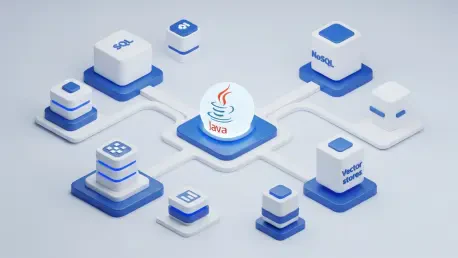

The contemporary software landscape has underwent a silent but profound transformation where the primary concern for engineering teams has shifted from managing the underlying infrastructure to orchestrating the immense complexity of distributed data flows. While the previous decade focused heavily on the mechanics of containerization and cloud-native scaling, the current era identifies a new bottleneck: the fragmentation of data across diverse storage paradigms. Jakarta EE 12 arrives as a definitive response to this challenge, marking the transition from a purely infrastructure-focused framework to a sophisticated platform designed for the Data Age. By providing a unified programming model that spans relational, non-relational, and even vector-based data stores, this release ensures that Java remains the primary language for enterprise stability and innovation.
The importance of this evolution cannot be overstated for organizations currently navigating the high-speed demands of modern business logic and the burgeoning requirements of artificial intelligence. In an ecosystem where developers are often forced to choose between the safety of established standards and the agility of specialized tools, Jakarta EE 12 offers a middle ground that provides both. It addresses the significant cognitive load placed on engineers who must juggle disparate APIs for every new database or messaging system added to a stack. Consequently, the platform serves as a stabilizing force, transforming fragmented data strategies into a cohesive, standardized architecture that can withstand the volatile cycles of technological hype.
The Shift: Infrastructure Management to Mastering Data Complexity
The industry has reached a point of saturation regarding infrastructure automation, where tools for managing clusters and containers have become standardized commodities. As these low-level concerns fade into the background, the primary source of technical debt for most enterprises has become the “data mess” created by the rapid adoption of specialized microservices. Each service often brings its own database flavor, leading to a sprawling landscape where unified governance is nearly impossible. Jakarta EE 12 shifts the focus upward, providing developers with the tools to manage this complexity through consistent abstractions rather than manual orchestration of individual data drivers.
Moreover, the platform recognizes that the modern enterprise is no longer defined by a single centralized source of truth but by the flow of information across a distributed network. This transition requires a move away from traditional infrastructure management toward a more holistic view of unified data management. By elevating data access to a first-class citizen of the platform, Jakarta EE 12 reduces the time spent on “plumbing” code and allows architects to focus on semantic intent. This approach ensures that business logic remains decoupled from specific storage implementations, facilitating a more resilient and adaptable software lifecycle.
The role of Jakarta EE 12 as a stabilizer is particularly critical in an environment characterized by the rapid arrival and departure of transient frameworks. While many specialized libraries offer quick wins for specific tasks, they often lack the long-term support and vendor neutrality required for mission-critical applications in sectors like finance or government. Jakarta EE 12 bridges this gap by incorporating modern data requirements into a governed, open standard. This allows organizations to adopt cutting-edge data patterns without sacrificing the predictability and backward compatibility that have been the hallmark of the Java ecosystem for decades.
Historical Trajectory: From Centralized Mainframes to Distributed Realities
To understand the current state of enterprise Java, one must trace the long journey from the era of centralized mainframes to the modern distributed reality of the cloud. In the early days, application state and business logic were tightly coupled within single, monolithic environments where data consistency was managed by a solitary relational database. However, the shift toward client-server models and eventually cloud-native architectures fragmented this simplicity. Today, a single user transaction might touch a dozen microservices, three different database types, and multiple event streams, creating a “distributed reality” that is orders of magnitude more complex than the systems of the past.
This increased complexity has led to a significant “cognitive load” on software engineers, who are now expected to be experts in SQL, NoSQL, graph theory, and now vector similarity searches for AI applications. The “hype effect” often drives teams to adopt the latest trending database without fully considering the integration overhead or the long-term maintenance costs. Jakarta EE 12 addresses this by providing standardized abstractions that mask the underlying complexity of polyglot persistence. Whether an application is communicating with a traditional relational database or a modern document store, the developer can utilize a consistent mental model, reducing the friction associated with switching between different technological paradigms.
The reality of polyglot persistence is no longer a choice but a necessity for competitive businesses. Relational databases remain essential for transactional integrity, yet NoSQL stores offer the schema flexibility needed for rapid iteration, and vector databases provide the foundation for modern search and retrieval-augmented generation. Jakarta EE 12 acknowledges this diverse landscape by refusing to favor one model over another. Instead, it creates a common language for data access that respects the unique strengths of each technology while providing a unified interface for the developer. This balance ensures that teams can choose the best tool for the job without creating a siloed and unmanageable codebase.
Solving Data Fragmentation: Jakarta Query and Type-Safe Repositories
The introduction of Jakarta Query represents perhaps the most significant structural change in this release, as it seeks to separate semantic intent from specific execution strategies. Historically, querying has been a source of significant fragmentation, with developers forced to learn different query languages for every persistence provider they used. Jakarta Query provides a unified semantic model that allows for a consistent way to express data requirements across Jakarta Persistence (JPA), Jakarta Data, and Jakarta NoSQL. This means that a filter or a search defined in the business layer can be translated into the appropriate native query language by the platform, ensuring portability and reducing the risk of vendor lock-in.
Advancements in Jakarta Data 1.1 further enhance this experience by pushing the repository pattern toward a state of compile-time verification. Traditional data access often relied on string-based queries that were only validated at runtime, leading to frequent errors and fragile code. The new fluent APIs and repository contracts in Jakarta EE 12 allow developers to define data operations that the Java compiler can check for correctness. This shift toward type-safe repositories significantly improves developer productivity and system reliability, as common mistakes are caught during the development phase rather than in production environments.
By providing a consistent mental model for diverse database technologies, Jakarta EE 12 effectively lowers the barrier to entry for complex polyglot architectures. Developers no longer need to spend weeks mastering the specific syntax of a new NoSQL provider; instead, they can apply their existing knowledge of Jakarta Data to interact with the new store. This reduction in friction is essential for modern teams that need to pivot quickly in response to changing market conditions. The standardization of these data access patterns ensures that the “data age” is characterized by architectural clarity rather than the chaotic fragmentation that often accompanies rapid technological shifts.
Defense Against Obsolescence: Why Open Standards Remain Critical
In the volatile world of software development, open standards represent the only effective defense against the inevitable obsolescence of proprietary tools. Jakarta EE operates at the unique intersection of open source and open standards under the governance of the Eclipse Foundation, providing a level of transparency and vendor neutrality that single-company frameworks cannot match. This model is vital for “human scalability,” as it provides a common language for developers across different organizations and industries. Much like the standardized dimensions of shipping containers revolutionized global trade, standardized Java specifications allow for the seamless exchange of skills and components across the global software market.
Protecting enterprise investments in sectors like banking and healthcare requires a commitment to stability that spans decades rather than months. These industries cannot afford the risk of a “rip-and-replace” architectural shift every time a new framework becomes popular. Jakarta EE 12 maintains a rigorous focus on backward compatibility while providing clear pathways for incremental modernization. This ensures that a system built five years ago can still be updated to leverage virtual threads or new data specifications without requiring a total rewrite. This strategic longevity is the primary reason why Jakarta EE remains the bedrock of global financial infrastructure.
The influence of Jakarta EE specifications extends far beyond the platform itself, serving as the foundational blueprint for external frameworks like Spring, Quarkus, and Micronaut. While these frameworks often innovate in the areas of developer experience or deployment speed, they frequently rely on Jakarta specifications for core functionality like dependency injection, persistence, and validation. By continuing to evolve the standard, Jakarta EE 12 provides a rising tide that lifts the entire Java ecosystem. This collaborative environment prevents the fragmentation of the Java community and ensures that innovations developed in one corner of the industry eventually benefit all developers through standardized APIs.
Practical Pathways: Leveraging Java 21 and New AI Frontiers
Modernizing the core baseline of the platform to Java 21 has unlocked a new level of performance and concurrency for enterprise applications. The adoption of virtual threads allows Jakarta EE 12 to handle massive numbers of concurrent requests without the overhead associated with traditional platform threads. This is particularly beneficial for high-throughput microservices and data-intensive applications where I/O operations previously acted as a significant bottleneck. By optimizing for the latest features of the Java language, Jakarta EE 12 ensures that enterprise systems can achieve the resource efficiency required for modern cloud-native and serverless deployments.
Preparation for the next decade of software development also involves integrating artificial intelligence directly into the business logic layer. The emergence of Jakarta Agentic AI provides a standardized framework for managing AI agents and their interactions with vector databases and secure enterprise data. This initiative ensures that Java developers can build AI-augmented systems using the same familiar patterns they use for traditional business logic. Instead of treating AI as an isolated silo, Jakarta EE 12 integrates these capabilities into the broader application lifecycle, allowing for sophisticated workflows that combine transactional consistency with generative intelligence.
The journey toward Jakarta EE 12 was defined by a collective realization that the most successful modernization strategies were those that favored incremental improvements over total system overhauls. Organizations that audited their existing data layers and transitioned toward Jakarta Data repositories found they could improve performance while reducing technical debt. Engineers discovered that the platform provided a resilient foundation that balanced the need for modern AI features with the non-negotiable requirements of security and stability. As the industry looked toward the challenges of the coming years, the role of standardized, vendor-neutral frameworks became even more essential for navigating the complexities of a data-driven world. Strategies for the future focused on maintaining this balance, ensuring that the next generation of enterprise software remained as robust as the systems that preceded it. By embracing these standardized pathways, the enterprise community successfully transitioned into a new era of architectural maturity.