
The global landscape of digital infrastructure is undergoing a radical metamorphosis as the demand for intelligent processing pushes the big data storage market toward a staggering valuation of over three hundred thirty billion dollars by 2035. This projected growth, representing a massive leap from the sixty-six billion dollar mark seen in recent years, signals a fundamental shift in how corporations perceive and utilize their digital assets. No longer viewed as a static repository for cold records, storage is becoming a dynamic, high-performance environment essential for the survival of the modern enterprise. As organizations transition toward an “AI-first” operational model, the priority has moved from simple data preservation to ensuring that every byte of information is instantly available for complex processing and real-time decision-making. This evolution requires a departure from traditional archival methods, favoring instead a responsive architecture that can accommodate the relentless influx of global data.
The Proliferation of Unstructured Datasets and Software Flexibility
The current surge in data volume is largely driven by a diverse array of information sources that defy traditional organization, ranging from social media interactions and IoT sensor streams to sophisticated cloud-native applications. Managing this flood of unstructured data presents a unique challenge, as legacy relational databases are often ill-equipped to handle the variety and velocity of modern digital footprints. To keep pace with global connectivity and the rigorous training requirements of advanced machine learning models, storage systems must undergo a foundational change in how they ingest and process information. This transition involves moving beyond structured spreadsheets and embracing a more fluid approach to data handling that can extract meaning from chaotic inputs. As we progress toward 2035, the ability to store and analyze these massive, messy datasets will separate industry leaders from those who remain tethered to outdated methodologies, making the efficient management of unstructured information a core requirement for success.
Central to this transformation is the widespread adoption of Software-Defined Storage (SDS) and object storage, which provide the architectural flexibility needed to transcend physical hardware limitations. SDS allows for the centralized management of storage resources through specialized software, decoupling the data layer from specific physical devices and enabling seamless scalability. Simultaneously, object storage is facilitating the creation of massive data lakes capable of expanding to exabyte levels, a necessity for the training of large-scale artificial intelligence systems. These architectures allow companies to store vast quantities of diverse data without the overhead of complex folder hierarchies, making information retrieval more efficient for automated workflows. By prioritizing these flexible structures, enterprises can ensure their infrastructure remains resilient in the face of unpredictable growth. The move toward software-centric management represents a decisive break from the rigid cycles of hardware procurement that once slowed down digital expansion.
High-Performance Hardware and Hybrid Management Models
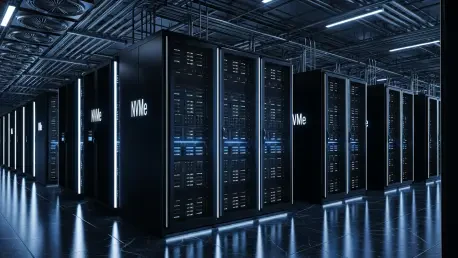
Eliminating the performance lags that historically plagued real-time analytics has become a primary objective for engineers designing the next generation of data centers. The industry is rapidly gravitating toward Non-Volatile Memory Express (NVMe) architectures, a technology specifically engineered to remove the bottlenecks inherent in older storage protocols. By streamlining the communication path between the CPU and the storage media, NVMe allows data to move at the breakneck speeds required for advanced high-performance computing. By 2035, this level of high-speed access is expected to be the global standard, ensuring that even the most data-intensive applications can retrieve critical information without perceptible delay. This shift is not merely about raw speed; it is about creating a seamless interaction between storage and processing units. As latencies vanish, the barrier between stored data and active intelligence dissolves, allowing for a more integrated approach to computational tasks that can respond to changing market conditions.
Modern enterprises are increasingly favoring hybrid and multi-cloud strategies to mitigate the risks associated with vendor lock-in while maintaining maximum operational agility. This strategic approach combines the robust security and control of on-premises servers with the nearly infinite scalability offered by public cloud providers. By diversifying their storage portfolio, organizations can optimize their spending and place critical workloads in the most appropriate environment based on performance or regulatory needs. The management of these complex environments is also shifting from a reactive stance to a proactive one, driven by the integration of AI-powered analytics. Storage platforms are now utilizing predictive models to monitor system health and automate data tiering, ensuring that information is stored in the most cost-effective and secure manner possible. These systems can anticipate spikes in demand and automatically move frequently accessed data to high-speed tiers while migrating older information to more affordable archival layers.
Strategic Industry Ecosystems and Long-Term Practical Outlook
Major technology leaders like Amazon, Microsoft, and IBM are currently laying the groundwork for a future dominated by AI-ready infrastructure through partnerships with innovators such as NVIDIA. These companies are developing specialized storage layers designed specifically to handle the intense read-write cycles of heavy machine learning training workloads. These collaborative efforts focus on optimizing the data pipeline, ensuring that GPUs are never left idling while waiting for information to arrive from the storage media. Such specialized systems prioritize operational agility and high-density storage, allowing for the consolidation of massive datasets into more compact and energy-efficient footprints. This trend toward vertical integration between hardware and software providers is creating a new class of intelligent storage that is far more capable than general-purpose hardware. For organizations looking to maintain a competitive edge, investing in these purpose-built ecosystems is becoming a necessity rather than an optional upgrade as the scale of data continues to grow.
The transition toward the fully integrated storage environments of 2035 was defined by a shift in priorities from simple capacity to intelligent availability and automated responsiveness. Decision-makers who recognized the potential of software-defined architectures early on were able to scale their operations with far greater efficiency than those who remained committed to legacy hardware. The focus on NVMe adoption proved crucial for eliminating the performance gaps that once hindered real-time analysis, while hybrid cloud models provided the necessary balance between security and scale. Furthermore, the implementation of proactive, AI-driven management tools transformed storage from a dormant asset into a strategic resource that optimized itself based on organizational needs. By unifying disparate data sources into a cohesive, automated layer, businesses successfully bypassed the bottlenecks of manual data migration and ensured a continuous flow of information to their processing engines. These strategic choices collectively established a foundation for sustainable growth.