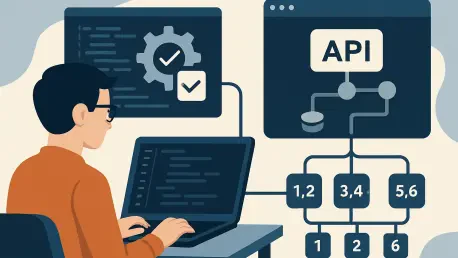

The relentless pace of modern software delivery means that a single static test case is no longer sufficient to guarantee the reliability of an interconnected digital ecosystem. Engineers frequently find themselves trapped in a cycle of duplicating code to accommodate various input scenarios, which leads to bloated repositories and fragile maintenance. Mastering data-driven testing provides the ultimate solution by allowing a single script to process hundreds of different data combinations. This guide will help you achieve a sophisticated, automated framework that separates technical logic from business data, ensuring your APIs remain resilient against both expected and unexpected inputs.
Enhancing Test Efficiency through Data-Driven API Automation
In the modern software development lifecycle, verifying an API’s resilience requires more than just testing a single “happy path.” Data-driven testing has emerged as a critical strategy to ensure APIs handle a vast array of inputs without duplicating code. This approach allows teams to run identical validation logic against diverse datasets, ranging from standard user profiles to complex edge cases that might otherwise be overlooked during manual verification.
By leveraging the power of Java, the flexibility of Rest-Assured, and the robust orchestration of TestNG, developers can create sophisticated automation suites that are both scalable and easy to maintain. This architectural shift ensures that your testing suite grows in depth without increasing in complexity. This guide explores how to transition from hard-coded tests to a dynamic, data-centric framework using the @DataProvider annotation to fuel your automation engine.
Why Decoupling Data from Logic Is Essential for Modern APIs
The primary challenge in manual or linear automation is the redundancy created when testing multiple scenarios for the same endpoint. If you have ten different ways to fail a login attempt, writing ten separate test methods is an inefficient use of resources that complicates the codebase. Data-driven testing solves this by separating the “what,” which is the test data, from the “how,” which represents the test logic.
This technical separation ensures that when an API schema changes, you only update your logic once, and when new business requirements arise, you simply add a row to your data source. In an industry where APIs must handle diverse edge cases—ranging from invalid characters to unauthorized tokens—this approach minimizes maintenance overhead while maximizing test coverage. Moreover, it allows non-technical stakeholders to contribute to the testing process by defining data scenarios without touching the underlying Java code.
Step-by-Step Guide to Implementing Data-Driven Testing with Object Arrays
Mastering this methodology involves a structured approach, beginning with the correct environmental setup and progressing through the design of data containers that feed your automation scripts.
1. Configuring the Maven Environment and Dependencies
Before writing code, you must ensure your project has the necessary libraries to handle HTTP requests and test execution. A well-configured environment serves as the backbone of any automated testing framework, preventing compatibility issues later in the project.
Use Maven to Manage Rest-Assured and TestNG
Adding the Rest-Assured, TestNG, and Lombok dependencies to your pom.xml provides the foundation for fluent API assertions and reduced boilerplate code. Maven handles the retrieval of these libraries from central repositories, ensuring that every developer on the team is using the exact same versions of the testing tools.
Leverage Lombok for Concise Data Models
Utilizing Lombok annotations like @Getter, @Setter, and @AllArgsConstructor allows you to create Plain Old Java Objects (POJOs) that represent your API payloads without manual clutter. This library automatically generates the necessary methods during compilation, keeping your source code clean and focused solely on the data structure itself.
2. Modeling Request Payloads with POJO Classes
Creating a dedicated class for your data ensures type safety and makes your test scripts much more readable. Instead of dealing with raw JSON strings that are prone to typos, you interact with Java objects that follow the specific structure of your API.
Map JSON Fields to Java Variables
By using @JsonProperty, you can bridge the gap between Java naming conventions and the specific keys required by the API’s JSON schema. This annotation tells the underlying library exactly which Java variable corresponds to which JSON field, allowing for seamless serialization and deserialization of the request body.
Incorporate Validation Fields in the Data Model
Adding an expectedStatus field directly into your POJO allows you to test both successful scenarios, such as a 201 Created response, and failed scenarios, like a 400 Bad Request, within the same data loop. This design choice makes your tests truly polymorphic, as the validation logic adapts to the specific intent of the data provided.
3. Orchestrating Data Flows with the TestNG @DataProvider
The @DataProvider annotation acts as the engine that feeds your test methods with diverse datasets. It is the central hub where all possible scenarios are defined and organized before they are handed off to the execution engine.
Construct a 2D Object Array for Test Inputs
TestNG requires a two-dimensional Object array where each row represents an individual test execution and each column represents a parameter. This structure is highly efficient for managing multi-parameter inputs, providing a clear visual representation of all the test cases that will be executed during the suite run.
Streamline Payload Delivery via Parameterized Objects
Instead of passing dozens of individual strings for each field in your JSON, passing a single POJO through the DataProvider keeps your test method signatures clean and manageable. This encapsulation means that if the API adds a new field, you only need to update the POJO and the DataProvider rather than every single test method signature in your framework.
4. Executing and Validating API Tests
The final step is connecting the data source to the actual Rest-Assured logic to perform the HTTP calls. This is where the preparation pays off, as the test method becomes a concise set of instructions that handles any data thrown at it.
Connect the Test Method to the Data Source
Use the dataProvider attribute within the @Test annotation to instruct TestNG to iterate over your object array. This connection tells the framework to run the decorated method once for every row in your data provider, automatically injecting the objects into the method parameters.
Verify Responses Dynamically Based on Input Data
Use Rest-Assured’s validation DSL to check that the API’s response matches the specific expectations defined for each data set in your array. Because the expected results are bundled with the input data, the assertion logic remains generic yet powerful enough to validate a wide variety of outcomes correctly.
Essential Takeaways for Scalable API Automation
- Logical Separation: Always kept test data external to the test execution logic to simplify maintenance and improve readability.
- POJO Integration: Used POJOs to represent complex JSON structures for better type safety and reusability across different test suites.
- Parameterized Efficiency: Utilized TestNG’s @DataProvider to run hundreds of scenarios using a single @Test method, reducing code duplication.
- Flexible Validation: Included expected results within your data sets to cover negative testing and edge cases seamlessly.
The Future of Data-Driven Frameworks and Industry Trends
As API ecosystems grow more complex, the industry shifted toward even more dynamic data sources. While Object arrays are perfect for small to medium-sized suites, many organizations integrated external sources like Excel, JSON files, or even live databases to drive their tests. This evolution allowed teams to manage thousands of permutations without bloating the Java source code, moving the data management into specialized environments that business analysts could access.
The rise of Contract Testing and AI-generated test data also suggested a future where data-driven frameworks automatically adapted to changes in API documentation. Modern tools now analyze Swagger or OpenAPI specifications to suggest new data rows, further reducing the manual effort involved in maintaining test data. This trend toward automation of the data generation process itself ensures that testing remains synchronized with rapid development cycles.
Final Thoughts on Mastering API Testing with Java
The transition toward a data-driven architecture provided a clear path for scaling quality assurance efforts without an exponential increase in labor. By implementing the strategies discussed, such as the use of POJOs and the @DataProvider annotation, engineers built a resilient testing architecture that evolved alongside the application. The next logical step involved experimenting with externalizing data into CSV or JSON files to handle even larger datasets that surpassed the practical limits of hard-coded arrays. Those who refactored their most redundant test cases noticed an immediate improvement in the clarity and coverage of their frameworks. Future considerations should focus on integrating these data-driven suites into continuous integration pipelines to ensure that every code commit is validated against an exhaustive battery of data scenarios.