
Government agencies across the globe are currently grappling with the immense pressure to modernize legacy systems while navigating the dense thicket of administrative bureaucracy and stringent data sovereignty laws. A pioneering collaboration between the German Federal Employment Agency and the global technology consultancy Capgemini has successfully demonstrated how multi-agent artificial intelligence can dismantle these long-standing operational barriers. By automating the transformation of complex technical specifications into functional IT tickets, this initiative provides a scalable model for public institutions to accelerate their digital evolution without compromising security. Historically, the transition from high-level “Requests for Change” to actionable tasks within platforms like Jira required hundreds of manual hours spent by specialized staff. This shift to an automated, multi-agent approach signifies a move toward a more resilient and efficient public service infrastructure that prioritizes accuracy.
Navigating Operational Complexity and Data Sovereignty
The primary challenge inherent in this digital transition involves the conversion of dense “Requests for Change” and detailed user stories into actionable tasks within widely used project management platforms. Historically, this has been a manual, labor-intensive process that required technical staff to parse through hundreds of pages of documentation to extract specific technical requirements. This significant bottleneck not only drained specialized human resources that could have been allocated to higher-level architecture but also introduced natural human inconsistencies that often led to delays in critical digital updates. In a public sector environment where precision is paramount, even small errors in ticket creation can snowball into larger systemic issues during implementation. Therefore, the drive for automation was not merely about speed; it was about establishing a standardized, error-free method of translating policy requirements into technical reality across diverse departments within the agency.
Implementing Localized AI Within Protected Environments
Several unique factors make public sector automation particularly difficult, specifically regarding persistent staffing shortages and the technical density of foundational IT documents. Furthermore, strict privacy mandates often prevent the use of standard cloud-based AI tools, requiring innovative solutions that can operate entirely within a secure internal environment to protect citizen data. To solve this dilemma, the project utilized a specialized on-premises architecture, ensuring that sensitive information remains safely behind the agency’s firewall while still benefiting from the advanced capabilities of modern machine learning models. This localized approach allows the institution to maintain absolute sovereignty over its data assets, complying with both national and international privacy standards. By avoiding the public cloud, the agency has created a secure sandbox where innovation can thrive without the traditional risks associated with data exposure or unmanaged third-party storage.
Integrating Human Expertise Into Automated Workflows
A core component of this deployment strategy is the “human-in-the-loop” philosophy, where AI acts as a dedicated collaborator rather than a complete replacement for existing human expertise. Staff members retain final approval authority over all AI-generated tickets, ensuring that the technology handles the repetitive formatting and summarization while human experts focus on strategic decision-making and logic. This approach maintains exceptionally high quality standards and builds employee trust by demonstrating that automation is intended to augment their professional capabilities rather than automate their roles out of existence. When employees are relieved of the burden of manual data entry and document parsing, they are empowered to engage in more creative and impactful problem-solving tasks. This cultural shift is vital for long-term digital adoption, as it aligns the interests of the workforce with the technological goals of the agency, fostering a sustainable environment.
Engineering Efficiency Through Specialized Agent Coordination
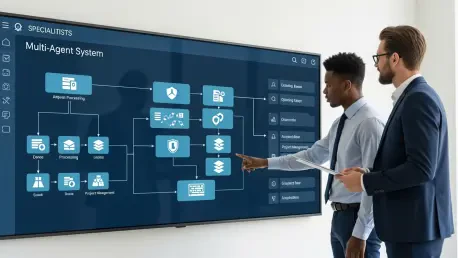
The system operates through a highly coordinated team of specialized agents—including a Reader, Planner, Creator, and Reviewer—all managed through the CrewAI orchestration framework. By using a mix of privacy-compliant large language models like Aleph Alpha and Mistral, these agents can efficiently navigate the “token limits” of long-form text to extract relevant metadata without losing the overarching context. This modular setup allows each agent to focus on a specific phase of the ticket lifecycle, from the initial analysis of a document to the final quality control and consistency checks before the ticket is pushed to production. This architecture is designed to handle the complexity of government documentation by breaking down monolithic tasks into manageable sub-processes. By distributing the cognitive load across multiple specialized models, the system achieves a level of accuracy and detail that far exceeds the capabilities of a single, generalized artificial intelligence model.
Orchestrating Task-Specific Agents for Technical Accuracy
The successful implementation of this pilot program has led to significant efficiency gains and improved content consistency across various IT departments within the government structure. Beyond the immediate benefits of faster ticket generation, this modular architecture provides a scalable blueprint for the ongoing evolution of public administration at both the federal and regional levels. Planned expansions suggest that these multi-agent systems can eventually be adapted for broader document classification, legislative analysis, and even certain types of citizen-facing communications that require high accuracy. By positioning the agency as an intelligent, high-readiness institution, the project has demonstrated that legacy bureaucracy can be successfully modernized through the thoughtful application of agentic workflows. As these systems continue to mature, they will likely become the standard operating procedure for any public entity looking to bridge the gap between policy and execution.
Evaluating Scalability and Long-Term Policy Implementation
Reflecting on the project’s milestones, the integration of multi-agent systems successfully bypassed the traditional roadblocks of public sector IT modernization. Stakeholders observed that the key to success was not the raw power of the models themselves, but the structured orchestration of specialized agents that mimicked human departmental workflows. For agencies looking to replicate these results, the next logical step involved conducting a comprehensive audit of existing documentation processes to identify high-volume bottlenecks suitable for automation. Public sector leaders found that investing in localized, on-premises infrastructure was a necessary prerequisite for maintaining data sovereignty while leveraging advanced machine learning. Moving forward, the focus shifted toward cross-departmental collaboration to share pre-trained models and best practices, ensuring that the benefits of AI were distributed equitably across all branches of government service.